
This article is based on my podcast below
Rome, 410 CE. The city is surrounded by barbarian king Alaric. A messenger rushes into the Roman Senate. The messenger says, “the Visigoth king Alaric names his price: 5,000 pounds of gold, 30,000 of silver…and 3,000 pounds of Indian pepper.”
Yes. Pepper. But this isn’t about food. It’s psychological warfare. Alaric is telling Rome: “I’ll hurt you where it hurts. You cannot season your soup with gold. Can you?”
Alaric weaponised Rome’s addiction to an Indian spice. The panicky Roman Senate decides to pay. Alaric has exploited a dependency as real as any modern nation state’s addiction to oil, semiconductors, or rare earths.
This isn’t a trade story. This is an addiction story. Addiction of the West to Indian Pepper. And other spices. For 3,000 years, the West chased India. Columbus died trying to reach us.
Mass-Market Globalization in 120 CE
Archaeologists are digging through a Roman soldier’s cold latrine at Hadrian’s Wall, the frozen edge of Roman empire. The wall that separated them from the barbarians. They find coins, pottery shards…and then, shockingly: peppercorns. From Kerala, in a toilet? In Britain. In 120 CE.
Roman soldiers on the frontier were eating Indian pepper with their porridge. Brothels spiced their cheap wine with it. In Pompeii, they found pepper in an ordinary kitchen. Before the volcano erupted. A last meal flavoured by India.
This wasn’t elite luxury. This was mass-market globalisation.
The Pharaoh’s Secret
Pepper’s story begins long before Rome, at least three thousand years ago. Cut to 1881. Archaeologists unwrap Pharaoh Ramesses II. They expect gold, jewels and the treasures of Egypt. What they find instead is startling. Black peppercorns from Kerala, packed inside the pharaoh’s nose.
Think of the route those seeds traveled. The Nile. The desert. The Red Sea. The Arabian Sea. All to deliver a single spice into the afterlife of a king.
Pepper was not seasoning. Pepper was prestige. Pepper was currency. Pepper was power.
The Billion-Dollar Bet
Now let me take you aboard the ship Hermapollon in 150 CE. Captain Marcus has just mortgaged his life savings. He has signed a contract at 24% interest to fill his ship with wine, copper, and lots of gold coins. He’s sailing from Egypt to a place most Romans have never heard of: Muziris, on India’s Malabar Coast.
The voyage ahead is brutal. Three months across the Arabian Sea under monsoon winds that can split a hull. Marcus has only one certainty. If he returns with pepper, he becomes super wealthy. If he fails, his family loses everything.
We know all this because archaeologists found his contract. The Muziris Papyrus. A document that reads like a billion-dollar invoice. His cargo was valued at nine million sesterces. That was equal to several years of tax revenue from Egypt. All on one ship. One man. One colossal bet.
Aatmanirbhar Bharat, 150 CE
When Marcus reaches India, it’s dawn at Muziris, and the Periyar River glitters like gold. Roman coins are piled onto bronze scales in staggering quantities. Tamil tax collectors record everything on palm-leaf ledgers with calm efficiency. Around them, workers lift sacks of pepper so heavy a child could disappear inside.
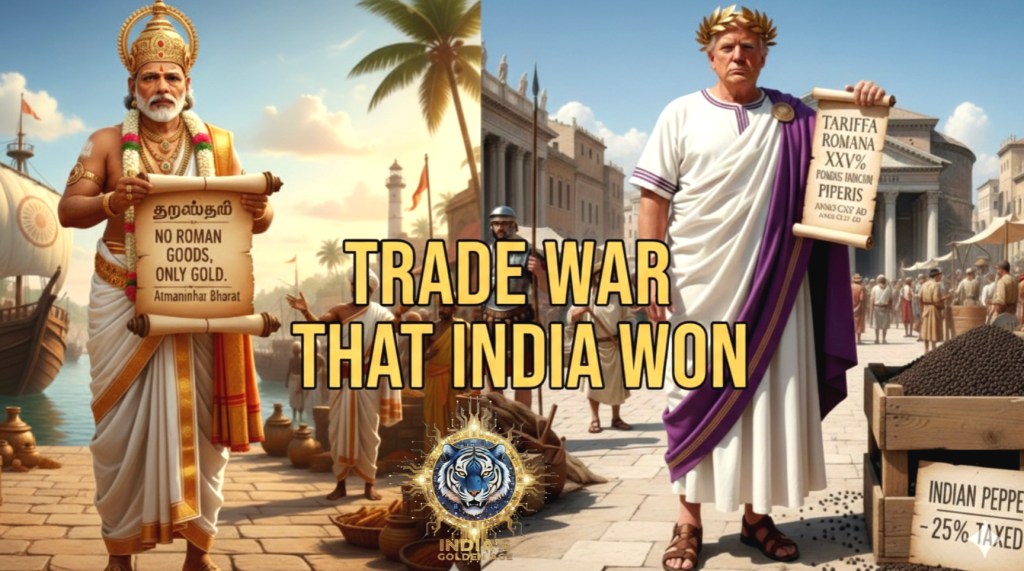
Marcus knows the rule here. Indians want only gold and silver. Maybe a little Roman wine for his South Indian princess sweetheart. Nothing else matters here in Aatmanirbhar Bharat.
In the warehouses behind him, women do the skilled labour: sorting by grade, sun-drying to precise moisture levels, quality control. Tamil poetry even mentions their “pepper-stained fingers.”
India’s First NRI Story
On his way back alongside Marcus’s ship, another battered vessel limps into Berenike, Egypt. The cargo inside is worth a fortune. But the real story walks down the gangplank. Tamil and other South Indian sailors from coastal communities step off first on the Egyptian shore. Sunburned. Exhausted.
Some of these Indians were traders themselves. They worked with Arab middlemen and Buddhist guilds from Sri Lanka, creating reliable supply chains across three continents. They provided home delivery of pepper to Rome long before the idea existed.
These were some of the earliest Indian diaspora workers. Before Dubai. Before H1B. Their presence is not a footnote. It is the beginning of India’s NRI story. In their stay at Berenike, homesick, they carve their names into the warehouse wall. A quiet act of rebellion against obscurity. Those scratches survive today.
The Industrial-Scale Supply Chain
The Muziris Papyrus was discovered in an Egyptian trash heap 2,000 years later. It details the contract as follows: 500 talents of pepper, 60 chests of nard, and 4,800 talents of ivory. Roman taxes or Trump Tariff: 25%. Indian guild fees: 20%.
This was a high-stakes global trade network. Industrial scale. Ancient efficiency. India sat in the middle and controlled the flow.
Blaming India: Then and Now
Cut to 77 CE: Pliny the Elder complains that India is draining Rome of fifty million sesterces a year. He blames foreign luxury and feminine decadence. Yet Romans pour pepper into everything: meat, wine, soup. They crave what they denounce.
Sound familiar? Great powers blame foreign goods for domestic decay. Chinese EV Cars. Indian IT H1B. But pepper didn’t weaken Rome. Currency collapse, military overstretch, corruption weakened Rome. But, like now, blaming India was easier.
And while Roman senators obsessed over lost gold, on the Malabar coast the picture is the opposite. Roman Gold funded temples. It built infrastructure, roads. It supported scholars, poets. What Rome calls a loss becomes South India’s gain. It helped build a civilisation.
Who Really Discovered the Monsoon Winds?
The textbooks say Greek Hippalus cracked the code of the monsoon winds and opened the floodgates of pepper trade. But the story has holes. Indian and Arab sailors had used those winds for centuries. The Tamil Sangam poem Purananuru describes seasonal winds in detail, predating Hippalus by at least 100 years.
Before that, the mariners of Orissa, India traveled to Southeast Asian countries during the northeast monsoon. They returned during the southwest monsoon. Hippalus didn’t discover anything. He learned it from Indian sailors. And then he took the credit. Sound familiar?
This pattern repeats across history. Indian systems of medicine, agriculture, maths, and astronomy were rebranded as European breakthroughs. Even today, when India files patents for turmeric, neem, or yoga, the West calls it biopiracy.
The truth is simple. Whoever shapes the narrative controls the market.
India never invested enough in that fight. But that tide is turning. The narrative is shifting back, tweet by tweet and podcast by podcast.
Information Asymmetry: The Dragon Lie
In another narrative game, in the medieval ages, Arabs told Europeans that pepper grew in forests guarded by dragons. The berries turned black when harvesters set the forests ablaze. Europe bought every word. And paid for it. The lie was genius.
Keep the buyer scared and he will never try to reach the source. This was information asymmetry long before the term existed.
When Monopolies End
Kerala’s pepper monopoly lasted more than three thousand years, thanks to the unique climate of the Western Ghats. That advantage ended in the seventeenth century when the Dutch successfully transplanted pepper to Java. Soon it spread to Sumatra and then Brazil. India’s monopoly collapsed almost overnight.
The lesson is strikingly modern. Semiconductors. Rare earths. Pharmaceuticals. No advantage is permanent. To stay ahead, India must innovate.
Gold vs. Fiat: The Ancient Debate
The Romans paid for pepper with gold coins. Immediately afterward, the Indians melted them down. They did not trust Caesar’s face. They trusted the intrinsic value of the gold. Rome relied on fiduciary value, the idea that the government’s promise was enough. India relied on purity.
So when Nero debased the currency, Indian traders detected it instantly and revised payments. Two thousand years later as Americans continue to print their way out of trouble, the debate continues. Bitcoin or Gold vs dollars. Biden weaponised dollar, Trump weaponised trade.
Central Banks around the world are furiously adding gold. Reducing their paper US Dollar reserves. Ancient India already knew. Fiduciary value is a collective hallucination. It works…until it doesn’t. Buy Gold. Sell the Dollar.
Trust as Infrastructure
Another lesson. A Greek merchant in Roman Egypt would finance a voyage to India with a captain he would never meet. The captain would sail for three months. He would trade through Tamil middlemen. The captain would return with spices and repay the loan at twenty-four percent interest.
There were no banks, no courts, no state-backed guarantees. The entire system ran on trust and reputation networks. And it worked for centuries.
That is the lesson. Soft power infrastructure matters more than physical infrastructure: legal confidence, dispute resolution, predictable systems etc.
India has built highways and ports but does the system inspire trust? Do investors believe disputes will be settled fairly and quickly? Ancient India understood: you can’t export trust. You have to build systems that generate it.
Cultural Confidence, Not Cultural Walls
Pepper was not the stand-alone export. Ideas traveled with it. Zero. Astronomy. Philosophies like nirvana. Kerala welcomed traders from across the world—Romans, Jews, Christians, Muslims, Chinese. Yet it remained unmistakably Indian.
Cultural identity strengthened because of exchange, not despite it.
Today we hear the same fears about globalisation. America debates immigration. India debates cultural dilution. Is it MAGA vs OR MEGA Make Everyone great again. Ancient India shows: strong cultures absorb and synthesise. Weak cultures build walls.
India welcomed everyone, assimilated everyone and remained India. That’s civilisational confidence.
Columbus’s Failure That Changed the World
Finally, no pepper story is complete without Columbus. Columbus took the gamble. He sailed west to reach India and end the middleman monopoly. He died believing he had succeeded. But his failure to reach India, as we know, changed world history.
The ‘New World’ was discovered by accident because Europe was desperate to break the spice stranglehold.
The Everyday Spice That Built Empires
The next time you reach for your pepper grinder, remember that this everyday spice once built ports. It funded empires and connected three continents. It made South India prosperous for nearly three thousand years. No wonder the Romans called it ‘the black gold.’
The podcast is also available on Spotify, Apple Podcasts, Amazon Music & other podcasting platforms.
 Sarvajeet D Chandra
Leave a comment