The Queen Who Made Chandragupta
An epic historical thriller by Sarvajeet Dinesh Chandra
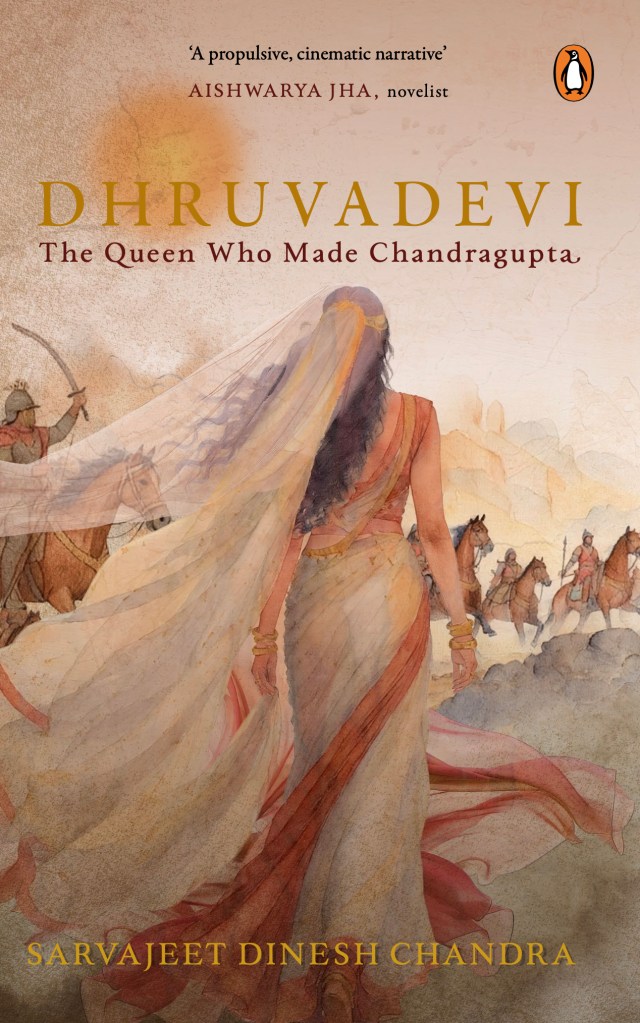
Book Available on Amazon India, Flipkart, Crossword & Select Bookstores
Book Available on Kindle Worldwide. Kindle US, Kindle UK, Kindle Australia
About the Novel
History remembers Chandragupta. This is the story of the woman who made him.
Dhruvadevi is set against the backdrop of the Gupta Empire’s rise, and the fierce resistance of the Western Saka. It weaves together political intrigue, warfare, shifting alliances, and portrayals of love, betrayal and ambition.
At its heart is Dhruvadevi, a Gupta Mahadevi, the Chief Queen, who defies the constraints of her time to become the architect of a new era. Dhruvadevi’s story is both a celebration of female agency and a critical reflection on the forces that shape nations.
Dhruvadevi’s story is an epic historical thriller. The novel attempts to reimagine history. The story is told through the eyes of those often left out of it. These include women, Sakas, Licchavis, Nagas, and the Buddhist Sangha.
The novel speaks as much to our contemporary conversations on gender, autonomy, and nationhood as it does to the ancient world it brings to life. First in a trilogy of novels, set in the Gupta era, the book is crafted for readers who crave intellectual depth, emotional intensity and thriller action.
Author- Sarvajeet Dinesh Chandra
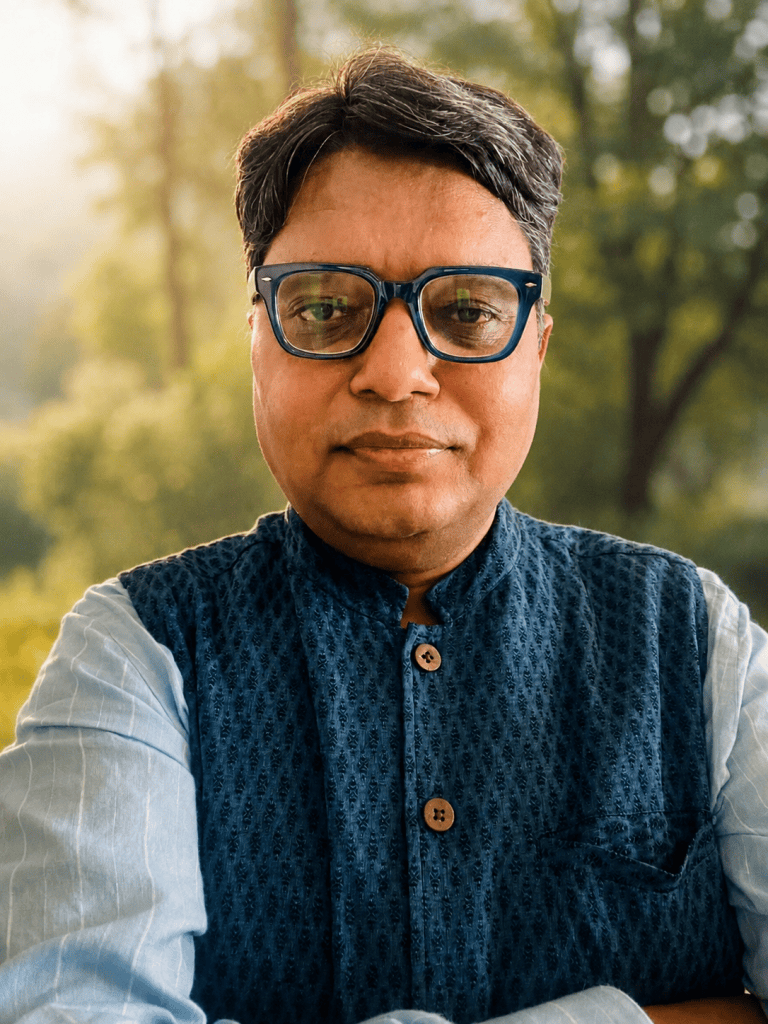
Sarvajeet Dinesh Chandra is a storyteller fascinated by the forgotten heroines and heroes of history, the people the record overlooks, and the extraordinary choices that shape the destiny of empires.
His debut novel, Dhruvadevi, speaks as much to our contemporary conversations on gender, autonomy and nationhood as it does to the ancient world it brings to life, and it is the first book in his planned Gupta-era trilogy.
His fascination with Dhruvadevi began during his postgraduate studies at MICA, where he founded a theatre group and encountered Jaishankar Prasad’s play Dhruvaswamini. In its pages he discovered Dhruvadevi, a woman whose story refused to leave him alone.
The son of the archaeologist and prolific Hindi author Dr Dinesh Chandra, who inspired him to write and to study Indian history, Sarvajeet began writing at a very early age, composing poetry, ghazals and songs in Hindustani and English, some of which he has shared on his Unpen podcast. He also hosts India’s Golden Age Podcast, which explores the enduring lessons of India’s past and their relevance to its future.
A business strategist and serial entrepreneur, he brings a rare blend of narrative instinct and strategic insight to fiction. Passionate about revitalising India’s heritage, he co-founded Craftsvilla, an online marketplace for Indian arts and crafts.
He holds a B.E. in Mechanical Engineering from M.S. University and a PDPC from MICA, Ahmedabad. He loves theatre, Sukyo Mahikari. and wildlife safaris.
He lives in Mumbai with his wife Jasravee & son Aarav.
You can connect with him on social media at @authorsarvajeet.
Please write to Sarvajeet on sarvajeetchandra@gmail.com
Check out the ‘Dhruvadevi’ on Amazon
Connect with Sarvajeet on Social Media
The Queen Who Wouldn’t Leave Me Alone
I did not discover Dhruvadevi through history. I found her, decades ago, in Jaishankar Prasad’s Hindi play Dhruvaswamini (1933), which I shortlisted, as one of the options which my fledgling theatre group could potentially stage.
Unlike the Draupadi archetype, who was gambled by her husband(s), here was a woman, who refused to be traded like property. The Gupta queen stood up against a patriarchal structure, defied the orthodoxy and shattered the stereotype of queens and women in ancient India that history and mythology consistently serves us. She was bold, had strong opinions, and was willing to, somewhat dangerously, act upon them.
I wanted to, so deseperately, stage the play.
However, my endeavour to understand her world ended fairly quickly when I could not find a female lead who could play the role. However during the play reading sessions, I did peek into the queen’s world. There was something compelling, and unsettling about Dhruvadevi at the same time.
In the years that followed, I did find surprising historical tidbits about Dhruvadevi. Like the fact that she married her brother-in-law Chandragupta. Or that she was the mother of the illustrious Gupta kings Kumaragupta & Govindagupta.
The more I researched the times, the era, the fragments of the ancient play (Devichandraguptam written by Vishakhadatta), the more questions I had.
I wondered what happened to her weak husband Ramagupta, what choices Dhruvadevi had to make, why the so-called barbarian Saka king coveted her. I also wondered what role she might have played in the rise of Guptas, and the ushering of the Gupta Golden Age. The more clues I found, the more I was convinced that Dhruvadevi was a powerful queen history had erased, conveniently forgotten.
Through the years, Dhruvadevi refused to leave me alone.
And then Covid came, as a blessing in disguise, bringing the breathless, hyper-active city of Mumbai to a halt. The city, for a little while, stopped devouring its own tail. In that pause, Dhruvadevi crept in surreptitiously. She knew that she had my unperturbed attention. And I began writing her.
Check out the ‘Dhruvadevi’ on Amazon
Listen to the India’s Golden Age Podcast/Video-Cast
The Spy Who Taught Me to Write. And Interpret History.
A friend of my father’s once told me, that I would be considered a miserable failure if I ended up doing a B.A. in history, and that usually it was the last recourse for a below average student. Hence like a lot of other ‘good’ students, whatever that meant, I ended up grudgingly focusing on science & maths.
My father lived several lives at once: spy, poet, historian & novelist. I also started leading a double life. I found enough ways to take out time from Newton’s Laws & Pythagoras’ Theorem (an Indian invention by Baudhayana btw) and whet my appetite for history.
My historical fiction journey started with copy editing my father’s books. My father wrote books on history, especially iconography, aside from the prolific poetry collections, and dramatic novels he would dish out (and publish sometimes under my mother’s name!). Also, being a PhD in archaeology, he had a lot of old history books in his library, which I studied, and sometimes re-studied (like the Kamasutra by Vatsyayana).
The book that made the most impression on me was “The Wonder That Was India” by A L Basham.
At the time, I just wanted to believe in the title. After all, it carried a white man’s stamp of approval. Mr Basham remained my hero for a long time, until his place was usurped a few years ago by another white storyteller, William Dalrymple. Writing Dhruvadevi, finally helped me get rid of the these white heroes, and the desperate need for their validation.
As a schoolboy though, I got carried away by the ‘Wonderful India’ narrative. I did a science project, trying to prove that we had aeroplanes (the Pushpak Vimana from Ramayana) and a host of other ridiculous claims. This truly spooked my science teacher, who otherwise rated me highly. My father ended up consoling me by saying that on some aspects, at the very least, like town planning (his PhD thesis was on ‘Town Planning in Ancient India’), Ancient India was indeed amazing.
It took me a lifetime, however, to figure out that ancient Bharat was indeed a wonderful civilisation. As a country, we have lived through many golden ages, and were obnoxiously well off for long periods of time (to have the luxury of writing the Upanishads). This ‘discovery of India’ was triggered by my research for my novel Dhruvadevi. And continued with the podcast I started recently, ‘India’s Golden Age‘. But that story is for another day.
Somehow, I convinced my father that I needed to visit Delhi’s Central Archaeological Library to get good marks in 9th & 10th grade history. It was a flimsy argument but I suspect my father could sense my enthusiasm, and did not try to puncture it. I spent my summers immersed in the wonderful world of history books & journals, marvelling, for instance, at the finesse of Maya Civilization (which was just a footnote in my history book). I quite liked the days spent reading serious dissertations, well above my pay grade, and taking a spicy fruit chaat break at Janpath nearby.
My father did think that I was overstudying the subject, but he didn’t have the heart to dissuade me. What helped my case was that I was a good proof reader (and occasionally a critic) for his books. A writer lives a lonely, solitary life. And I was his reliable companion. I would ask questions, give suggestions, correct passages, anything to remain useful etc.
Looking back I feel that his skills as a spy were quite useful in historical research. Sometimes history is like solving a puzzle, cracking a case. My father would talk of connecting the dots, especially in understanding ancient India where very little information was available on most subjects . He would reminisce about the long walks with his eccentric ancient history professor in Lucknow University, who in the middle of an interesting interpretation would say ‘excuse me’, take a fart break, and then resume the discussion as if nothing really happened.
I learnt history was not just collection of facts and evidence, it also needed judgement. I also learnt that to deeply research an ancient era, one had to take various sources: inscriptions, coins, literature, travelogues, mythological books like the Puranas for example into account. I also learnt how to create the three buckets: what could be established beyond doubt, what can be inferred, and what is likely to remain a dark hole.
That training and framework held me in good stead when I researched for and wrote Dhruvadevi. Today, one would assume that a LLM would make the research easier. If you ask an LLM today, who is the likely Saka ruler who besieged the Guptas, the LLMs will talk about Rudrasimha (the last Saka ruler), but there is a problem in chronology. Rudrasimha was not a contemporary of Gupta King Ramagupta (disputed by some historians). If Ramagupta existed, he likely ruled in the 375-380 CE period, the grey era between the death of Samudragupta, to when Chandragupta was clearly in charge. The Saka king who issued coins in that five year period (till 378 CE) was Rudrasena. So with all due respect to AI, if you really need to dig deep into history, as my father taught me, and connect the dots, humans still hold an edge.
I dedicated my novel to my father Late Dr. Dinesh Chandra. It is a small token of gratitude to a man whose books, ideas, thoughts, interpretations and eccentricities shaped my thinking. In many subconscious ways, he also influenced my writing. At this point of time, I do not regret though that I did not do a BA in history. My novel is enriched by so many other subjects that I studied, like war, strategy, theatre, brand building, etc, etc. (even things like cuisines, music).
I know that my father speaks through me when I say that in some ways Dhruvadevi would have been a queen, like the way I describe her. In some ways she would not be. Regardless of that, he would highly approve of the adventure, the roller coaster ride I went on to discover the ‘Queen Who Made Chandragupta.’
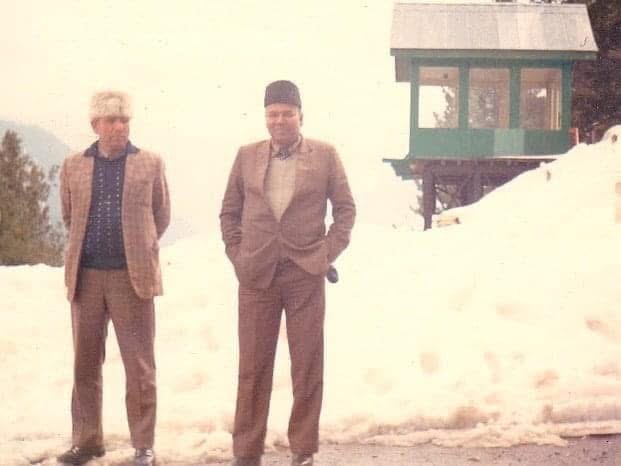
(My father, on the right, during one of his Kashmir missions)
My Journey From a Conference Room to a War Camp: How Speed Beats Scale
The ‘Napoleon of ancient India’, Samudragupta, attempted to immortalise himself on the pillar at Prayaga, celebrating his innumerable victories, boasting about his superiority to one and all. But he does not claim victory over the the Western Sakas/Kshtrapas, who ruled western India.
The story becomes more interesting when we look at his son, Chandragupta Vikramaditya, who it seems, spent decades fighting the Sakas. It seemed the most important priority for him, eventually earning him the title “Sakari”, the terminator of the Sakas, perhaps only towards the fag end of his life.
One wonders how could an ancient Ukraine-type smaller Saka kingdom, stand up to the Russia-like Gupta Empire? This question troubled me when I began researching my novel, Dhruvadevi: The Queen Who Made Chandragupta.
“Barbarians” Who Ran Two of India’s Greatest Cities
My instincts as a business strategist told me that in order to have a chance against a monolith, you need to know when to fight, and when to hide. Size has some obvious advantages, but also creates some inevitable vulnerabilities. As a smaller player, you have to assess the risks, understand the terrain, choose where to play.
Business and war operate on remarkably similar first principles. Strategy matters obviously, but tactics and execution matters just as much, or maybe more. What differs, obviously, is the stakes, the price of failure. In business, a bad decision may cost you a quarter. In war the same mistake may cost you a civilisation.
Ostracised by the Gangetic elite as barbarians, or Mlecchas, the Western Sakas nevertheless ruled Gujarat and large parts of central India for close to four centuries. They controlled two of the greatest cities of the time, vital hubs of ancient Indian commerce. They ruled Ujjain, a crucial inland crossroads hub connecting the Deccan with northern India, and Bharuch, one of the major ports of the time.
They were not just casual traders. They maintained one of the more stable currencies of the era, commissioned the earliest long inscription in Sanskrit at Junagadh, and patronised a sophisticated artistic tradition in western India, with the submerged stupa at Devni Mori offering one striking example. Perhaps the biggest tribute to them was when the Government of India adopted the Saka era for its calendar system.
That Saka prosperity, the civilisational strength surprised me when I began thinking about their long conflict with the Guptas. I was keen to find a plausible answer to the question: how could they withstand the overwhelming military power of the Guptas?
Geography as a Weapon
The answer lies partly in something every strategist learns sooner or later: geography is not merely the backdrop to a war. It can become one of its most powerful weapons. We see how Iran has weaponised the Strait of Hormuz. It explains why India paid a high price in Kargil war, and why it is so important for Indian army to hold onto the Siachen glacier.
In the novel, I put forward a hypothesis about how the Sakas might have used the Malwa Plateau to their advantage. Its rugged terrain, dense forests and treacherous black cotton soil, especially during the monsoon, would make it hard for an invading Gupta army, adept at fighting in the plains.
The elephants, the terrifying animals on open ground, the tanks of ancient Indian warfare, were vulnerable in muddy, narrow & rocky terrain. I can imagine the beasts being swallowed by the mud trap mid-charge, become easy pickings for Saka archers. The Gupta army moving through unfamiliar, narrow passes and broken terrain, were vulnerable to guerrilla warfare tactics. The Sakas could potentially have used ambushes, sudden attacks and rapid withdrawal to exploit that vulnerability.
Velocity vs. Mass
In order to fight a guerrilla war, the Sakas needed to possess another weapon: mobility.
It is quite plausible that the Sakas possessed a deadly cavalry component. As a people with steppe origins, they would have had traditions of horsemanship and a unique ability to shoot from horseback, potentially even while moving at speed. If attacked with overwhelming force, they could quickly withdrew deeper into terrain they knew intimately, draw Guptas away from their bases, attack vulnerable detachments. They could strike at Gupta flanks, their supply lines , and then disappear.
Centuries later, Chhatrapati Shivaji and the Marathas would employ similar logic to harry the Mughals. Mobility, intimate knowledge of the terrain and carefully calculated engagements allowed a smaller force to impose enormous costs on a much larger one.
The Sakas did not need to match the Guptas in sheer military strength. They needed to ensure that the Guptas could never bring all that strength to bear at once. They avoided the head-on, open plains combat, where they knew that Gupta numbers would become overwhelming. The Sakas never gave the Guptas the fight they wanted.
This idea found it expression in the novel where the Saka Mahakshtrapa Rudrasena argues, “We must be proactive and vigilant, not fearful of the Guptas. The Guptas will never defeat us! Not until they understand the simplest truth about war. Military force is a product of mass and velocity. Let them have greater mass. But we, the Sakas, will possess greater velocity. Always.”
I have always valued “velocity”. It is as important in business, as in war. Jennings and Haughton called it, “It’s Not the Big that Eat the Small… It’s the FAST that Eat the Slow!” The phrase is modern, but the principle is very old. In Act 1 of my novel, we see this David-Goliath fight unfold. But in Act 3, we see how a Goliath learns to fight like David.
Check out the ‘Dhruvadevi’ on Amazon
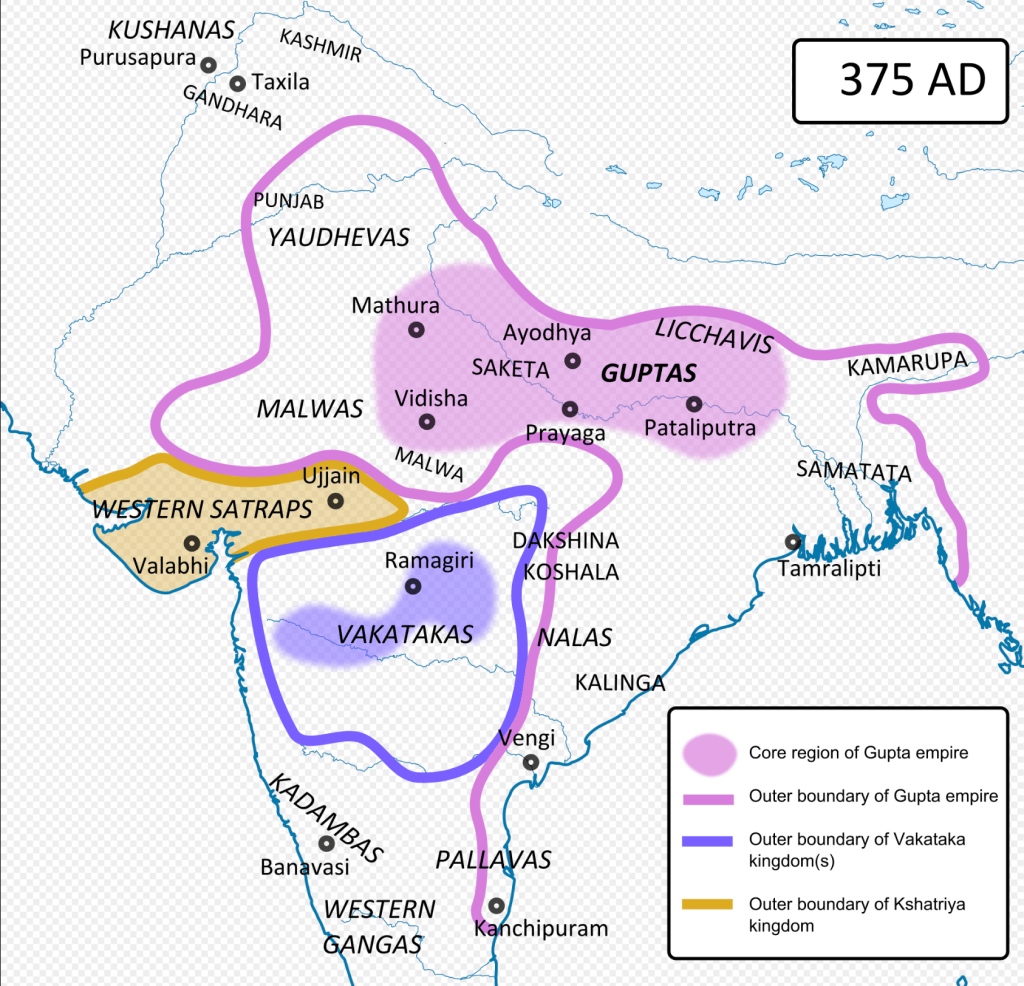
(Source of Map: World History Encyclopedia)
Check out the ‘Dhruvadevi’ on Amazon
Gupta Age Theme Episodes from India’s Golden Age Podcast
Vishnu and the Gupta Empire: A Fusion of Beliefs
Chief Adversary of the Guptas –The Sakas: From Barbarians to Builders of India
Navigating the Puranas: India’s Civilisational Framework

