
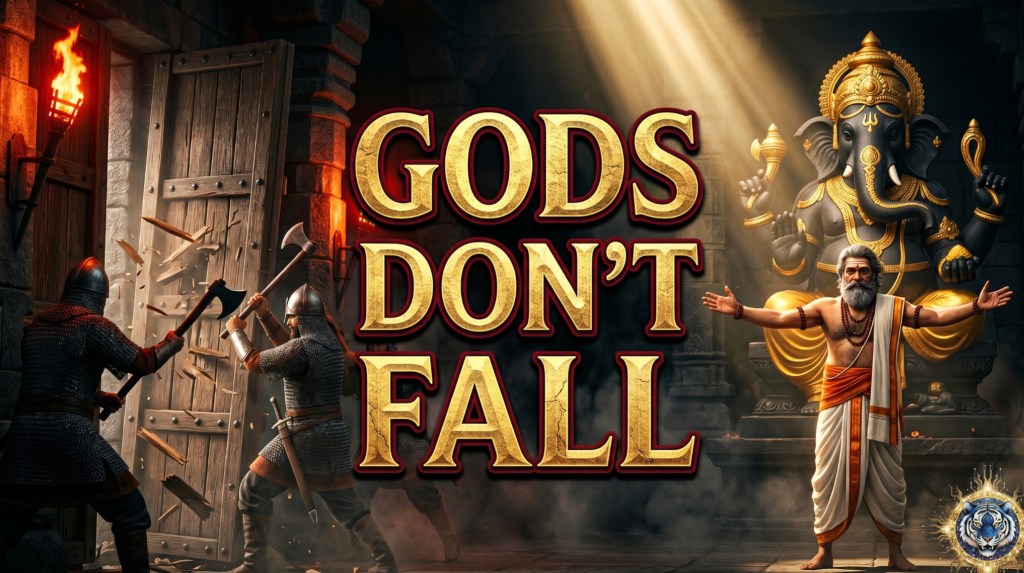
Imagine the Indian subcontinent in 300 CE. The Mauryas are gone. Ashoka’s unifying code, the Dhamma, and his team of Dhamma Mahamatras (essentially compliance officers) have long since vanished. What remains is a fractured landscape of tribal republics, Brahmin settlements, merchant guilds, Buddhist monasteries, and rival chiefs, each community living by its own code, worshipping its own gods, and answering to its own ruler.
A farmer in Bengal and a fisherman on the Tamil coast inhabited completely different worlds: different gods, different rulers, different sacred calendars. Unity, in any meaningful sense, seemed impossible.
Then the Guptas arrived. They already possessed hard power: elite forces, battle-tested generals, and the resources to sustain prolonged campaigns. They could have ruled entirely through force, and for a time, they did. But somewhere in that imperial court, a more consequential question was being asked.
“How do you unify an empire with hundreds of small kings and tribal chiefs, each with their own gods and grudges?”
In my novel, I imagine Gupta Queen Kumaradevi’s answer: “Don’t wage war against their gods. Make them part of a bigger story. Our story.”
That shift changed Indian history and gave new political and cultural force to the idea of Bharat.
The Code That Ran a Civilisation: How the Puranas Became India’s Social Architecture
The Guptas’ most powerful instrument was not military. It was the eighteen major Puranas, supported by hundreds of smaller ones and more than four lakh verses, many composed or significantly expanded during the Gupta era. Their strength was not their size. It was their architecture. Most Puranas followed the same five-layer structure: the creation of the universe, cycles of time, genealogies of gods and kings, cosmic epochs, and dynastic histories.
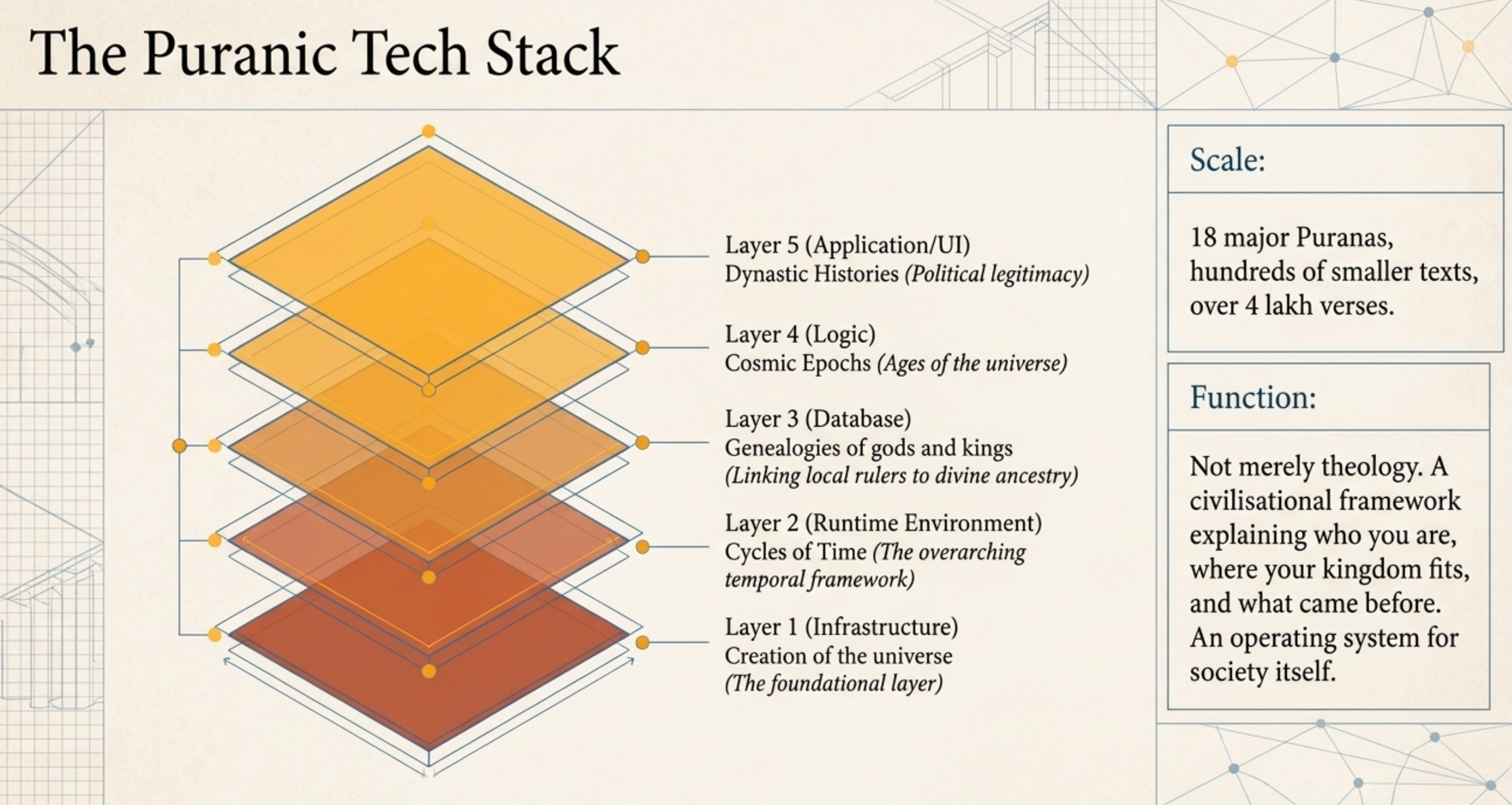
The Puranas were a civilisational framework explaining who you are, where your kingdom fits, what came before you, and why certain rulers possess divine legitimacy. An operating system for society itself.
Consider what Harishena, Samudragupta’s court poet, does around 350 CE. He is tasked with drafting an inscription on a pillar once used by Ashoka, and that decision alone carries a strategic message: the Guptas are not simply ruling after Ashoka. They are presenting themselves as his continuation.
Harishena’s inscription describes Emperor Samudragupta as equal to Kubera in wealth, Yama in justice, and Indra in battle, thereby placing the emperor within the Puranic vision itself. The Guptas understood something empires often learn too late: military conquest demanded soldiers, supply chains, and enormous resources, but narrative conquest worked differently. You plant the story once, and it spreads on its own, through priests, pilgrims, temples, and texts.
Walking Through Mythology: How Temples Became the Subcontinent’s Mass Communication Network
For common people, the temple was the most effective medium to consume the Puranas, and the reason was elegantly simple. Most people in India could not read Sanskrit. They did not need to.
They could walk physically through narrative architecture, the mythology exhibited like a museum on temple walls: Vishnu reclining upon the cosmic serpent, Nara and Narayana seated beneath a tree, the Pandavas alongside Draupadi.
What makes this even more remarkable is what was absent: no central ministry controlled the process, no imperial office supervised every sculptor, and no standardisation council enforced uniform design. Yet coherent civilisational imagery spread across an entire subcontinent without modern communication networks. That kind of cultural unity is difficult to achieve even today.
The Priest, the Chief, and the Fish Goddess: How India’s Most Successful Unification Strategy Actually Worked
The Guptas faced a problem no empire had properly solved before them. “How do you unify Bharat where every village already worships different gods, follows different rituals, observes different sacred calendars?”
Destroy local belief and rebellion follows immediately. Across the Gupta age, a subtler and far more durable process emerged: incorporation.
Picture a Brahmin priest entering a Bengal village, carrying a royal charter and a Purana manuscript. He listens to the tribal chief, studies the local shrine, and then says something carefully calculated: “Your fish goddess is a form of Durga. The village river belongs to the sacred network of the Ganga. Your ancestors even fought beside Arjuna.” The chief is sceptical. He asks about the fish offerings. The priest reassures him that they are recognised within the Bhagvata tradition.
Perhaps it was true. Perhaps it was not. But by the time anyone disputed it, regional traditions had often already emerged to support the claim. The crux of the strategy was this: your gods remain, your rituals remain, but now you are connected to a much larger sacred network, including pilgrimage routes, trade corridors, political legitimacy, and shared civilisational memory.
The operating system was always backward-compatible. Contradictions within the Puranas are not flaws. They are features. A storyteller in Bengal adapts the narrative for local worship. A temple in Tamil Nadu inserts its own geography. A king in Kashmir traces his lineage back to lunar dynasties from mythic time. Everyone contributes. Nobody controls the whole framework. Rigid systems shatter. Adaptive systems survive.
Software in a Teak Chest: The Extraordinary Spread of India’s Cultural Framework Beyond Its Borders
Late in the fourth century, a merchant ship crosses the Bay of Bengal. Deep inside a teak chest lie copies of the Vishnu Purana and the Vayu Purana. The merchant is not a missionary. He is thinking about tides, ports, and profit. But the cultural software inside that chest was powerful enough to outlive him and his kingdom.
The journey carries the chest to Borneo, to Java, to Cambodia. On the banks of the Mahakam River in present-day Indonesia stand stone pillars inscribed in Sanskrit, describing King Mulavarman, whose family just three generations earlier had been local tribal chiefs. King Mulavarman, is as close to a Puranic king as they come, performing Vedic rituals and carving Gupta-style royal proclamations into stone.
No invasion or coercion brought this about. The system spread because it offered a language of kingship that people wanted to inherit. Then came Angkor Wat, an entire temple complex rising from Cambodia like a monumental Purana in stone, with the Churning of the Ocean of Milk carved across its walls by rulers who had never set foot in India. Borders do not stop stories. Armies are unnecessary when people carry ideas willingly, because those ideas help them explain the world and their own place within it.
Aurangzeb, Macaulay, and the Limits of Erasure: What Happened When Empires Tried to Shut the System Down
In 1669, Aurangzeb ordered the destruction of temples at Kashi and Mathura. In 1835, Macaulay’s education policy defunded Sanskrit institutions across the subcontinent. Two very different methods, separated by nearly two centuries, yet both aimed at the same targets: temples, scholars, and transmission networks.
What neither fully grasped was this: you can destroy buildings, and you can defund institutions, but systems rooted in memory, ritual, and everyday life do not disappear easily. The operating system was never stored only in stone or palm-leaf manuscripts. It lived inside people.
From UPI to Puranas: What Modern India Can Learn From Its Most Successful Civilisational Experiment
Today we have UPI, an open architecture with a lightweight central protocol, with different banks and companies building their own applications on top. The Gupta-era Puranic system worked similarly, fifteen hundred years earlier. Different gods. Same protocol.
The parallels carry urgent lessons for contemporary India.
The framework, not the content, is what scales. The Guptas did not impose a single deity or a single ritual. They built a shared architecture within which enormous diversity could flourish. India’s democratic and federal systems work best when they follow the same principle: a robust framework that accommodates difference rather than suppressing it.
Incorporation beats erasure. Every attempt to destroy or erase religious and cultural identity, whether Aurangzeb’s demolitions or Macaulay’s institutional defunding, produced resistance and resentment. The Gupta model of absorption and integration produced something far more durable: voluntary belonging. The lesson for contemporary India’s cultural and political leadership is that coercion is expensive, whilst narrative inclusion is generative.
Decentralisation is not chaos. The fact that no central ministry controlled Gupta-era temple iconography was not a weakness. It was the system’s greatest strength. Local creativity fed the larger framework. India’s innovation potential, whether in technology, governance, or culture, is strongest when the centre sets protocols and local communities build upon them freely.
Stories outlast armies. Angkor Wat was built by rulers who never visited India. UPI is being adopted across borders without diplomatic coercion. India’s soft power, when it is genuinely rooted in its civilisational tradition rather than performed for external audiences, has historically been its most durable export.
Memory is the most resilient infrastructure. When buildings were destroyed and institutions defunded, the system survived because it lived inside ordinary people through ritual, song, story, and practice. India’s greatest strategic asset is not its military capacity or its GDP growth. It is the depth and continuity of a civilisational memory that has absorbed, adapted, and reimganied across millennia.
The Guptas did not simply build an empire. They built a story that people wanted to live inside. That is a lesson worth carrying forward.
The article is an excerpt from my podcast – India’s Golden Age. Available on YouTube, Spotify, Apple Podcasts and other Podcasting Platforms.


Leave a Reply