
Seven centuries before the birth of Christ, at the fault line between Persia, the Silk Road, and the Indo-Gangetic plains, stood Takshashila. It was a frontier city and a market for goods, rumours, and ideas. It was one of the great centres of learning the ancient world had ever produced.
Inside a physician’s home, herbs hung drying from beams whilst students sat nearby, one grinding medicine in the corner as the teacher took a patient’s pulse. Two fingers. A few silent seconds. Then he nodded to the student beside him: “Now you try.” Later that day, when a student produced a clay cup of medicine, the teacher said simply: “Again. Make the potion again. The dose must be exact.”
That word ‘again’ matters a great deal. Learning in Takshashila was not the memorisation of lines from a scroll. It was learning by doing, iterating until you got it right.
Eighteen Disciplines, One Radical Idea: Knowledge Belongs to Everyone
Takshashila taught eighteen fields of study, including medicine, archery, law, politics and even elephant science, because in that age elephants were military assets, economic power and symbols of kingship all at once. Students paid what they could, and wealthier families quietly carried the burden for poorer ones. Not charity but obligation. The thinking was simple: if Takshashila trains a brilliant physician, that physician serves society. Knowledge was treated as a collective investment, not a private privilege.
The Takshashila model began around 700 BCE and continued for over a millennium, producing some of the world’s greatest minds.
- Chanakya, the political genius and statecraft expert
- Panini, whose Sanskrit grammar is so mathematically precise that modern computational linguists treat it as a precursor to formal language theory
- Charaka, father of Ayurvedic medicine
- Jivaka, physician to the Buddha
Alexander the Great visited Takshashila as a tourist in 326 BCE, when it was already centuries old.
The University That Ran on Debate, Not Dogma
By 630 CE, Nalanda was no longer just a university. It had become an intellectual civilisation. Ten thousand students studied there under more than a thousand teachers across eight vast compounds, with a hundred lectures delivered each day. The library held millions of manuscripts on subjects ranging from surgery to erotic poetry, written in languages from Sanskrit to Chinese.
The discipline was relentless. Debates at sunrise. Lectures through the afternoon. Study and meditation until midnight, with no exceptions and no days off. Education was completely free, funded by the revenues of 120 villages granted through Gupta royal decree. Admission rested entirely on merit. At the gates stood the Dvarpandita, the Gatekeeper Scholar, and nine out of ten candidates failed to pass.
Still, scholars travelled from every corner of Asia: Chinese monks, Korean scholars, Persian students, Indonesian pilgrims etc. One of them was Xuanzang, a twenty-seven-year-old monk who crossed deserts and bandit territory for three years simply to reach Nalanda. The intellectual rigour he encountered there shocked him. “The priests are grave and dignified,” he wrote. “They study deeply.”
But Nalanda’s true strength was not its scale or its infrastructure. It was the shastrartha, the culture of public debate. Picture a stone hall crowded with students, monks, teachers and visiting pandits, where two scholars faced each other whilst hundreds listened carefully enough to detect every weak premise and every clever deflection. At Nalanda, knowledge had to survive public attack. A Nalanda teacher might have said, “The debates, that is where you are made or broken. Lose one badly, and your students start questioning you. Funding disappears. Your reputation bleeds slowly. People will quote your defeat long after you are gone.”
This system produced thinkers who could defend ideas under sustained attack. Now compare that to the modern learning cycle of memorise, regurgitate, forget, repeat.
Where Economics Met Enlightenment
In 640 CE, Xuanzang arrived at Vallabhi in Gujarat expecting another great Mahavira, a Nalanda equivalent. Instead, he found something closer to a nerve centre of trade, politics and statecraft. The monks astonished him. He wrote that they were “deeply versed in worldly knowledge.”
Vallabhi functioned almost like an ancient school of economics and administration. A professor explained the curriculum to Xuanzang: “We teach Arthashastra, but we apply it to contemporary trade problems, like three empires sharing the same harbour. We teach languages: Sanskrit, Brahmi, Sogdian, so that deals can be struck across kingdoms. We teach Ganita, commercial arithmetic, including interest rates, profit margins and how to calculate returns when half your ships might never come back.”
During a Vallabhi lecture, Professor Sthiramati posed a question to his students: “A drought strikes. Grain prices triple. How does a king feed the people and maintain his army?” A Kashmiri student suggested suspending taxes. A Persian merchant’s son countered immediately that no taxes meant an empty treasury and therefore no famine relief. Then a student named Nimesh spoke, voice cracking slightly: “Respected Acharya, you draft laws that make hoarding costlier than circulation. You align the merchant’s self-interest with the people’s need. You don’t punish greed. You channel it.” Three beats of silence. Sthiramati nodded.
This was not theoretical education. Vallabhi’s scholars later advised courts and managed trade networks stretching from Western Asia to Tibet and South-East Asia.
A Network, Not a Monument: India’s Educational Civilisation
Nalanda and Vallabhi were part of a broader educational network that included other great monasteries such as Vikramashila and Somapura. The Pala rulers of Bengal and Bihar funded several of them at once, whilst dynasties like the Maitrakas sustained others such as Vallabhi. They competed, specialised and borrowed from one another, and scholars moved between them as naturally as merchants moved between ports. This was an educational civilisation that examined itself continuously, and that perhaps was its greatest strength.
Three Erasures: Fire, Swords and a Clerk’s Pen
The first major rupture to India’s educational civilisation came in 499 CE when the White Huns invaded Takshashila. When Xuanzang visited Takshashila in the seventh century, he found only ruins. Vallabhi was gradually eroded in the eight century, by frequent Arab raids.
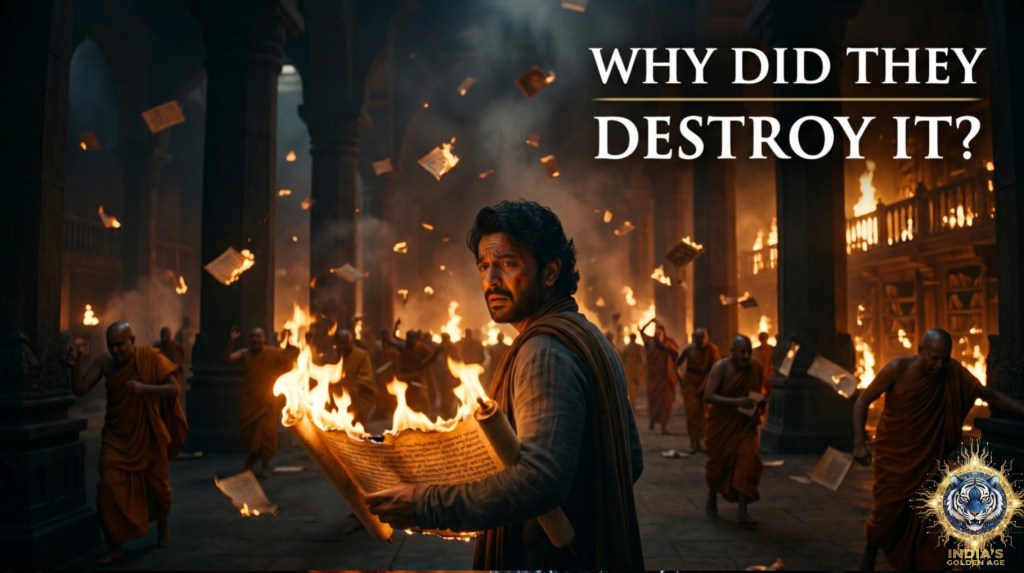
Then came 1193 CE. There is a story of a Turkic Mamluk general, Muhammad Bakhtiyar Khilji, falling gravely ill, with his own physicians unable to cure him. A Buddhist scholar from Nalanda, the Ayurvedic physician Rahul Sri Bhadra, succeeded where they had failed. Legend says Khilji felt not gratitude but humiliation. When he later visited Nalanda and saw its immense libraries, he is said to have remarked: “There is no Quran here. Burn it.”
The Nalanda library, a nine-storey building of accumulated human thought, burned for months. What had taken more than six centuries to build was destroyed in days.
The third erasure came without fire or swords. In 1835, Thomas Babington Macaulay wrote in his Minute on Education: “A single shelf of a good European library is worth the whole native literature of India and Arabia. We must make the natives English in taste, English in intellect, in culture.” The gurukuls and village pathshalas were denied patronage, denied legitimacy and gradually denied survival. An Ayurvedic physician in Kerala watched inherited medical knowledge dismissed as superstition by colonial medicine, at a time when European doctors still prescribed mercury and conducted surgery without anaesthesia.
Gottlieb Wilhelm Leitner’s 1882 survey concluded: “Indian education was widespread, effective, and diverse. It served all castes and classes before being ruined by colonial policies.” Mahatma Gandhi later argued that British rule had left India more illiterate than it had been a century earlier. By 1947, literacy had fallen to roughly sixteen per cent.
A civilisation that once exported mathematics, astronomy, logic and philosophy across continents was now taught to see itself as intellectually inferior. This was the deepest wound that the British gave us, one from which we are still recovering.
Knowledge That Outlived Empires
Despite the destruction, much of India’s intellectual legacy survived by travelling outward. Xuanzang returned to Chang’an carrying 657 Sanskrit manuscripts after fifteen years of study in India. Emperor Taizong of Tang honoured him and commissioned scholars to translate the texts, and knowledge once housed in Nalanda began shaping another civilisation. Mathematics, science and astronomy travelled west through Arab scholars into Europe. Zero. Decimal systems. Trigonometry. Ideas so deeply woven into modern life that most people no longer stop to ask where they began.
The Dalai Lama later remarked: “The source of all the knowledge we have has come from Nalanda.”
What Today’s India Must Learn from Its Own Past
Let us imagine a conversation between Dharmapala of Nalanda and Nimesh of Vallabhi captures a tension that still defines Indian education today.
Dharmapala challenges: “Vallabhi education is all transactions. Where is the pursuit of truth? You train clerks, not sages.”
Nimesh replies calmly: “Truth doesn’t keep people alive during famine. Effective governance does. Nalanda scholars debate reality. Vallabhi students plan grain imports when the rains fail. Both have value. Only one is urgent.”
Dharmapala thinks, then answers: “But what keeps your systems, your policies, from becoming instruments of oppression? Philosophy keeps power in check.”
Nimesh nods: “Which is why we should collaborate, not compete. Bharat needs both.”
Bharat needs both. That line is still true.
The architecture of ancient Indian learning combined shastrartha, the rigour of public debate, with gurukul immersion, experiential learning and integration of the spiritual with the intellectual. It funded knowledge as a public good, welcomed the world without demanding it conform, and produced thinkers who shaped civilisations long after their institutions were gone.
Three lessons stand out for modern India.
- First, access and excellence are not opposites. Takshashila and Nalanda proved that free, merit-based education could produce the world’s finest minds.
- Second, debate is not disorder. The shastrartha was not chaos; it was the mechanism by which knowledge was tested, refined and made trustworthy.
- Third, the purpose of education is not merely employment. Vallabhi taught trade. Nalanda taught philosophy. Both were necessary, and both served something larger than the individual student.
Xuanzang walked thousands of miles for Indian education. The question India must now answer honestly is this: what can it offer today that Harvard or MIT cannot? Until that question is answered with something more than nostalgia, India will keep exporting talent instead of attracting it.
The article is an excerpt from my podcast – India’s Golden Age. Available on YouTube, Spotify, Apple Podcasts and other Podcasting Platforms.


Leave a Reply