
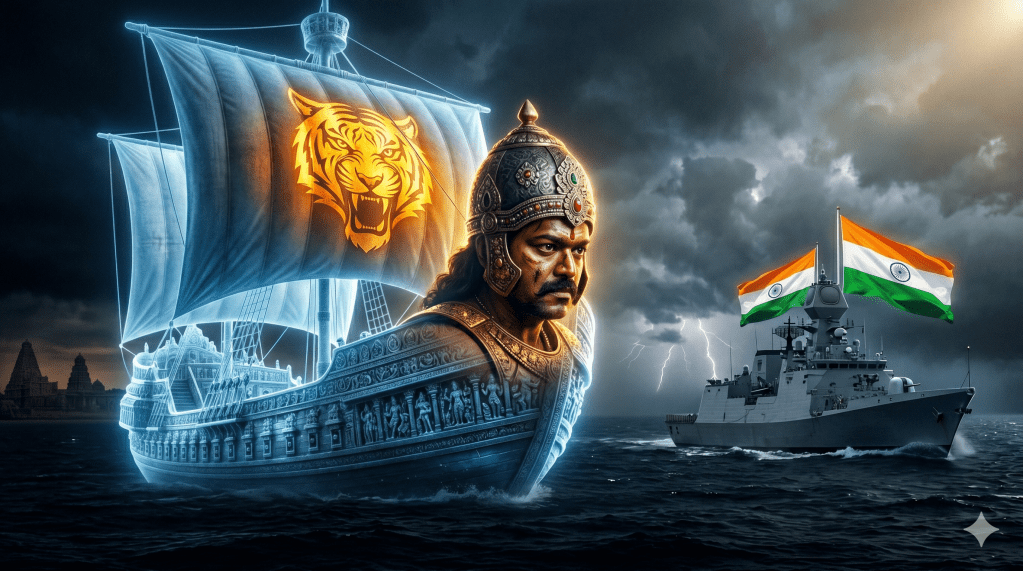
The Cholas did not just rule India. They ruled the Indian Ocean.
They built a dam two thousand years ago that still waters fields in Tamil Nadu today. They raised a granite temple without mortar or modern machinery, a structure that defies easy explanation even now. They launched a naval fleet that struck fourteen cities across South-East Asia in a single co-ordinated campaign. The Cholas were not just another dynasty in the long, crowded ledger of Indian history. They were a civilisation that the world forgot far too quickly.
From Minor Chieftains To Monarchs: How the Cholas Turned a Power Vacuum Into an Empire
Emperor Ashoka mentions the Cholas as far back as 273 BCE. By the second century CE, Karikala Chola had built the Kallanai across the Kaveri river, a dam so precisely engineered that it continues to irrigate fields across Tamil Nadu today. That was the Chola way: built to last.
For much of their early history, the Cholas operated as minor chieftains, strategically marrying their daughters into the more powerful Pallava and Pandya dynasties. Then, in 848 CE, history offered them an opening.
The Pallavas and Pandyas had spent decades tearing each other apart in a costly war over the Kaveri delta, leaving both kingdoms exhausted and vulnerable. Into that vacuum stepped the Chola dynasty, and by 985 CE, Arulmoli Varman had ascended the throne. You likely know him by another name: Rajaraja Chola the First, the Sun King. He was 38 years old, and he had plans.
66 Metres of Granite and Zero Mortar
In 1010 CE, Rajaraja Chola stood at the base of what he had just completed: the Brihadeeswara temple in Thanjavur. A granite tower rising 66 metres, it remains one of the tallest temple towers in the world to this day. It was built largely without mortar or cement, and without modern machinery. The 80-tonne capstone was raised to the top, most likely via an earthen ramp that reportedly stretched for miles. Today it is recognised as one of the three Great Living Chola Temples and holds UNESCO World Heritage status.
But Brihadeeswara was never just a temple. It was an economic institution. Rajaraja’s own inscriptions record six hundred salaried devadasi dancers on the payroll, alongside priests, musicians, cooks, accountants, and gardeners. Each year, the temple received thousands of tonnes of rice and redistributed them as wages and seed grain. Rajaraja was not simply constructing a place of worship. He was building a functioning economy around a sacred centre.
Around the same period, Rajaraja commissioned a comprehensive land survey of his empire, recording every village boundary, every irrigation right, and every taxable asset. Historians frequently compare this exercise in intent to England’s Domesday Book, which was compiled 76 years later.
Sri Lanka Was the Opening Move
Rajaraja approached a map the way a chess player approaches a board, not asking what was there but what position he needed to occupy three moves from now.
His first move was Sri Lanka. The island sits across India’s southern tip, a chokepoint between two seas. He captured the northern half and consecrated it with a Shiva temple. His second move was the Maldives, small coral islands to most observers, but to Rajaraja, they were toll booths for the Arab merchant ships passing east. By the time Rajaraja passed the throne to his son Rajendra, the Indian Ocean board was precisely set, with one decisive move still remaining.
The King of the South Became the King of the North
In 1022 CE, after months of marching, Rajendra Chola’s army reached the Ganges. They defeated the Pala king, and according to legend, Rajendra ordered the defeated princes to carry pots of Ganges water all the way back to Tamil Nadu, a journey of nearly two thousand kilometres.
Rajendra was building a new capital, Gangaikonda Cholapuram, and the Ganges water was ceremonially poured into a vast artificial reservoir called the Cholagangam. The message was unmistakable: the holiest river in India had been brought south. The king of the south was now the king of the north.
Rajendra also sent diplomatic missions to Song Dynasty China. Unlike many Indian rulers, he never ignored what the oceans could offer.
Five Centuries Before the East India Company, a South Indian MNC Was Running the Indian Ocean
The greatest naval expedition in medieval Asian history began, in all likelihood, with a merchant guild’s complaint.
The Ayyavole Ainurruvar, or The Five Hundred Guild, were not a simple trading association. They carried their own flag, the bull of Shiva. They maintained their own armed contingents, known as the Three-Leaf Warriors. They operated under their own legal code, followed their own diplomatic protocols, and left inscriptions that archaeologists have recovered across South-East Asia. Five centuries before the East India Company was incorporated, South Indian merchant guilds were running what can only be described as multinational corporations.
For years, the Srivijayan Empire had been blocking the sea lanes through the Strait of Malacca, seizing ships and confiscating cargo from any trader attempting to bypass Srivijayan ports. The guild leadership brought their grievance to the Chola court. At roughly the same time, the Srivijayan envoy at the court of the Song Dynasty in China made a remark that was humiliating “The Cholas are a subordinate power. We control the trade through the straits.“

Trade, prestige, and strategy finally converged in October 1025 at Nagapattinam harbour, where Rajendra flagged off the naval attack. The Chola forces combined royal naval power with the private fleets of the guilds. Merchant ships were rebuilt into fighting vessels fitted with archer platforms, catapults, and reinforced hulls.
Srivijaya anticipated the attack at Kedah, the major port. Rajendra sent a decoy there. The main fleet sailed through the Sunda Strait and struck Palembang, the political centre, from the south. The city fell quickly, and the palace gate was taken as tribute.
Strike, Win, Leave
The Chola fleet struck fourteen Srivijayan port cities in a single co-ordinated campaign. Reading that list today is essentially unrolling the entire maritime spine of South-East Asia.
And then Rajendra made the decision that defines the Chola legacy. He told his commanders they were not staying. The Srivijayan stranglehold was broken, and the guilds would handle the rest. No garrisons were left behind. No governors were appointed. The objective had never been to rule Sumatra. It was to secure the sea lanes and ensure the free flow of trade.
Srivijaya’s dominance over the Strait of Malacca weakened decisively after the attack. Tamil guild influence expanded in its place. An 1088 inscription found in Barus, Sumatra, records the presence of the Tamil Ainurruvar guild, confirming the system worked. Protection in exchange for prosperity: influence without occupation.
Stitched Ships Without a Single Nail
Chola trade dominance was also built on Indian engineering that the rest of the world had not yet conceived. South Indian guilds constructed stitched ships, vessels held together not with iron nails but with coconut fibre packed into drilled planks and stitched with coir rope. When the wood swelled in water, the cross-stitch held firm. The resin-sealed hull flexed and dispersed impact. A nailed European hull concentrated stress, causing nails to strain and wood to split. Combined with the strength and durability of Malabar teak, Indian ships were far more resilient, more easily repaired, and significantly longer-lived.
When Marco Polo arrived in 1292, he described ships with hundreds of crew members, multiple decks, merchant cabins, and watertight compartments. He reported them as four times the size of European ships, with much longer operational lives. Europeans called him a liar for decades.
From Malik Kafur to the British Raj: How the Chola Legacy Was Systematically Dismantled
The Chola Dynasty officially ended in 1279 CE. Decades later, in March 1311, Malik Kafur, general of Alauddin Khalji, marched into the Tamil south. The campaign moved swiftly. At the temple of Chidambaram, Kafur’s forces encountered immense accumulated wealth. The court poet Amir Khusrau recorded what followed: ceilings were stripped of jewels, shrines were destroyed, and the scale of plunder was staggering. What had taken centuries to build took only weeks to empty.
The temple economy that survived the Malik Kafur assault did not survive what came next. By 1860, under the British Raj, the Inam Commission reclassified temple lands as state property, dismantling a thousand-year-old economic system through bureaucratic paperwork.
Then came the British officials and collectors, moving through Tamil Nadu with catalogues and cameras, identifying, cataloguing, and removing. According to UNESCO estimates, thousands of pieces of art, many of them temple deities, stolen during this period are currently held in Western museums or private collections.
Under traditional Indian law, a temple deity is not an antique or a cultural object. A deity is a legal person, a living god, worshipped in a specific temple, for specific reasons, in a specific tradition. The Chola deities stand today stripped of all context, behind climate-controlled glass in institutions that call them art. They are not art. They are absences.
The Chola Civilisation Never Actually Died
The Chola civilisation never truly ended.
In Swamimalai, bronze casters continue to practise the lost-wax technique, known as Cire Perdue, perfected during the Chola period and unsurpassed anywhere in the medieval world. This method, refined to extraordinary precision, has been passed down through generations, surviving political upheaval, colonial disruption, and the passage of time itself.
In 2004, physicists at CERN in Geneva placed a Nataraja at their entrance, seeing in it a symbol of the universe in constant creation and constant destruction. A Chola artisan’s conception, shaped in the tenth century, now speaks to modern science. Bharatanatyam, the dance form that the Chola temples institutionalised, is taught today from Chennai to Chicago.
The Chola army came home in 1025. The Chola culture stayed in South-East Asia, in its temples, in the Sanskrit and Tamil words embedded in local languages.
Lessons for Today’s India
The Chola story is not merely a chapter in a history textbook. It is a manual for strategic thinking that remains remarkably relevant.
On sea power and geography: India is currently expanding naval infrastructure in the Andaman and Nicobar Islands, positioned precisely at the mouth of the Malacca chokepoint, the same chokepoint that Rajendra Chola struck a thousand years ago. The sea lanes still decide everything, as the Strait of Hormuz continues to remind the world. The Cholas understood this instinctively and built their entire strategic doctrine around it.
On trade and influence: The Chola model of projecting power through merchant guilds rather than military occupation, protection in exchange for prosperity, influence without colonisation, is a template that modern India’s foreign policy thinkers are only beginning to revisit seriously. China’s Belt and Road Initiative has been widely described as sophisticated, but the Cholas had built a more nuanced version of it in the eleventh century.
On institutions over monuments: Rajaraja Chola’s greatest legacy was not the Brihadeeswara temple as a building. It was the economic institution he built around it: the payroll, the land survey, the redistribution system.
On cultural continuity: The Chola bronzes, the stitched ships, Bharatanatyam, the Kallanai dam are not relics. They are part of our living tradition.
The Cholas continue to remind us that India’s destiny is intrinsically linked to its ocean. Rajendra Chola, might have said, “Empires march on land, civilisations sail.”
The article is an excerpt from my podcast – India’s Golden Age. Available on YouTube, Spotify, Apple Podcasts and other Podcasting Platforms.


Leave a Reply