

Gangetic plains, 800 BCE. One wrong measurement could ruin a sacrifice. An altar drawn out of proportion could insult both king and deity. In this world, Baudhayana flourished, serving as priest and mathematician alike. And his instrument was a rope.
Centuries before Pythagoras formalised what we now call his theorem, Baudhayana recorded geometric principles in the Shulba Sutras, which translates as the Rules of the Cord. Had mathematical history been told as a genuinely global story, his name would not sound so unfamiliar today.
Not a Textbook. A Field Manual
The Shulba Sutras were not written for philosophers debating in halls. They were field manuals for constructing Vedic fire altars, known as the chiti. Every fire altar carried a different shape and a different purpose: to destroy an enemy, to obtain land, or to gain prosperity. As the Vedas state, “He who desires heaven is to construct a fire altar in the form of a falcon.”
Crucially, all the fire altars, of different shapes, had to be of precisely equal area, 7.5 square purusha. The Tretha Agni, for instance, consisted of three shapes, a rectangle, a circle, and a semicircle, and the area of all three had to match exactly.
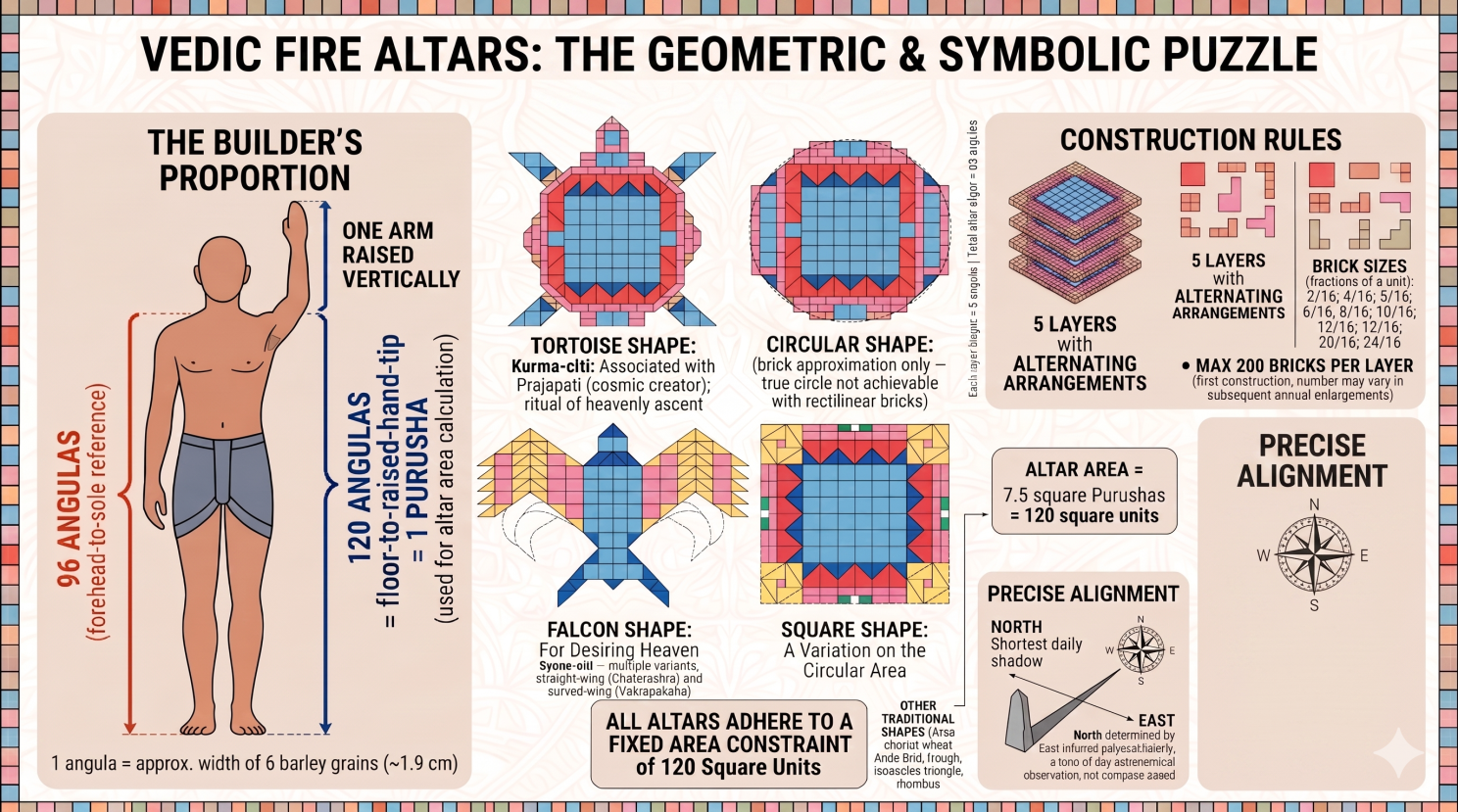
The very word Sulba means rope or cord. Mathematics and measuring instrument shared the same word because geometry in ancient India was never separate from physical practice. You learned it with your hands, kneeling in grass, pulling cords tight against wooden pegs.
Baudhayana stated the theorem as follows: “Take the rope. Stretch it across the diagonal. The area it makes is exactly what the horizontal and vertical sides make together.”
What we write today as a² + b² = c². That is what he said, in Sanskrit, around 800 BCE.
Why Baudhayana’s Greatest Insight Was Admitting He Could Not Finish
Consider what the priests were actually solving. The Shyena Chiti, the falcon altar, was built five layers high from roughly 10,000 bricks, and yet its total area had to remain exactly seven and a half square purusa, the same as a square altar or any other variant. This was not architecture alone. It was ritual precision tied to cosmic order, and it demanded geometry of real sophistication.
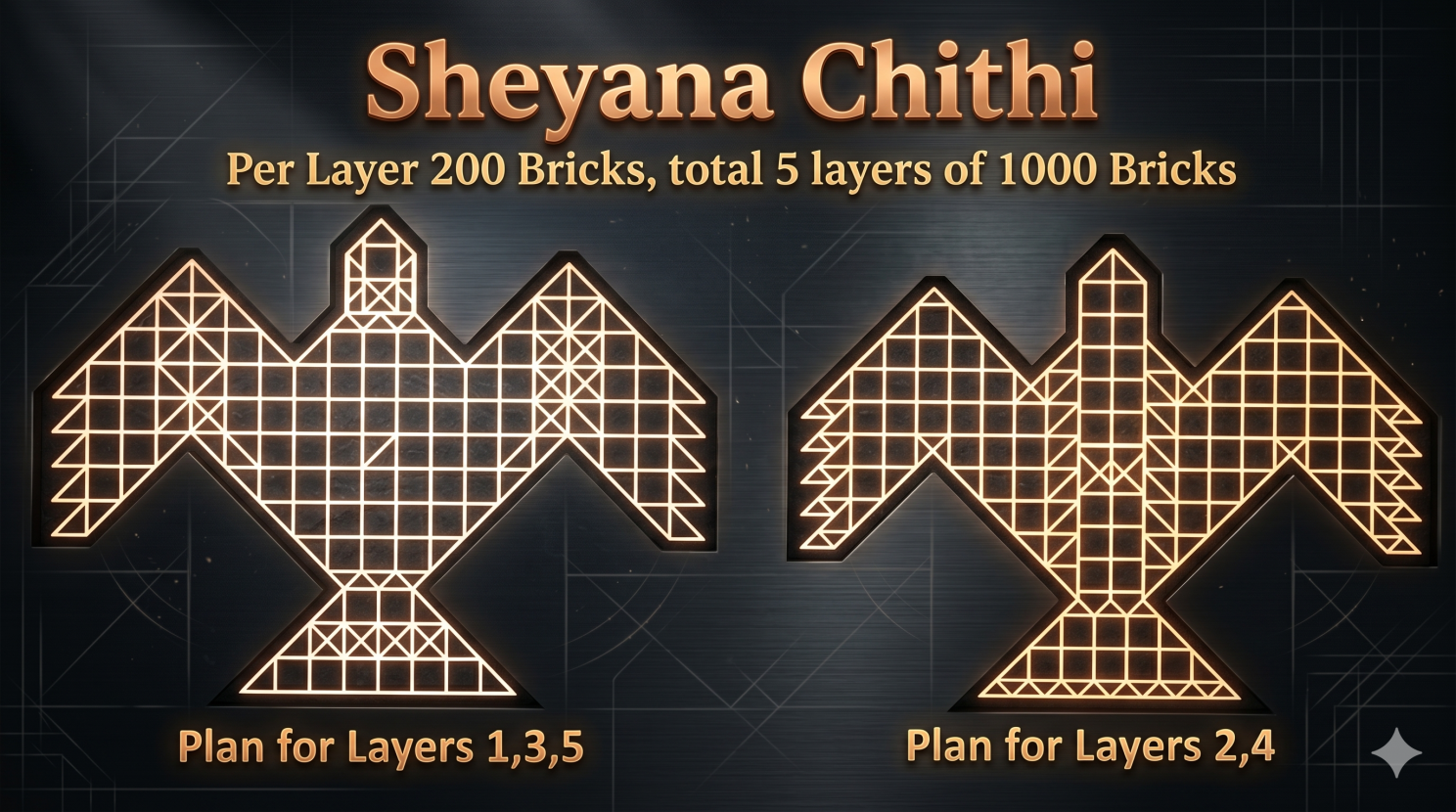
To solve these problems, Vedic ritualists had to work with the square root of two, the ratio hidden inside the diagonal of a square. Baudhayana’s approximation was remarkably precise. His step-by-step method instructs: increase the measure by its third, then that third again by its own fourth, then subtract the thirty-fourth part of that fourth. The answer he arrives at is 1.4142156. The actual value is 1.4142135. That is four digits of precision, achieved in 800 BCE with no sophisticated instrument except a rope.
And here lies the most remarkable detail in the entire text. Baudhayana does not pretend his ‘square root of 2’ calculation is exact. He writes: Sa-vishesha, meaning “with remainder.” He recognised that the diagonal of a square could not be captured perfectly through ordinary ratios, and he said so openly.
That intellectual honesty may be the single most sophisticated thing in the Shulba Sutras. Most mathematicians, across most periods, prefer certainty. They want their measurements exact and their conclusions settled. Baudhayana left room for the remainder. The answer comes close, he acknowledged, but not perfectly close.
Why Is It Called Pythagorean? The Answer Is Not Mathematical
The historical sequence deserves to be stated plainly. The Plimpton 322, a Babylonian clay tablet, records Pythagorean triples as far back as 1800 BCE. Problem 79 of the Rhind Papyrus from Egypt, dating to around 1550 BCE, references the 3:4:5 ratio, demonstrating a clear working understanding of the geometric principle. The Indian Shulba Sutras stated the principle in its general form by around 800 BCE. Greek formalisation came afterwards.
The reason we call it the Pythagorean theorem today is not historical. It is perhaps a political one.
What This Means for India Today
Modern India finds itself at an interesting juncture, simultaneously producing world-class engineers, mathematicians, and technologists, while sometimes struggling to locate its own intellectual inheritance in the global conversation. Baudhayana offers three lessons worth carrying forward.
The first is institutional honesty. Baudhayana’s sa-vishesha, his willingness to say the answer is incomplete, is a model for research, policy, and leadership. Cultures that acknowledge the limits of their current knowledge tend to build better systems than those that manufacture false certainty.
The second is the integration of theory and practice. The Shulba Sutras did not separate mathematical thinking from physical application. In fact the complicated shapes of various fire altars, serving different objectives, posed an interesting challenge to Vedic mathematicians.
The third is the reclamation of a complete history, not for nationalist pride, but for accurate understanding. A nation whose students do not know that Baudhayana approximated the square root of two to four decimal places in 800 BCE is a nation operating with an incomplete map of its own capabilities. Knowing the full story is not vanity. It is self-awareness.
The article is an excerpt from my podcast – India’s Golden Age. Available on YouTube, Spotify, Apple Podcasts and other Podcasting Platforms.


Leave a Reply