
When Faith Became a Strategy
Around 300 AD, the Gupta dynasty inherited a fractured empire, and their rulers understood something that most conquerors never quite figure out: battles are won with soldiers, but civilisations are won with belief. As a respected scholar of the era might have said, “to own the future you do not rule people, you shape the gods they pray to.”
The foundations the Guptas built upon were already in place. In the Mathura region, warrior clans called the Vrishnis worshipped a deity named Krishna Vasudeva, a celebrated superhero and possibly the king of a dynasty, remembered fondly across generations. At the same time, Brahmin scholars were quietly attempting something extraordinary. They were working to elevate Vishnu, a relatively minor deity in the Vedas, into a universal, unifying god.
It is worth pausing on the sheer scale of that engineering challenge, the almost literal leap of faith required to unify hundreds of different sects under a single god.
When Two Gods Became One
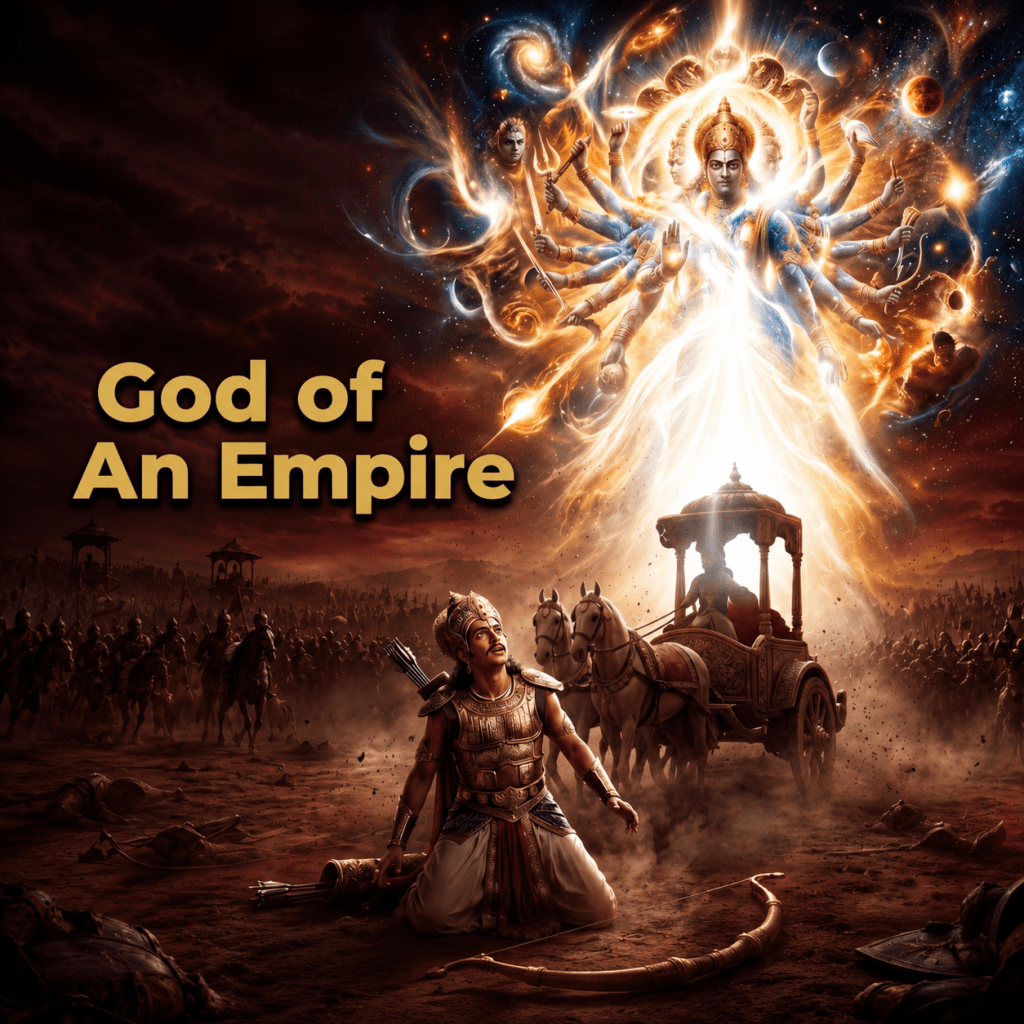
The Mahabharata accelerated the fusion of Vasudeva-Krishna and Lord Vishnu, and the Bhagavad Gita then gave that fusion its most unforgettable expression. Lor Krishna declares, and it is worth listening to this carefully, “I am the Self seated in the heart of all living beings. I am the beginning, the middle, and the end of all beings.”
That was not poetry, and it was not philosophy either. It was a declaration. The hero of a warrior clan in Mathura had become the supreme force of the entire universe.
Samudragupta’s Masterstroke of Soft Power
Let us move to 335 CE, when Emperor Samudragupta had already won enough battles to understand their limits. He had conquered most rival kings across South Asia, and in doing so he had come to an important conclusion: military victory can destroy kingdoms, but it cannot build civilisations on its own.
So he leveraged Lord Vishnu as a unifying force, weaving the Vishnu connection into every layer of royal identity. His title, parama-bhagavata, meaning supreme devotee of Vishnu, made the association explicit. The emperor’s emblem was Garuda, Vishnu’s own vehicle, stamped onto every gold coin circulating across the empire. Imagine the cumulative effect of that choice. Every merchant, every farmer, and every local chieftain who held those coins in their hands encountered the same compelling message, again and again: the king and Vishnu were on the same side.
In my novel, Dhruvadevi, the chief Gupta queen and daughter-in-law of Samudragupta, sums up the strategy with the clarity of someone who lived inside it. She says, “One Vishnu idol in every home. One Vishnu temple in every city. One version of the Mahabharata for all.” Simple, ruthless, and remarkably effective.
Chandragupta II and the Art of Cosmic Order
Samudragupta’s son, and Dhruvadevi’s second husband, Chandragupta II, carried the project further still. Around 401 CE, on the slopes of a hill in Madhya Pradesh, and after a long and bloody war with the Western Sakas that consumed much of his life, Chandragupta directed his minister Virasena to build something remarkable.
He commissioned a cave temple at Udayagiri, carved directly into living rock. Dominating the cave wall was a colossal image of Varaha, Vishnu’s boar incarnation, shown tearing through the cosmic flood to rescue the earth goddess Bhudevi, who clings to his tusk. Near the edge of that immense scene stands a small, reverent figure with head bowed, possibly the king himself. The message required no words at all. Vishnu preserves cosmic order, the king serves Vishnu, and together they define the very structure of the universe.
How the Buddha Became Vishnu’s Ninth Avatar
Then, one fine day, came the boldest stroke of all, and it was a move nobody saw coming. For centuries, Buddhism had commanded enormous influence across India. Buddhist monasteries flourished from Taxila to Tamralipti, with deep roots in the merchant class, who funded it generously and loved it deeply.
You cannot simply erase a tradition that is so deeply embedded. Try it, and you invite serious rebellion, especially from the wealthy merchant class. So Brahmin theologians did something rather out of the box: they absorbed Gautama Buddha into the Vishnu tradition as its ninth avatar.
The sequence now ran as follows: Matsya, Kurma, Varaha, Narasimha, Vamana, Parashurama, Rama, Krishna, and then Buddha. It was an audacious move: incorporating an ascetic who had questioned Vedic authority and built one of the world’s great alternative spiritual systems. Buddha was no longer seen as an outsider. He was now woven into Vishnu’s own cosmic story.
For millions of Buddhists across India, the message was clear even though nobody ever said it aloud: your teacher is now included within this larger tradition, so you might as well move, lock, stock, and barrel. There was no war, no conflict, no forced conversion, and no persecution involved. Just redefinition, absorption, and assimilation, and it worked so completely that most people today barely notice the scale of what actually happened.
What makes this even more interesting is that the idea of the Avatara evolved hand in hand with the concept of the Bodhisattva, or the past lives of the Buddha. Both traditions influenced each other heavily, and both were motivated by a shared mission to restore dharma and alleviate human suffering across different eras.
The Business Model Behind the Belief
Concepts and beliefs like the avatara remain little more than poetry without institutions to sustain them, and the Gupta kings understood this well. So they put their money where their mouths were. Through devadana and brahmadeya endowments, they granted tax-free land to temples and Brahmins across the empire. The temples became the institutions, and the Brahmins became the institution managers.
Over time, as income and devotees grew, temples turned into something extraordinary. They were no longer just places of prayer but genuine economic engines: employing sculptors, goldsmiths, weavers, priests, and farmers. They managed land, funded merchants, and connected communities across hundreds of kilometres. A temple could secure a region more quietly, and far more sustainably, than soldiers ever could.
By the reign of Kumaragupta, Dhruvadevi’s son, Vaishnava sites stretched across the entire Gupta Empire. Wherever one travelled, the symbols remained familiar: Garuda, Varaha, and Vishnu reclining on the cosmic serpent. The spread of the Vaishnava order was remarkably consistent and coherent, helped in no small measure by the rapid growth of the temple network.
For most people across this vast subcontinent, people who could not read a single line of Sanskrit, the temple itself was the scripture. The sculpture was the text. Walk into any major shrine and the same stories surrounded you, the same gods, the same cosmic order. Nobody coordinated this from the top. There was no central ministry and no imperial standardisation council. That, in itself, was civilisational coherence achieved at an extraordinary scale.
Purana Operating System – How One Empire Solved a Thousand Village Problems
And how can we forget the Puranas, the civilisational operating system that the Guptas helped build. The Puranas gathered myths, kings, gods, and cosmic history into vast narrative frameworks, stories that travelled easily from temple courtyards to village gatherings.
The Puranas solved a problem that no empire before them had properly cracked. Dhruvadevi herself might have framed the problem in this way: “How do you unify Bharat, where every village already worships different gods, follows different rituals, and observes different sacred calendars?” Destroy local belief, and rebellion follows almost immediately. Replace it by force, and you create enemies out of people who might otherwise have been allies. So the Puranas proposed a different solution instead: incorporation, in the same spirit as the absorption of the Buddha.
Imagine a Brahmin priest entering a village in Bengal, carrying a royal charter in one hand and a Purana manuscript in the other. He studies the local shrine, listens carefully to the tribal chief, and then says, very carefully:
Brahmin: “Your fish goddess is a form of Durga. The village river belongs to the sacred network of the Ganga. Your ancestors even fought beside Arjuna.”
Perhaps it was historically true, or perhaps it was constructed on the spot. But by the time anyone investigated, a local tradition would already have emerged in support of the claim. Your gods remain, and your rituals remain, but now you are plugged into the main network, connected to pilgrimage routes, trade corridors, and a shared civilisational memory stretching back to mythic time. The Purana operating system was, in every sense, always backward-compatible.
Every Golden Age Casts a Shadow
Like all golden ages, the Gupta one carried its own shadow too. The Eran inscription of 510 AD contains some of the earliest stone evidence associated with sati. The Chinese traveller Faxian described entire communities of Chandalas living beyond village boundaries under strict social restrictions.
Recent DNA studies suggest that widespread intermarriage across communities declined sharply between roughly sixteen hundred and nineteen hundred years ago, a window that overlaps exactly with the Gupta era. Caste distinctions were becoming harder to cross. Some scholars argue that this growing rigidity of caste helped drive long-term genetic isolation within the Indian population, something that is hopefully changing now, albeit very slowly.
Inclusion and exclusion have always moved together in India. The same framework that absorbed the Buddha also drew tighter lines around who belonged to the mainstream and who did not, and that tension has still not fully resolved. It continues to echo across India today.
An Empire Fell, but the Idea Didn’t
By 550 AD, the Gupta empire had collapsed. But the ideas it had nurtured did not collapse along with it.
The temple architecture pioneered by the Guptas evolved into the great sacred complexes of later centuries, and the avatar doctrine became the heartbeat of the bhakti movements that swept across India for a thousand years afterwards.
The modern concept of Hinduism, loosely described as Sanatana Dharma, a single religion of sorts, is in fact a fairly late development that largely crystallised in the nineteenth century. But many of its cultural foundations, the temples, the Puranas, the avatar doctrine, and the culture of bhakti, were laid firmly during the Gupta age. It would not be an exaggeration to say that the Guptas institutionalised and accelerated the development of Sanatana Dharma, or modern Hinduism as we know it.
The ingredients, however, had always been there, long before the Guptas turned them into a finished recipe. In 113 BC, centuries before the Gupta dynasty even existed, a Greek ambassador named Heliodorus erected a pillar near Vidisha in central India, dedicated to Vasudeva, the God of Gods. This was the same Vrishni deity, remember, that would later fuse with Vishnu. The Greek ambassador was not forced into this act. He chose it, because something in the tradition answered questions he carried within himself: what holds the world together, what is the right way to live, and where does a single human being fit within the larger order of things?
The Guptas did not invent those questions. They tried to answer then, and then embedded them in stone, in stories, in symbols, and in the very architecture of belief itself. The empire eventually disappeared, but the answers and the stories remained, and in many ways they are still shaping the world today.
Lessons for Today’s India
- Unity is built through shared symbols, not just shared rules. The Guptas understood that a coin, a temple, or a story could travel further and last longer than any decree. Modern India’s own attempts at building a shared national identity echo the same lesson: coherence has to be felt, not just legislated.
- Absorption works better than confrontation. The graceful incorporation of the Buddha into the Vishnu tradition, and the Puranic habit of folding local gods into a larger network rather than erasing them, offers a template that remains relevant. In a country as diverse as India, the instinct to include rather than exclude tends to build more durable unity than the instinct to override.
- Institutions outlast ideologies. Belief alone, however inspiring, needs institutions such as temples, endowments, and networks to survive across centuries.
- Every golden age has a shadow, and pretending otherwise is dangerous. The same Gupta era that produced extraordinary art and unifying belief also hardened caste lines and normalised practices like sati. A mature reading of history, and of the present, means holding both the achievement and the cost in the same frame, rather than choosing convenient nostalgia.
- Soft power is still power. The Guptas won loyalty through coins, cave art, and stories long after their armies had exhausted themselves. In a country negotiating its place in a fast-changing world, the reminder that culture, storytelling, and shared belief can do work that force cannot is as relevant now as it was seventeen centuries ago.
The article is an excerpt from my podcast – India’s Golden Age. Available on YouTube, Spotify, Apple Podcasts and other Podcasting Platforms.


Leave a Reply