
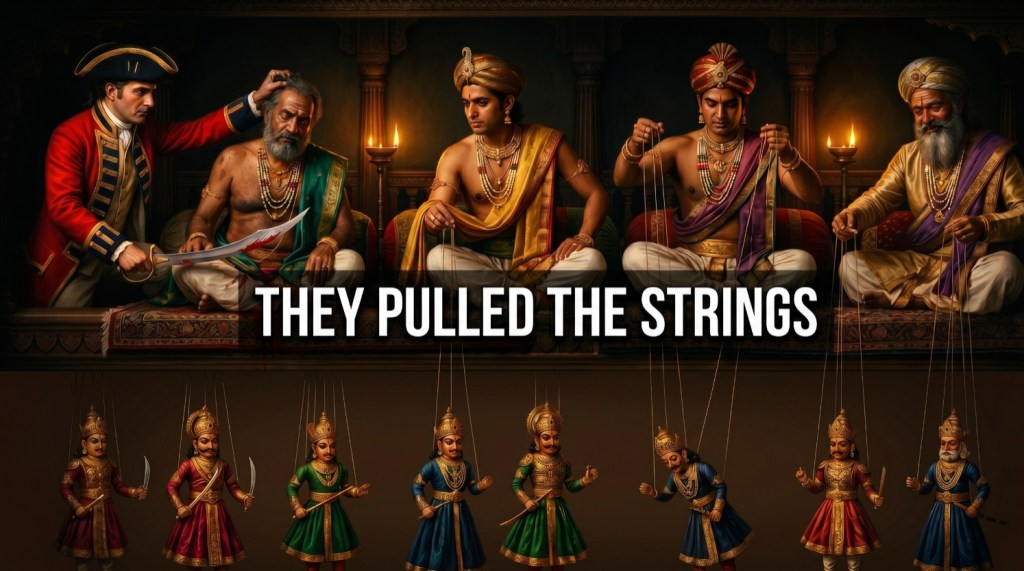
Five centuries before the East India Company appeared, Indian merchants were already running powerful multinational enterprises, complete with their own courts, banks, and armed fleets. The kings danced to their tunes. They dominated the sea lanes between India and Southeast Asia, and across the rest of the Indian Ocean.
Britain did not merely colonise India. It disrupted a thriving commercial civilisation, dismantling its trade, its industry, and its crafts.
A Jetty in Bharuch, and the Man Who Traded with the World
Although we can start at Indus Valley, for brevity’s sake, let us begin the story of India’s commercial civilisation at a jetty in Bharuch, on India’s western coast, around 300 CE. A merchant leader named Kanha stands by the water. Inside his warehouse are bales of impossibly fine fabric, sacks of pepper worth more than silver in Rome, and carnelian beads that no Mediterranean craftsman has managed to reproduce.
India was the shopping capital of the world, and Kanha had very little use for Roman goods, except for their gold and silver.
Kanha led a shreni. The Arthashastra describes shrenis as associations of people engaged in a common profession or trade, yet the mandate was far larger than that description suggests. The shreni fixed prices, regulated wages, enforced quality standards, and judged disputes, with its courts recognised by kings. It issued loans, held deposits, and sponsored temples that advertised its reputation. It operated across political borders, often with its own envoys and, when needed, its own armed contingents. Empires rose and fell around it, but the trade and the shreni continued to thrive.
Why Ashoka’s Empire Was Also a Trade Infrastructure Project
Let us go back a few centuries before Kanha’s time, to around 250 BCE. The Battle of Kalinga is over. Ashoka has issued his edicts and positioned himself as an apostle of peace. Across the empire, workers are cutting roads, digging wells, and building rest houses and medical centres. Historian Romila Thapar sees not merely compassion in this programme, but logistics.
Among the major beneficiaries of Ashoka’s infrastructure buildup were merchants and guilds. The king needed the trade taxes. The guilds needed his roads and rest houses. It was a bargain that neither side could afford to break.
Beyond their arrangement with kings, merchant guilds also appear to have been significant donors to Buddhist monasteries at Sanchi and elsewhere. Why? Because Buddhism offered merchants something that wealth alone could not buy: prestige.
There were also more practical reasons. Guild money built monasteries, which in turn supplied scribes, legitimacy, banking-type facilities, and secure halting points along dangerous trade routes. India’s Companies Act of 2013 made corporate social spending mandatory. What we now call corporate social responsibility was being practised by Indian guilds at least two millennia ago.
Invention of Endowment. And World’s First MBA-Type Programme
The Gupta age, beginning in the fourth century CE, did more than create wealth. It found ways to preserve and transmit it. Merchant guilds developed what scholars describe as perpetual endowments, in which wealth was set aside and the income from it funded temples, schools, pilgrims, and other public needs over long periods. This was being done more than a thousand years before the modern university endowment became famous.
As merchant wealth expanded, institutions such as Vallabhi, near present-day Bhavnagar in Gujarat, grew into major centres of learning for commerce. Imagine a Vallabhi professor, in 650 CE, describing the curriculum remarkable in its rigour and practicality.
“We teach Arthashastra, but we apply it to contemporary trade problems, such as three empires sharing the same harbour. We teach languages: Sanskrit, Brahmi, Sogdian, so that deals can be struck across kingdoms. We teach Ganita, commercial arithmetic: interest rates, profit margins, how to calculate returns when half your ships might never come back.”
That is risk pricing and risk management, formulated and taught centuries before Western education coined a word for the discipline. Students arrived from various parts of Asia. The training was practical, demanding, and focused on trade and commerce. If the ancient world had business schools, Vallabhi would have been the first and foremost. Today, most people have never heard its name.
The Five Hundred of Ayyavole: South India’s Original Multinational Corporation
Fast-forward to Tamil Nadu in the eleventh century CE, where a guild of merchants is having its charter re-inscribed in stone. This has happened dozens of times over three centuries, with the same charter carved at sites across South and Southeast Asia. The guild is the Ayyavole Ainurruvar, the Five Hundred of Ayyavole, and its network stretches from the Malabar Coast to Sri Lanka, Malaya, Sumatra, Java, and Cambodia. Its agents operate in Chinese ports, it flies the bull of Shiva as its emblem, and it maintains armed contingents known as the Three-Leaf Warriors.
Five centuries before the East India Company, South Indian merchant guilds were already operating multinational corporations.
When the Srivijayan Empire began disrupting trade through the Strait of Malacca, it appears to have been the final provocation for Chola King Rajendra Chola. The response was a naval strike, in conjuction with ships & resources of merchant guild. It was a naval attack unlike anything medieval Asia had seen.
The Srivijayan capital fell. The trade routes reopened. The merchant guilds emerged more powerful than ever. A 1088 inscription found in Barus (exporter of camphor, a very precious commodity) in Sumatra records the growing presence and influence of the Ainurruvar guild. Over time it became an umbrella structure incorporating other large multinational-type guilds, including the Manigramam and the Anjuvannam, the latter interestingly run by expatriates: Syrian Christian, Jewish, and Arab merchants who traded from Malabar.
India’s Stitched Ships Were an Engineering Marvel That Powered Its Commerce
Indian trade dominance was also fuelled by an extraordinary shipbuilding tradition. Imagine Neeli, a shipwright and one of five hundred shareholders in a maritime guild. Her guild specialised in building stitched ships, constructed without iron or nails. Each plank was drilled, packed with coconut fibre that swells in water, then stitched with coir rope. Resin seals the seams.
In a stitched ship, in case of impact, the hull flexes to disperse it. A nailed European hull, on the other hand, concentrates stress at every nail point, causing wood to split. Combined with Malabar teak, Indian ships were far more resilient, repairable, and long-lived, and their long working lives generated exceptional returns on investment.
When Marco Polo arrived in 1292, he saw giants: ships with hundreds of crew members, multiple decks, merchant cabins, and watertight compartments. Hulls stitched like cloth, built to bend rather than break. Polo said they were four times the size of European ships, with much longer working lives. Europeans called him a liar for decades.
India’s Robust Bank-Type Networks & Invention of the Letter of Credit
For a thriving trade, Indian merchants had exceptional access to capital and banking-type institutions. Monasteries first, and temples later, became more than places of worship: they functioned as vaults, lenders, and reservoirs of capital. The Arthashastra contains detailed provisions that modern readers would recognise as banking regulation, and Indian merchants also developed sophisticated financial instruments centuries ahead of their European counterparts.
The Yajnavalkya Smriti describes the adeshpatra, a promissory note that functioned much like a letter of credit. A merchant in Ujjain could issue an adeshpatra payable in Sopara, the great port north of present-day Mumbai. The system worked because both merchants belonged to the same guild network, and anyone who defaulted risked expulsion and commercial ruin. Long before Renaissance Italy, Indians were already using instruments that facilitated long-distance credit. From this tradition emerged the hundi, the financial instrument that powered Indian commerce for centuries.
The decline of Indian trading multinationals followed the decline of temple-based banking. When Portuguese intrusion disrupted trade, temple revenues fell, credit dried up, ships were not commissioned, and somewhere between 1600 and 1700, there was a last generation of master shipwrights who still knew the old methods.
‘The Banker of the World’ & The British Led Decline
Although risk capital for international commerce dried up, Indian financial systems continued producing banking giants for local needs in Surat, Bengal and elsewhere. None were more famous than the Jagat Seths of Bengal, whose title literally meant “Banker of the World.” By the 1750s, Robert Orme, the official historian of the East India Company, regarded them as possibly the greatest banking house in the known world. Jagat Seth Fatehchand financed nawabs, merchants, and European trading companies alike.
Then came the Battle of Plassey. Fatehchand backed Robert Clive against the Nawab of Bengal, believing he could shape the outcome and remain indispensable. He was wrong. Clive won. The Company took Bengal. Financial power became centralised under British control, and the Jagat Seths gradually faded from prominence.
Regulations favoured British agency houses, and traditional Indian financial practices were restricted or marginalised. By the nineteenth century, many of India’s great banking families had lost their former influence, and a steady weakening of traditional Indian financial institutions accompanied the broader disruption of industry and guilds by the British.
From Shrenis to Startups: The Ancient Playbook Modern India Is Rediscovering
India’s current rise is often presented as a fresh chapter in the nation’s history. In reality, it is the continuation of a much older story. The digital infrastructure and global supply chains of today would have been familiar in principle to the Ayyavole Ainurruvar. The technologies have changed. The logic has not.
For more than two thousand years, Indian merchants connected distant markets, moved capital across continents, and built networks that outlasted kingdoms. Empires rose and fell around them, but commerce endured. Colonial rule interrupted that tradition and weakened many institutions, yet it could not erase what centuries had embedded into the civilisational fabric.
What are the lessons for today’s India?
The first is that scale and structure belong together. Indian guilds combined commercial ambition with institutional discipline. They fixed prices, regulated quality, resolved disputes, and extended credit within frameworks that all participants trusted. India’s modern corporations would do well to remember that governance is not a compliance exercise; it is what makes long-term scale possible.
The second is that knowledge and commerce go together. Vallabhi taught risk pricing and multilingual negotiation because its professors understood that the most durable competitive advantage is a trained mind. India’s investment in education as a strategic asset, from IITs to business schools, follows a civilisational logic that is far older than we often acknowledge.
The third is that networks precede empires. The Ainurruvar did not wait for a unified Indian state to expand across Southeast Asia. They built trust-based networks, enforced by shared codes of conduct and reputational risk, and those networks outlasted the political entities around them. In an age of digital platforms and global Indian diaspora, that architecture is available again.
The fourth is that financial inclusion is not a modern invention. Guild banking, temple lending, the hundi, and the adeshpatra created credit access for merchants who would otherwise have been excluded from long-distance trade. Every fintech founder trying to solve credit access in India today is, knowingly or not, working within a civilisational tradition.
As Indian multinational companies expand across the world once again, their most valuable lessons may already have been learned, a thousand years ago, by the merchants of Ayyavole.
The article is an excerpt from my podcast – India’s Golden Age. Available on YouTube, Spotify, Apple Podcasts and other Podcasting Platforms.


Leave a Reply