
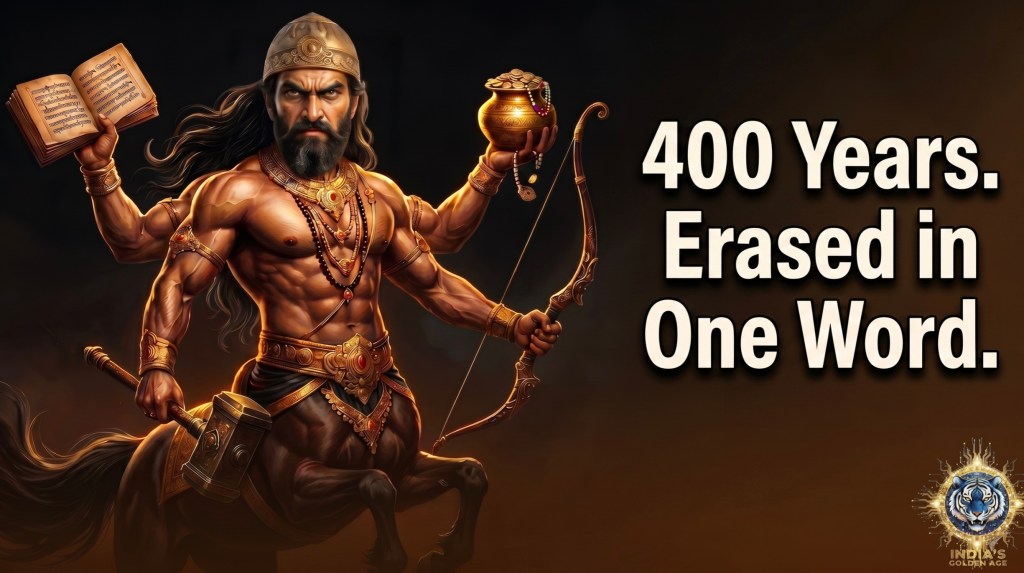
The scholars of the Gangetic heartland called the Sakas mleccha: barbarians, outsiders, people who did not belong. History tells us that they were anything but. For nearly four hundred years, one branch of these so-called mlecchas ruled Gujarat and Malwa. The Western Sakas, also known as the Western Kshatrapas, held power longer than the Mauryas and longer than many dynasties still celebrated in textbooks today.
From the Steppe to the Subcontinent: How Nomads Became Nation-Builders
Picture the Eurasian steppe: grass without end, sky without shelter, no walls or cities, a flat/boring horizon. The Sakas started out in that world, and then they began moving around. Raised on horseback, trained from childhood in the art of mounted warfare, their signature weapon was the composite bow, crafted from wood, horn, and sinew. In skilled hands it was devastating weapon, as a Saka rider could fire accurately at full gallop, feign retreat, then turn in the saddle and strike before his enemy could react.
When one branch of them entered western India, they found something the steppe, and the lands they inhabited after that, could never offer: bustling cities and ports, thriving commerce, and Roman wealth flowing into Bharuch and Ujjain. They could have taken what they wanted and moved on. Instead, they stayed, and that choice would leave its mark on ancient India in more ways than we can easily imagine.
Why No One Could Dislodge Them: The Geography That Made the Sakas Unbeatable
To understand the longevity of Western Saka/Kshtrapa rule in western & central India, one must understand why they proved so difficult to remove. The Malwa Plateau was a natural fortress. Ancient lava flows had created a rugged landscape of mesas, ridges, and black cotton soil that, when the monsoon arrived, became a lethal trap. In that terrain enemy carts sank, supplies stalled. Even the feared war elephants of the Gangetic kingdoms lost their advantage entirely.
Besides any force advancing from the Gangetic plains had to fight its way through the tricky Vindhya passes, where the Sakas easily ambushed them. They knew every ridge, every waterhole, every forest. Besides being natural horsemen, they had a speed & agility advantage, which favoured their hit & run tactics. If attacked with overwhelming force, they quickly withdrew deeper into terrain that favoured them. If besieged, they relied on wealth flowing from the western ports. The Sakas understood, with uncommon clarity, that geography is not just a defensive asset but a lethal weapon in its own right.
The Ancient Singapore: How the Sakas Built One of the World’s Great Trade Empires
Around 70 CE, a Greek merchant compiled the Periplus of the Erythraean Sea. When he described Barygaza, modern Bharuch, he was describing one of the great commercial hubs of the ancient world, a port city that functioned like a modern Singapore. Historians estimate that over a hundred Roman and other ships docked at Bharuch every year, buying cotton, ivory, teak, indigo, and pepper.
The Sakas were the facilitators of all of it. They controlled the roads, the ports, and trading hubs like Bharuch and Ujjain, and goods were traded inland through Saka territory via the great Southern Road, the Dakshinapatha. The wealth generated was immense, and the Sakas invested it wisely. They issued high-quality silver coinage, carefully dated in Brahmi script and maintained to a remarkably consistent standard. While other rulers struggled to maintain confidence in their currency, Saka silver became possibly the most trusted currency in the subcontinent, and that may have been their single greatest institutional achievement.
The Barbarian Who Mastered Sanskrit: Rudradaman I and the Birth of Classical Prose
Around 150 CE, a Saka king named Rudradaman I commissioned what is often considered the first great prose inscription in classical Sanskrit: the Junagadh inscription. The scholar Richard Salomon has described it as a turning point in the history of epigraphic Sanskrit, a prototype for the royal inscriptions that followed across the subcontinent for centuries.
Consider the irony: a mleccha king, a steppe warrior descended from nomads, became one of the earliest masters of Sanskrit political expression. And what does the inscription describe? Not a military victory, but the restoration of the Sudarsana reservoir after a catastrophic storm. The king explicitly promises that the work will be carried out without new taxes and without forced labour. Rudradaman, the outsider, had understood something profound: that lasting authority for an Indian king came not only from victory, but from genuine service to the people he governed.
Before Ajanta, There Was Devnimori: The Forgotten Artistic Legacy of the Western Sakas
There was once a place in northern Gujarat called Devnimori. Since 1965, it has slept beneath the Shamlaji reservoir. Fortunately, archaeologists reached the site before the flooding, and what they discovered was remarkable: a Buddhist monastery and stupa built under Western Saka patronage, with one inscription naming the Saka ruler Rudrasena as a patron of the complex.
Beyond the relics and artefacts, the monastery had sculptures. Faces of the Buddha shaped by two worlds at once, Gandharan influences from the northwest blending with local western Indian traditions to create something entirely new, an artistic language that may later be seen at Ajanta and in Gupta-period sculpture. The Guptas inherited more than territory and a thriving trading network from the Western Sakas. They inherited artistic traditions as well.
The Queen Who Refused: Dhruvadevi, Defiance, and the Moment That Changed an Empire
Now consider a woman whose story may be directly connected to the end of four centuries of Saka dominance in western India. The Gupta king Ramagupta found himself trapped by a Saka army, surrounded with no clear path to victory. The terms offered by the Saka king Rudrasimha were extraordinary: hand over Gupta Queen Dhruvadevi. And according to the historical account, Ramagupta agreed.
A Sanskrit play was later written about this episode, not because the mighty Gupta king was humbled by a Saka, but because a queen refused to be traded like property. Dhruvadevi turned disgrace into defiance, and what came next changed the fate of empires. Chandragupta II, her brother-in-law and later her husband, began the long campaign that finally ended Western Satrap rule. Even after securing an alliance with the powerful Vakatakas through the marriage of his daughter Prabhavatigupta, and fighting on multiple fronts, the Sakas held out for more than a decade, possibly two.
The Enemy They Could Not Erase: How the Guptas Built Their Golden Age on Saka Foundations
The coins tell the rest of the story Saka-Gupta coin with quiet precision. Western Saka/Kshtrapa silver coins disappear around 388 CE, and Gupta silver coinage appears soon afterwards. The resemblance between the two is striking: the same weight standard, similar portraits, familiar forms. The Guptas had not discarded the Saka system. They had adopted it wholesale.
The pattern appears everywhere you look. Bharuch remained vital. Ujjain continued to flourish. Trade flowed on. Guilds endured. Maritime commerce continued to enrich the treasury. Chandragupta called himself Sakari, the enemy of the Sakas, yet the empire he built carried Saka fingerprints at every level of its organisation. The Guptas deserve every bit of their reputation for cultural and intellectual achievement, but great civilisations rarely emerge from nothing. They are built upon foundations laid by those who came before, and among the foundations of the Gupta Golden Age were unmistakably the Sakas.
Three Empires, One Rock: The Stone at Junagadh That Holds India’s Civilisational Memory
If you ever visit Junagadh, stand before the great rock at the foot of Girnar hill, because it tells a story no textbook can. The rock carries three inscriptions: Ashoka in the third century BCE writing in Prakrit, Rudradaman in 150 CE writing one of the earliest great prose inscriptions in classical Sanskrit, and Skandagupta in the fifth century CE celebrating Gupta power at its height.
What makes this extraordinary is the connection between them. Skandagupta records the repair of a dam first restored by Rudradaman three centuries earlier, and the structure was still standing, still serving the people who depended on it. Three empires share that stone: the Mauryas, the Sakas, the Guptas. It is perhaps the most compressed civilisational statement in all of Indian history.
The Sakas disappeared as a political power, but many of the systems they helped develop continued under their successors. The Saka Era, founded in 78 CE, was adopted by the Republic of India as its official national calendar. For a people once dismissed as mlecchas, their measure of time still accompanies every official date issued by the Indian state. We are still counting time in their rhythm, whether we acknowledge it or not.
What the Sakas Teach Today’s India: On Outsiders, Institutions, and the Long Game of Civilisation
The story of the Western Sakas carries lessons that resonate far beyond the ancient world, and today’s India would do well to sit with them carefully.
The first lesson is about institutional continuity. The Sakas built systems, including currency standards, trade infrastructure, and reservoir networks, that survived their own political extinction. In an era where Indian institutions are frequently remade with each change of government, the Saka model of building for permanence rather than for the incumbent deserves serious reflection.
The second lesson is about the relationship between identity and contribution. The Sakas were perpetual outsiders in the eyes of the Sanskrit-educated elite, yet they produced the first great Sanskrit prose inscription, patronised Buddhist art, and maintained a trading system that enriched the entire subcontinent.
The third lesson is about the nature of legacy. Chandragupta II called himself Sakari and spent decades dismantling Saka political power, yet quite a few major systems of the Gupta Golden Age rested on Saka foundations. The lesson for today’s India, which is engaged in its own project of civilisational recovery and reframing, is that genuine cultural confidence does not require the erasure of inconvenient predecessors. It requires the honest accounting of all the hands that built what we have inherited.
The Sakas were not merely conquerors passing through. They were builders whose work outlived them, whose artistic traditions seeded Ajanta, whose silver coinage became the template for Gupta currency, and whose measure of time the Indian Republic still uses today. India has always been most generative when it has absorbed rather than excluded, and the Saka story is among the clearest proofs of that.
The article is an excerpt from my podcast – India’s Golden Age. Available on YouTube, Spotify, Apple Podcasts and other Podcasting Platforms.


Leave a Reply