
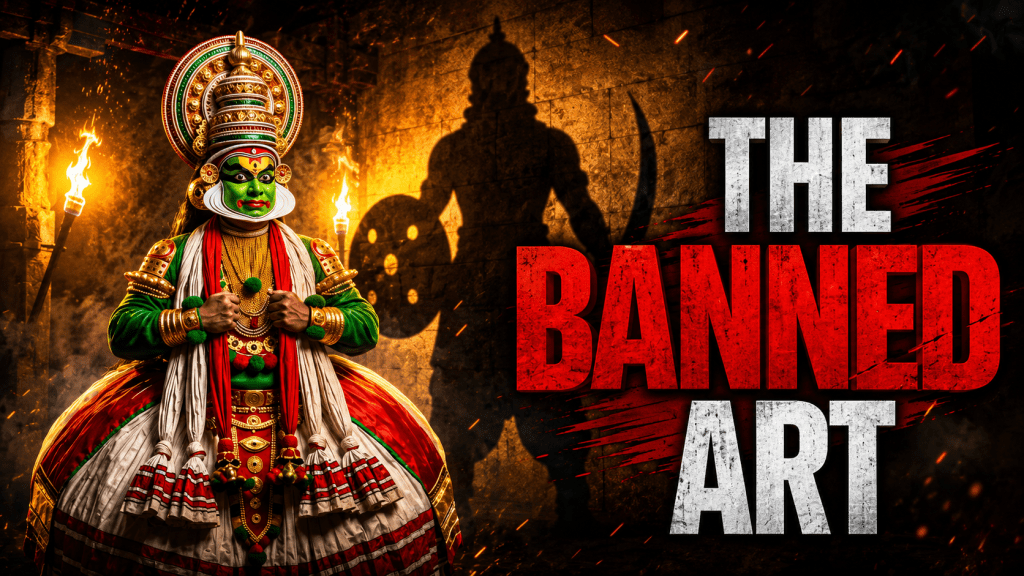
What if the oldest martial art in India was also the world’s most influential? This piece focuses on Kalaripayattu, a tradition at least a thousand years old from Kerala that shaped combat, philosophy, and possibly even Kung Fu. From guerrilla warriors who resisted the British Empire to an eighty-year-old woman still teaching today, this is a story about the art of fighting and the discipline of living.
Kalari -The Sacred Space Where Warriors Were Made
From the eleventh to the eighteenth century, Kerala’s villages shared one structure almost as sacred as the temple itself. Built low into the red earth, it was never meant to tower over the land. You stepped down into it, leaving the ordinary world behind.
In the south-west corner burned a seven-tiered lamp for Bhadrakali, fierce and watchful. Students lined up and bowed first to the earth, then to the goddess, and finally to the gurukkal. The order mattered, because it carried a message: you come from the earth, you answer to something greater than yourself, and you respect the teacher who carried the knowledge before you.
The gurukkal in Kalari was both teacher and physician. He taught the 108 marmam points of the human body, points that could end a fight in seconds or restore a broken man with the right touch. Training covered four core disciplines: physical conditioning, wooden weapon training, metal weapon training, and finally hand-to-hand combat targeting vital pressure points to disarm attackers without a weapon.
According to legend, Parashurama himself learnt Kalaripayattu from Shiva and taught it to the original settlers of Kerala. It became among the most important pillars of feudal Keralite society, imparting military training and Spartan-like discipline to the youth.
Honour Before Victory: The Forgotten Code of the Chekavar
In medieval Kerala, when village assemblies failed to settle a dispute, both sides appointed a Chekavar, a trained champion who often spent years preparing for a single duel. The fight unfolded before the community itself, governed by a code: no strike after surrender, no attack from behind, and no victory without honour.
Indian martial traditions were debating the ethics of warfare millennia before modern international law formalised such principles. The Dhanurveda, written at least two thousand years ago, is remarkable not merely for its understanding of combat but of restraint: surrendered enemies are not to be killed, civilians cannot be targeted, and war begins at sunrise and ends at sunset. The moral boundaries of violence were already being drawn on the subcontinent long before Europe thought to ask the question.
Unniyarcha and the Six Feet of Steel
The martial art was taught across classes, creed and gender. Some of the women practitioners became the stuff of legends.
In seventeenth-century Kerala, Unniyarcha stood in a marketplace when hostile Jonaka raiders closed in. The bazaar had fallen unnaturally silent.
Behind her, her husband Kunhiraman whispered in panic: “We can settle this peacefully. Give them money and let us leave before something happens.”
She turned slowly toward him and replied: “I come from the Puthooram house. We do not bow before thieves. Stay back.”
By then the urumi was already in her hand, six feet of flexible steel sliding free from her waist like a drawn serpent. She moved, the blade went wide, then back, then wide again, and most of the men were down before the crowd exhaled. This is not mythology. The Vadakkan Pattukal preserved stories like this in remarkable detail, in the ballads of Malabar.
The Indian Monk Who May Have Invented Kung Fu
Around 527 CE, a man arrived in China, from India, who became a legend: Bodhidharma. He was likely a Pallava prince from Kanchipuram, born into a warrior household and trained in combat from childhood. He then renounced power, became a monk, and sailed for China, carrying nothing but a long South Indian staff and years of physical discipline.
At Shaolin, legend says, he found monks physically weakened from endless study. He disappeared into a cave for nine years before emerging to teach movement, breath control, and combat drills. Popular mythology credits him with inventing Kung Fu. History leaves adequate clues. A stone stele from Shaolin dated 728 CE records staff-wielding monks in Tang military campaigns, and inside the Shaolin complex, frescoes depict darker-skinned monks teaching Chinese students, with striking visual parallels between certain Kung Fu forms and Indian mudras, and between Chinese pressure-point systems and the marmam traditions of South India.
When Kalaripayattu Became a National Security Threat to the British
By 1793, Malabar was under East India Company control on paper but in the forests it belonged to Pazhassi Raja, whose guerrilla fighters were masters of Kalaripayattu. In the forests of Wayanad and Malabar, they moved faster than British infantry could track, attacked suddenly, signalled in the dark, disappeared into the hills, and emerged somewhere entirely unexpected.
British officers wrote home with open frustration and reluctant admiration, among them a young Colonel Arthur Wellesley, decades before Waterloo made him famous: “These men know every hill, every stream. Every village is like a barracks.”
For twelve years, Pazhassi Raja bled the Company dry. When he was finally killed in 1805, the British understood that more than the man, the martial tradition behind him was a graver threat. Kalaris were immediately suppressed, gurukkals vanished into hiding, and through the Indian Arms Act of 1878, Indians were disarmed by law while Europeans remained exempt. Weapons of the martial art like the urumi and the kattari became illegal to own. Communities maintaining martial traditions across dozens of generations risked being branded as criminals.
Snake Clearings, Kathakali and Temples: Where Kalaripayattu Went Underground
In Kerala, though the weapons were seized, yet the martial art survived. Kicks were practised in silence, grapples disguised as exercise, and animal forms folded into Kathakali performances where British officials saw only ritual and theatre.
One of gurukkal may have told his students: “What you are learning appears to be prayer. Good. Let the British think that. But understand properly. This is war also.”
Students trained in snake-infested clearings, in moonlit courtyards behind high mud walls, fully aware that discovery could mean imprisonment. Some kalaris relocated quietly into temple compounds, since British officers hesitated to raid temples openly, creating a fragile zone of safety.
Meenakshi Amma: The Living Proof That Knowledge Cannot Be Colonised
During the 1920s in Thalassery, Kalaripayattu re-emerged from hiding, fuelled by the spirit of Indian nationalism. It had grown into something beyond a martial art, becoming a form of defiance in itself. Training of the four core skills restarted in full earnest.
When colonial history tried to push women out of the martial tradition, Meenakshi Amma became its quietest and most devastating rebuttal. Today she is in her eighties, a recipient of the Padma Shri, having trained since the age of seven and spent more than seventy years teaching Kalaripayattu. Her life carries a message that weapons can be seized and schools can be closed, yet the ancient knowledge passed down through generations of practice, is far harder to destroy.
Finally
Modern combat sports are a global multi-billion-dollar phenomenon that ask one question above all else: can you win? Ancient India asked a different question first. Are you worthy of the power you carry?
The article is an excerpt from my podcast – India’s Golden Age. Available on YouTube, Spotify, Apple Podcasts and other Podcasting Platforms.


Leave a Reply