
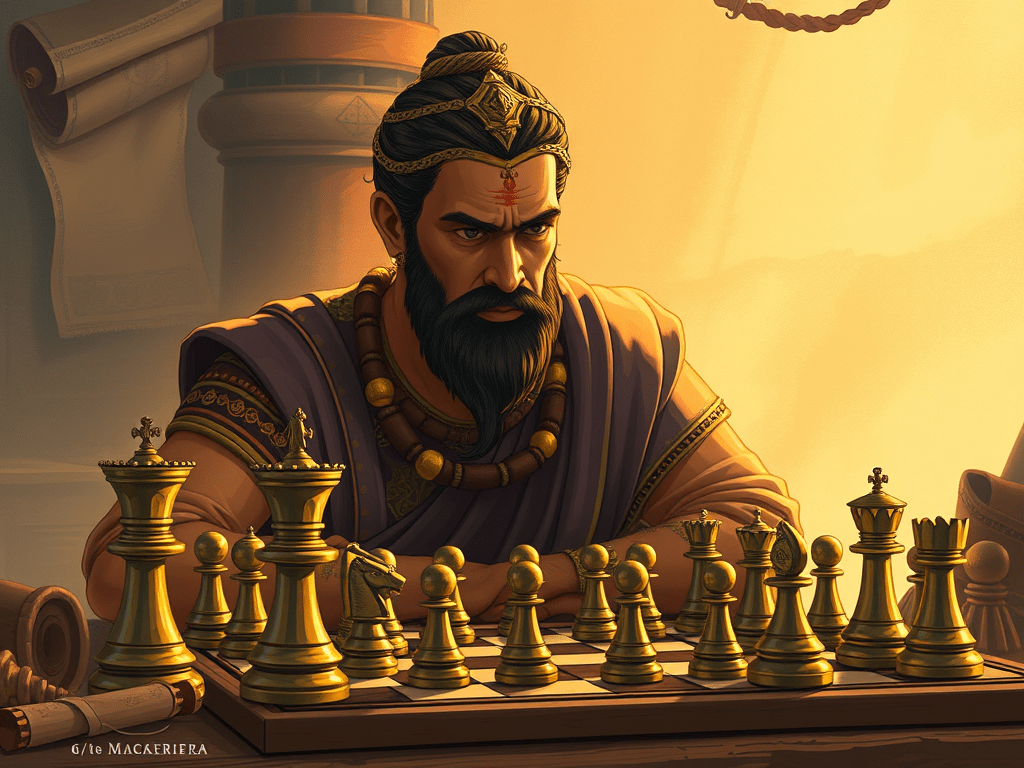
May 11, 1997. Chess genius Garry Kasparov faces supercomputer Deep Blue across the board. After nineteen moves, Garry raises his hands in frustration and steps away. A machine has beaten one of the greatest minds in chess. The world of chess will never be the same again.
Cut to September 2007. Mexico City. Viswanathan Anand becomes World Champion, dethroning the reigning champion Vladimir Kramnik. When Indian Grandmaster Anand holds the trophy, a circle fifteen centuries wide finally closes. The game has come home, to its birthplace, India.
The Birth of Strategic Thinking
India, 6th Century CE. A Gupta General studies the Chaturanga board the way he once studied enemy lines of Huns. He moves a piece and says: “The gaja lumbers, yet one misstep, and the ashva leaps to doom. This game is the chaos of war, trapped on a board.”
Later in the day, an imaginary court noble, let’s call him Vikrama, looks at the board. He observes: “Except for the chariot, it reflects the battlefield of today.” It is unlike other board games we play. The pieces are distinct, with each piece having different moves and rules.
Chaturanga was truly the world’s first metaverse, its original video game. It was the earliest simulation of war, a structured world of decisions and consequences. Strategic thinking had long been the spine of ancient Indian statecraft.
So how ancient was Chaturanga? A 2400 BCE grid from Lothal sits in a museum. No pieces. No inscriptions. Some claim it’s proof that the game is 4,000 years old. But others dismiss it as backgammon’s ancestor. However, it is possible that the game was played in some form before the Gupta Golden Age. The reference of the Caturanga word comes in the Mahabharata. The presence of chariots in Chaturanga suggests the game originated earlier than the Gupta golden age. Chariot warfare had disappeared by the Gupta era.
The Persian Challenge
Cut to a couple of decades later. It’s mid-sixth century. Vikrama, now an envoy of the Gupta king, enters Ctesiphon, capital of the Sasanian Empire. King Khosrow I presides over a court famous for its wise men. Vikrama sets Chaturanga in front of the Persian King. He says: “If you claim to be King of Kings, your court should be wise enough to understand this game.”
Later in a private meeting, Vikrama places the Chaturanga board before the Persian King. This is for the wiseman Wuzurgmihr to study every piece. Vikrama raises the stakes and says: “If your wise man Wuzurgmihr can deduce the rules we’ll pay tribute. If not, you pay us.”
A risky dare, indeed. King Khosrow thinks. The stakes rest on sixty-four squares. Wuzurgmihr solves the riddle overnight and even creates a second game to challenge the Indians. Perhaps the tale is Persian propaganda. However, no one can deny that Chaturanga or ancient chess was the IQ test of the ancient world.
The Persians renamed the game Shatranj, the Persian twist on Chaturanga. In Persia the king was called the Shah. When trapped, players said, “Shah Mat,” meaning the king is helpless. Not dead. Helpless. Chess was about trapping an enemy, not killing him. As the game moved west, Shah Mat slowly became Checkmate. With each new region, the game evolved, taking on local ideas.
The Islamic Transformation
Cut to 651 CE. Arab armies overrun Persia and the Sassanian Empire collapses. In the Arab Caliph’s court a cleric steps forward. “Is chess gambling?” the cleric asks. “It is not,” the Caliph, of Arabian Nights fame, replies. “There is no dice, no betting, no luck involved. Just logic and skill.” The caliph declares the game a mandatory pursuit at court.
Some time later, another cleric reminds the Caliph, “Islamic law forbids carvings of living creatures.” The Caliph summons the artisan woman, let’s call her Zaynab. “Indeed. Call Zaynab,” the Caliph says. Once she appears in the court, the Caliph instructs Zaynab: “Make the pieces functional, minimalist. No designs, no ornaments, nothing fancy.”
In Baghdad’s souks, Zaynab reshapes the pieces. She carves cylinders and clean forms, removing faces and bodies. She strips away likeness until only meaning remains. The Indian chariot becomes the geometric Rukh. The Islamic redesign makes chess portable, accessible, universal.
Soon the Arabs turn chess into science. In 850 CE al-Adli writes the first chess manual, a work dense with openings, endgames, and blindfold play.
Europe Discovers Chess
By 1000 CE chess pushes into Christian Europe with Moorish scholars, Viking merchants, and Crusader armies. Europeans examine the stark Islamic pieces and try to make sense of them. The elephant becomes the bishop because the notch looks like a mitre. The slit is really a pair of tusks.
In France the notch becomes a jester’s hat. In Mongolia it becomes a camel. Each culture rewrites the board. Most pieces change except for the Ashva, the horse. Knight is the great survivor. Its unique, non-linear jump is so distinctive that it resisted reinterpretation. A horse is a horse, whether in India or Spain.
In 1254, King Louis IX banned chess. He called it “a useless and boring game.” Priests condemned it. The Church warned against its “corrupting influence.” But everyone keeps playing. Royal courts. Markets. Troop camps. Bars. Bets escalated. Knives came out. Even monks succumb to the game. One monk creates a folding chessboard to hide the game inside a book.
Back in India the Mughals kept the game alive. Akbar orders giant chessboards at Fatehpur Sikri and plays with real people as pieces. A Persian diplomat was forced to bray like an ass after losing a chess match in Emperor Jehangir’s court. The game had travelled far, but India had never been far from it.
The Mad Queen Revolution
Meanwhile the Mediterranean sun scorches fifteenth-century Europe, a continent fascinated by powerful women and queens. In a court chamber an imaginary queen stares at the board. She says to a nobleman: “The counsellor ‘Vizier’ moves one square at a time. It’s too slow.” She drags the piece across the diagonal. Swoosh. The board wakes up. A slow game turns lethal. The counsellor becomes the Queen, fast and ruthless.
The result is Mad Queen Chess. The elephant turns into the bishop and gains range. Pawn promotion, castling, and new openings make play faster and sharper. Games that took hours now could potentially end in a few moves. The “Mad Queen Chess” spreads like wildfire. The Queen becomes the most powerful piece ever carved and helps keep the game alive.
Chess Travels East
While Arabs and Europeans reinvented the game, monks and Indian merchants carried chess east. In China it took the form of Xiangqi, a board split by a river representing the Yellow River. Pieces were placed on intersections, and the movement followed the lines. Japan developed shogi, where captured pieces could fight for the other side, a mirror of samurai loyalties.
Multiple chess traditions emerged, diverging like biological species in different ecosystems. The Indian game proved sturdy enough to change without losing its identity.
The Modern Era Begins
Cut back to Renaissance Europe. The printing press transforms chess. William Caxton’s The Game and Playe of the Chesse becomes the second book ever printed in English. In 1770, Hungarian inventor Wolfgang von Kempelen unveiled the Mechanical Turk. It was an “automatic” chess-playing machine that stunned Europe. It beat most challengers, including Napoleon Bonaparte and Benjamin Franklin.
The truth, of course, was a brilliant hoax: a hidden human chess master controlled the machine using magnets. Yet despite the deception, the Mechanical Turk popularised chess and became a symbolic precursor to real chess machines—and eventually, computers. By 1849 Nathaniel Cook’s chess design became the standard, thanks to Howard Staunton’s endorsement. The Staunton Set sweeps the world.
Across the seas in British India, English officers in Calcutta and Bombay played chess in smoky clubs. They taught it to the natives, believing it to be entirely a European invention. A film by Satyajit Ray, Shatranj Ke Khiladi, explores this world of Indian chess in the British era quite remarkably.
The Truth Emerges
In 1913 H. J. R. Murray publishes a massive study, drawn from Sanskrit texts, Arabic manuscripts, and European sources. His finding is blunt. India invented chess, he proves. His work is foundational. Scholars still rely on his work today.
Sixteen years later, in 1929, a young man Sultan Khan arrives in England from Punjab. He waits in the corner of a London club, watching the sahibs play, nervous, unable to speak English. But when he sits at the board, everything changes. He becomes a different man. Within months this “native” beats the strongest players in the Empire, winning the British Championship three times in four attempts.
The irony cuts deep. A colonised man proving mastery in a game born on his own soil. After 5 years Sultan Khan returns to India with his master. He disappears into obscurity almost as suddenly as he rose.
The Legend of Exponential Growth
The most famous story tied to chess is the legend of Sissa. The sage, according to the story, created the game to teach humility to a king. When the king asked what reward he wanted, Sissa said, “Place one grain of rice on the first square. Then double it on each subsequent square.” The king agreed without thinking. By the time he reached the sixty-fourth square, the king owed eighteen quintillion grains of rice. This amount was enough rice to bury India forty feet deep.
Ancient India understood exponential growth long before Wall Street. Chess was strategy and wisdom in a single design.
Five Lessons from Chess for Modern India
Lesson 1: Soft power grows through engagement, not propaganda. In the long run soft power grows through interest and engagement, not pressure or propaganda. Chess spread because it was richer and more engaging than other games.
Lesson 2: Transformation requires risk. An ageing Vikrama sits with a bunch of students. He taps the pawn and says: “The pawn moves through danger. It takes one step at a time. It is vulnerable to every piece on the board.” A student adds, “And everything changes when it reaches the other side?” Vikrama nods and says: “Pawn is the only piece that can transform.”
The message is simple. Transformation is real, but only for those who survive the journey. Every Indian founder, refugee, and first-generation achiever knows this truth. You are a pawn until you are not.
Lesson 3: Protect the periphery or the centre falls. Chess hides a blunt truth. The queen and the other pieces may guard the king. However, if the centre fails to protect the periphery, the periphery stops protecting the centre. Waste your pawns and the kingdom dies. Systems endure only when power flows outward and returns inward.
Lesson 4: Tradition lives when it evolves. Chess also shows the value of change. Someone altered the rules, turning the slow minister into the powerful queen. The game improved. India built chess, but its open architecture allowed it to grow. Tradition lives when it evolves. A global India is a stronger India.
Lesson 5: Embrace the modern whilst honouring the ancient. Vishwanathan Anand’s triumph in 2007 was not a return to India’s past. He won because he embraced the modern game. Computer preparation. Rapid events. European openings. Russian endgames. Modern engines guided his preparation. Yet, intuition, adaptability, and mental strength governed his play. These values are rooted in ancient Indian wisdom and Chaturanga. He is now the godfather of India’s chess boom.
The Future of Chess
Today any decent mobile app can defeat a grandmaster. On an online platform a teenager in Mumbai can play a grandmaster in Moscow. And in 2024, an Indian, Gukesh Dommaraju, became the youngest undisputed world champion at just eighteen years of age. Vikrama would have celebrated the achievement.
Every chess game is a new game. There are more possible chess games than atoms in the universe. Mathematicians call this the Shannon Number: 10 to the power of 120. The universe has far fewer atoms. Grandmaster Karpov called chess an enchanting mix of art, science, and sport.
Now, let’s go back to the beginning. Kasparov’s battle with Deep Blue marked the start of a new age. Intelligence moves forward. Human or machine, they both keep evolving. So does chess. Remember Persian King Khosrow’s words. Shahmat, or Checkmate, means “One more game.”
The podcast is also available on Spotify, Apple Podcasts, Amazon Music & other podcasting platforms.
 Sarvajeet D Chandra
Leave a comment