
28 April 1819. Captain John Smith of the British Madras Cavalry is out hunting tigers. He is also trying to escape boredom. They are moving through thick jungle near Chhatrapati Sambhaji Nagar, in Maharashtra, Western India. The tiger the hunting party were tracking disappears. Thereafter, a local shepherd directs them to mysterious “stone houses” hidden in the gorge.
Smith and his hunting party push through the thick jungle, cursing the heat. Then the jungle steps aside and the cliff appears. And then he sees the mysterious houses. Dark mouths in the cliff face. Ancient caves. Watching. Waiting.
Smith pushes aside creepers and notices a proper portico cut into hard rock. Smith knows at once that this is no accident of nature. This was built. And forgotten. A thousand years of silence breaks in a moment. Ajanta had waited centuries to be seen again.
The Audacious Beginning
It is late 2nd century BCE. The Satavahana dynasty rules the Deccan, controlling key trade routes from North India to the Arabian Sea. Buddhist monks gather near the Satavahana capital, Pratishthana (modern-day Paithan). They assemble in a horseshoe gorge carved by the Waghora River.
Before them rises a hundred-foot wall of volcanic basalt, formed millions of years earlier. The head monk breaks the silence. “Yes. This is where we build our monastery. Not on the rock. In it.”
The other monks look at him with surprise. The head monk is not naive. He knows this will take decades, maybe centuries. He knows he’ll never see it finished in his lifetime. This would require a huge community effort to pull it off. But the head monk goes ahead anyway.
During the Satavahana era, 2nd century BCE to 1st century CE, a small number of caves were carved. These caves were marked by stupas and symbolic forms typical of early Hinayana Buddhism. Then the chisels fall silent for centuries. At least three centuries. Buddhist pilgrims continued to visit.
In the 5th century, the Vakatakas become a dominant power in the region. They were aligned with the Guptas and benefited from trade wealth. They restart the Ajanta cave project, the activity peaking under Vakataka King Harishena, who ruled during the late fifth century.
Engineering the Impossible
The team of skilled Buddhist monks and artisans would start at the top. They would carve down to make a typical cave. Falling stone would ruin anything built below. By carving the ceiling first, they effectively sculpt the structure in reverse.
There were no blueprints, no written plans, only shared knowledge passed across generations. Some caves were simple places to live, Viharas. Others were prayer halls, Chaityas, with vaulted ceilings and stupas.
One cave, number 26, extends nearly one hundred feet into solid rock. Many caves were excavated with oil lamps and reflected light. One wrong cut and the ceiling gives way. One error could mean collapse. That the monks succeeded is the real mystery.
The Paintings That Defied Time
The engineering was remarkable but the reason the Ajanta caves become world famous was for the paintings. Around half a dozen pigments were used, all mineral based, bound with animal glue. On this limited palette, the artists achieved extraordinary depth.
The paintings were supervised by old monks, cut off from the world. These elders set the themes executed by guild artisans. At first glance, their choices seem surprising. Who would imagine such men approving portrayals of women marked by tenderness and sensual grace.
It is possible the elders drew not from observation but from memory. And from longing. The elders instructed the artisans to paint what they themselves could not speak of. Images carried in secret, that still haunted them in meditation.
Women at the Centre
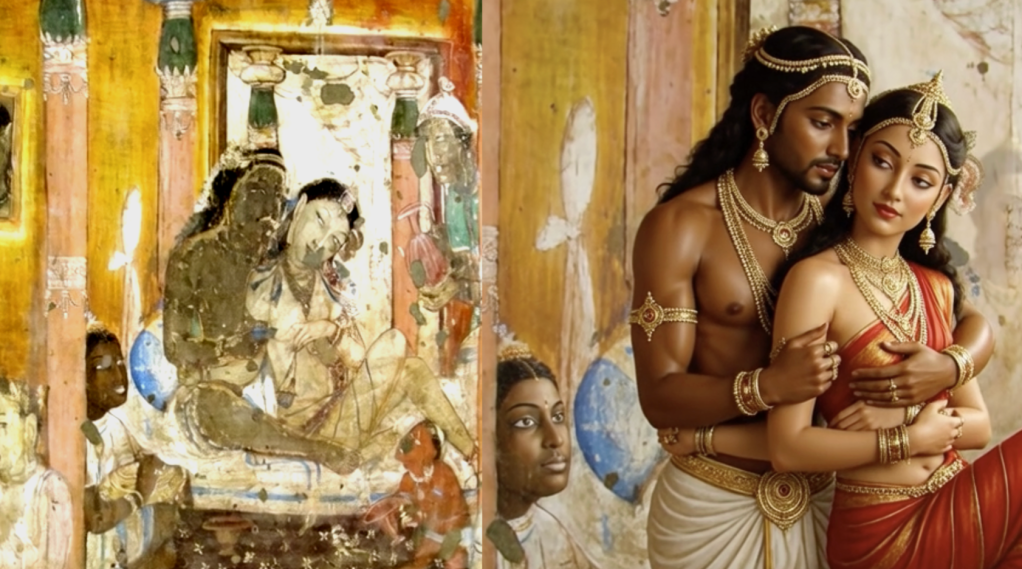
Talking of women, well they fill the walls at Ajanta. Apsaras dance. Queens move with intent. Courtesans seduce. Mothers nurse. Their poses are deliberate. Their jewellery detailed. Their expressions knowing. Sensual, yes. But never passive.
There is a painting of the woman looking in the mirror. She advances the narrative. In another painting, a queen grabs her husband’s robe as he walks away renouncing his kingdom. His calm face shows he has already left her world. The feeling still lands, after 1,500 years.
The old monks who commissioned these paintings did not pretend that women were invisible. Women were given agency, interiority and voice. The celibate monks understood something timeless. You cannot tell a human story without women at its centre.
Stories That Teach
The walls speak in parables. They depict the Jataka Tales, the Buddha’s previous lives, each life centred on sacrifice. In one life, he’s a prince who gives away his kingdom. In another, he’s an elephant who offers his tusks to a hunter.
In another, he’s a hare who throws himself into a fire to feed a starving Brahmin. Every story asks the same question: What would you sacrifice for others? What is the price of compassion?
These caves were not museums. The monks designed the caves to instruct, not impress. Every panel teaches. Walk in and the walls begin to talk. Pilgrims of every class learnt by a walk-through.
The paintings fulfilled their spiritual purpose, but their achievement went further. In artistic excellence, what remains stands confidently alongside anything sculpted or painted in Athens or Florence.
The Artist’s Legacy
Let’s imagine a painter Madhava. It is late fifth century. Madhava works high on bamboo scaffolding in Cave 1. Dust fills his lungs. Light reaches him only through a mirror held by an apprentice.
Today he gives Bodhisattva Padmapani, the lotus bearer, his eyes. Half-closed, introspective, infinitely compassionate. You feel judged and forgiven at once.
The supervising monk studies Madhava’s work and says, “Padmapani is luminous, peaceful, divine.” Then the monk meets the Bodhisattva’s eyes and says, “I feel the quiet fatigue of compassion. Over lifetimes.”
The monk murmurs, in deep appreciation, “Great work of art. Sadhu.” The rare word ‘Sadhu’ means everything to Madhava. It fills him with childlike joy. He playfully points out, “Watch his eye. Walk past. He seems to follow you.”
The monk does so, and is stunned by the trick. He smiles. “You will fade, Madhava,” he says gently. “Bodhisattva will remain. The gaze will live on.” Madhava smiles, knowing it is true.
The Science of Survival
More impressive than the eye trick is how the paintings endured for more than 1,500 years. The paintings survived because the artists engineered the wall in the beginning. Three layers of treatment.
First mud with cow dung and rice husk, then fine clay, then lime. Only then was paint applied. A tempera fresco hybrid whose chemistry still challenges modern conservation.
Walter Spink’s lifelong research on Ajanta Caves makes a startling claim. The paintings were not made gradually in the Vakataka era. This is contrary to common assumptions. Instead the work happened fast, in a short, focused period of about twenty years.
It was driven by Vakataka King Harishena’s ambition. Thousands descended on the gorge as Harishena pushed hard. “I want immortality. I want it now,” he might have claimed. When Harishena died in late fifth century, the money just stopped.
Work was abandoned mid-process. The silence came at once. That is how, Spink believes, Ajanta ended.
Faces Across Time
What has stayed with me whilst researching about the Ajanta paintings were the faces, the people. The king caught in the excitement of the hunt. The obedient son fetching water. A guard on duty.
These would be among some of the oldest painted Indian faces on record, dating to around the second century BCE. They look ordinary, solid, real.
The people in the paintings felt close. They look familiar to faces in western India, where I live. One has to keep reminding oneself that they are not from our world in 2025.
The glass covers were removed for photography in Ajanta Caves. As this happened, the guards joked about which painted figure looked like whom. The women’s bangles and clothing styles are still part of daily life in Maharashtra.
Even the hunters’ textiles feel contemporary. The continuity is startling. Two thousand years should feel like a gulf. Instead, the past feels very near, almost present.
India’s Gift to Asian Art
In the first millennium, during India’s golden age, Ajanta mattered to world art because it was plugged into Asia. These caves were part of a Buddhist network stretching from Sri Lanka to Japan.
Chinese pilgrim Xuanzang visits around 640 CE and records: “The figures of the devas are such as if they could speak.” Soon, caves in China showed softer drapery and deeper emotion.
The impact of Ajanta was everywhere. It ranged from the cloud maidens, or apsaras, of Sigiriya, Sri Lanka to Buddhist Jataka stories at Borobudur. This was one more step in the process of Indian aesthetics quietly rewiring Asian art since 3rd century.
Rediscovery and Reclamation
Let’s get back to British Cavalry Officer from Madras, John Smith. He quickly marked his rediscovery of the cave with an act of defacement. He left behind a piece of ugly graffiti.
Subsequently, British efforts at art-copying expeditions fail catastrophically. Fires in 1866 and 1885 destroy two major Ajanta art documentation projects. History, it seems, has a dark sense of humour.
Yet the awkward British colonial copies had an unintended consequence. A new generation of Indian artists began to turn to the caves. They started with Nandalal Bose. Their goal was to reclaim a visual language that was fluid. It was also emotional and global.
One that required no European endorsement. Tagore walked the caves and wrote of hearing the eternal voice of humanity there. For a colonised society repeatedly told it had no history worth preserving, Ajanta became a mirror. India saw itself again in full colour.
Lessons for Modern India
Ajanta has lessons for modern India.
Lesson one: Hand-made craftsmanship matters. The caves were built by hand by people who believed their work counted for something. As India accelerates towards AI and automation, there is value in preserving hand-made craftsmanship. The hand-knotted carpet. The hand-crafted sculpture. They are methods of storing human attention, dense enough to be felt centuries later.
Lesson two: Forgetting is deadlier than invasion. Ajanta fell silent not to armies, but to neglect. The last monk died. The forest closed in. That silence was final. Today the danger is passive erasure through global monoculture. Teach STEM. We must also teach our children about our history. They should learn our art and sculpture, our crafts, and our mythology.
The above article is from my podcast India’s Golden Age. The podcast is also available on Spotify, Apple Podcasts, Amazon Music & other podcasting platforms.
 Sarvajeet D Chandra
Leave a comment