
The Delicate Sword That Cut Through Everything Europe Believed
It is the late 11th century and Jerusalem bleeds under Fatimid control. In the chaos of mediaeval combat, Christian Crusaders clash with Muslim forces. Minutes into battle, Crusader knights make a terrifying discovery. Enemy blades slice through their swords like butter. The Crusaders realise, with dawning horror, that strength and skill will not decide this fight.
A fallen knight raises his broadsword in desperate defence. It is a European weapon forged over six brutal months. The sword weighs three pounds of iron. It has never once failed him until this very moment. The blade descending towards him looks almost delicate. Then comes contact, and his assumptions shatter along with his sword.
The Crusaders who survived said Arab steel won the day. They were wrong. Dead wrong. The steel was Indian.
The Most Advanced Metal Laboratory in Ancient History
This story does not start in Jerusalem. It starts three thousand years earlier, in the furnaces of India. For over two thousand years, the Indian subcontinent was the world’s most advanced laboratory of metal. Indian smiths produced high-carbon steel containing carbon nanotubes. They used techniques that modern science would only come to understand many centuries later.
Their steel-armed Vikings constructed a Delhi pillar that stands rust-free even after fifteen centuries. They powered trade networks stretching from the tip of Tamil Nadu to the fjords of Scandinavia. Craftsmanship, it turns out, outlasts empires.
The Bronze to Iron Timeline Was a Western Fiction
We were taught that history unfolds in a straight line. First comes bronze, then iron. The Mediterranean Iron Age begins around 1200 BCE. Everybody else simply catches up afterwards. Except that story is complete nonsense. Iron artefacts from the Central Ganga plains date to 1800 BCE, six hundred years earlier than the Mediterranean. The Indian Iron Age began at least 5,000 years ago. Excavations in Tamil Nadu suggest it started as early as 3000 BCE. An eight-foot iron spear was discovered at Thirumalapuram. It remains the longest iron implement from the Iron Age found in India so far.
The linear progression from Bronze Age to Iron Age was a Mediterranean and Turkish framework. It was retrofitted as universal truth. Then, it was taught to the rest of the world as if it were self-evident. This raises a question we ponder frequently. Why was the Western narrative allowed to define world history?
Meet Velvi, the Tamil Smelter Whose Knowledge Science Took Two Thousand Years to Explain
In India, metallurgy was embedded in cosmology itself. The Atharvaveda encodes technical knowledge inside ritual language. The prayers double as instruction manuals. When ore melted, it did not merely transform. It returned to life.
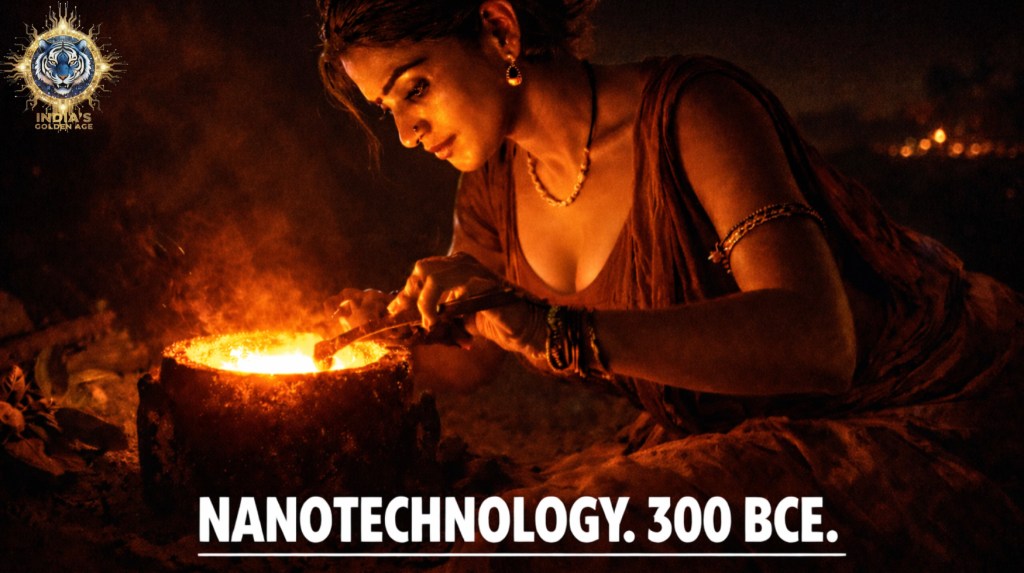
Let us imagine Velvi. It is 300 BCE in Tamil Nadu, three hours before dawn, when metal tells the truth by its glow alone. Velvi stands watching over the furnace, hands unsteady after a full day and night without sleep. Outside, the village rests. Inside her compound, six months of savings sit molten at twelve hundred degrees. A single error means hunger when winter comes.
She speaks to herself, or perhaps to an apprentice nearby: “Twenty-four hours. Exactly. Not less, not more. Carbon takes its own time with iron. Amma used to say that.” Inside the crucible sit wrought iron and dried cassia auriculata wood. They are measured with extraordinary care. Nothing in this process is accidental because survival depends entirely on precision.
Tamil Sangam literature mentions women smelters like Velvi working iron and steel. Archaeological evidence confirms that women controlled the most sensitive stages of production. These stages included charcoal preparation and wood selection. Even small errors in these processes meant ruin. This expertise passed from mother to daughter across generations, not through textbooks but through presence, repetition, and trust.
Velvi never knew the chemistry. She knew how. Cassia auriculata wood. Calotropis gigantea leaves. Ores from particular mines. Science took two millennia to explain what she had already perfected.
The Iron Pillar of Delhi Has Stood Rust-Free for Fifteen Centuries
The Iron Pillar of Delhi, built under Chandragupta Vikramaditya, has stood rust-free for over fifteen centuries. Researchers from leading institutions worldwide have studied it. They have proposed explanations involving phosphorus content. Other factors include climate conditions and ancient forging techniques. These techniques remain extraordinarily difficult to reproduce. Perhaps someone in 400 CE understood iron better than we do today.
The smiths of the Gupta era had no electricity and no microscope. They relied only on observation and accumulated experience. They had the courage to fail repeatedly until mastery was achieved. The pillar stands because someone understood their craft completely. By the time it was erected, Indian steel was no longer merely serving India.
From Tamil Furnaces to the Frankish Coast
Indian steel travelled. Viking swords, including the famed Ulfberht blades, contained crucible steel that Europe could not match for centuries. That steel was Indian wootz.
Birka, Sweden, 847 CE. A Viking warrior grips a new sword he cannot explain. His local smith cannot make anything like it. The trader who brought it spoke of a distant land of spices and steel. What matters is performance. When it strikes his shield, the sound surprises him, and against his older sword, it cuts clean through. Tonight, he will raid the Frankish coast, and this blade will decide whether he comes back alive.
The steel crossed half the world to reach him. It traveled from south Indian furnaces, through Baghdad, and up the Volga river. Archaeological evidence from Berenice and Mantai confirms that Tamil and Gujarati trade networks powered this exchange. Arabs called it Al-Hadid al-Hind, literally Indian steel. Europeans renamed it Damascus steel, and in doing so, erased its origin entirely.
From 25 Percent of Global Manufacturing to Under 2 Percent
By the eighteenth century, Indian metallurgy stood at its peak. Tipu Sultan’s famous sword was made from wootz steel. It was so sharp that British soldiers reported it could cut through their muskets. In the early nineteenth century, Michael Faraday tried to recreate wootz steel. He is the very man known for his work on electromagnetism. However, he failed in his attempt. Despite repeated Western attempts, the British could not crack the steel code. So they did something far more effective than imitation.
The East India Company deliberately engaged in deindustrialisation. It systematically reshaped India into a source of raw materials. It made India a captive market and prevented it from remaining a competitor. The numbers tell the story with brutal clarity: in 1750, India produced twenty-five percent of global manufacturing output. By 1900, that figure had fallen to below two percent. Workshops were dismantled. Guilds dissolved. Artisans were pushed into agriculture, and British institutions collected Indian artefacts whilst simultaneously destroying the systems that had produced them. This was not economic mismanagement. This was economic murder.
In 2006, Scientists Found Carbon Nanotubes in a Damascus/Wootz Sabres
In 2006, M. Reibold, Peter Paufler, and colleagues at Dresden’s Technical University examined a fragment of ancient wootz steel under an electron microscope. The researchers were stunned. They checked the calibration. They looked again. Carbon nanotubes. Cementite nanowires. Structures associated with modern nanotechnology, present in a Damascus Sabres or Indian Wootz Steel Blades.
Their research paper concluded: “By empirically optimising their blade-treatment procedure, craftsmen ended up making nanotubes.”
How did this metallurgy knowledge survive two thousand years? Guilds kept standards. Families trained families. Apprentices learned by doing, not by reading. At a Karnataka site, an archaeo-metallurgist documented bronze casting practices unchanged for nearly a thousand years. She was told something she has likely never forgotten. A local artisan looked at her and said simply: “You may know more science than me, madam. I can hear when the metal is ready. Can you?” She smiled and replied: “Not yet. Maybe one day.”
She also saw the risk clearly. When a master dies without apprentices, centuries of knowledge disappear in a single generation. Modern science can recreate wootz, but not at scale. The process works. The economics do not. The forges are silent now, but the work of Indian metallurgists like Velvi still speaks, if we choose to listen.
The article is an excerpt from my podcast – India’s Golden Age. Available on YouTube, Spotify, Apple Podcasts and other Podcasting Platforms.
 Sarvajeet D Chandra
Leave a comment