
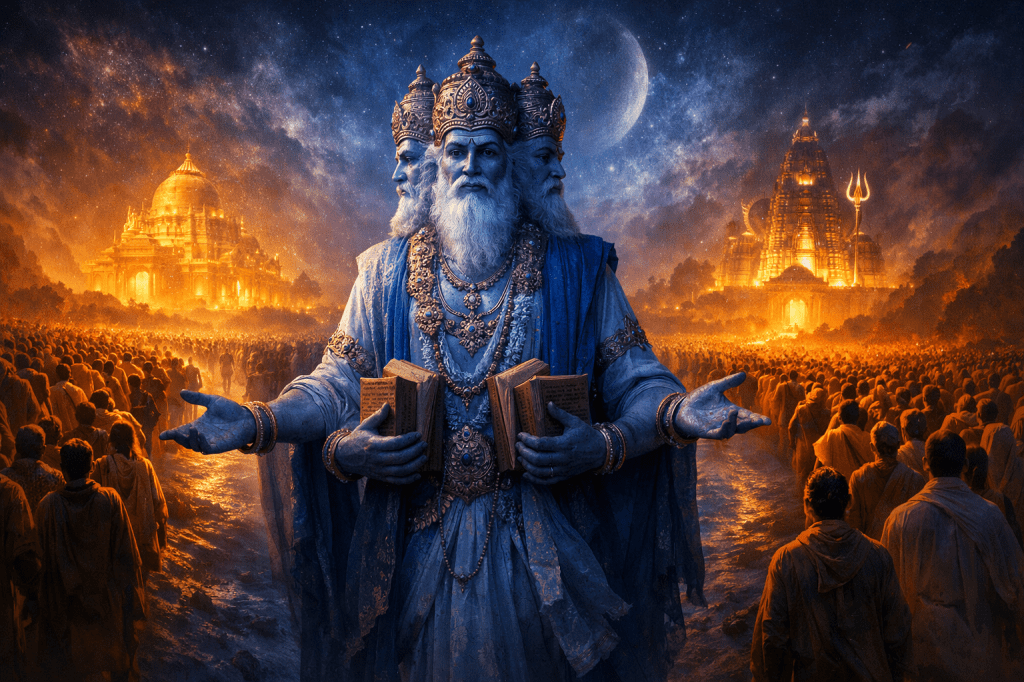
A billion Hindus. More than a million Hindu temples. Yet only one major temple for Brahma, the Creator of the Universe? The numbers hint at a story far deeper than mere statistics.
Lord Brahma lost the competition for human attention. As a result, he possibly became history’s first billion-dollar brand failure.
When Creation Isn’t Enough
Imagine a sculptor named Vishwakarma in Deogarh, 500 CE. He receives the biggest commission of his life. This occurs during the glittering Gupta Golden Age, an era when temples emerged as marketplaces for faith. Vishwakarma’s royal patron, the Gupta King, leans close and says, “The Vishnu panels, make them magnificent, Vishwakarma. People should feel that Lord Vishnu is protecting them.” When Vishwakarma asks about Brahma, the king waves a hand: “In a corner, somewhere.”
That dismissal captures everything. Brahma’s profile looks unbeatable on paper: creator of the universe, author of existence itself. But there is one fatal problem: creation happens once. After that, what next for the Creator God?
People/kings turn to gods who keep the world running.
- Vishnu preserves order, working every day. Demons strike? Vishnu steps in. Crops fail? People pray to him.
- Shiva takes on the toughest duties: removing obstacles, ending cycles, freeing those who seek release.
The work of Vishnu and Shiva never ends. Brahma’s creation is glorious, but the work is finished. In the economy of devotion, that is a structural weakness. And in religion, as in life, people pray to the ones who can help them today.
The Data Doesn’t Lie
The historical evidence in Gupta Golden Age is unambiguous. Copper-plate grants show land flowing to temples of Vishnu and Shiva, never to Brahma. Inscriptions glorify Vishnu, but never acknowledge Brahma.
Michael Willis’s data is blunt. In the Gupta era, there are roughly 140 Vishnu temples. There are about 160 Shiva temples. Brahma has perhaps three. When Brahma appears in a temple at all, he is tucked into a corner niche. He is given the polite respect reserved for an elder who is no longer needed.
The Elephanta Caves, built by Kalachuri Kings, capture the shift with remarkable clarity. The massive Trimurti shows Shiva handling creation, preservation, and destruction all at once. Brahma’s function is simply absorbed into Shiva’s. Shiva’s updated profile, one might say, reads: “Full Stack Divine Solutions.”
When a Tamil Teenage Girl Rewrote the Rules of Faith
By the 8th century, a quiet grassroots revolt was already underway. In a village square in Tamil Nadu, a teenage low-caste girl named Andal stood barefoot. She sang to Vishnu (as Ranganatha), blending devotion with raw, human longing. Her words erased the distance between human and divine, and crowds gathered while priests watched from the edges, uneasy.
Bhakti was D2C, bypassing the gatekeepers entirely. Bhakti needed no sacrifices, no elaborate rituals, no priestly intermediaries. In this new devotional world, Vishnu and Shiva gained traction since Brahma’s worship demanded elaborate rites and priestly knowledge. Vishnu could be worshipped with a single flower. While Shiva danced with outcasts.
One is left to wonder: was Brahma’s decline purely theological, or was it also a quiet rebellion against caste-controlled religion?
Why Vishnu and Shiva Went Viral Across Southeast Asia
As hindu religion spread overseas, the domestic pattern repeated itself with striking consistency. Tamil/Oriya traders carried Vishnu and Shiva with them to Southeast Asia, tucked into crates alongside their cargo. These gods travelled light, requiring only faith and simple offerings. Brahma’s complex rites never made the journey. By 600 CE, Southeast Asia was home to Vishnu and Shiva temples everywhere, while Brahma had none.
The gods who could be worshipped anywhere, by anyone, thrived and became global brands. Brahma struggled to remain even a local brand.
Stories We Tell in Defeat: Myths as Post-Mortems
As Brahma’s following shrank, stories emerged to explain why.
In one tale, Brahma grows a fifth head to admire his own creation. Then he directs his desire towards Saraswati, his own daughter. Shiva confronts him, removes the extra head, and declares him unfit for worship.
In another story, Vishnu & Brahma argue over supremacy before an infinite pillar of fire appears. Vishnu, as Varha, the boar, tunnels down, finds no bottom, and admits defeat with honour. Brahma flies up, as a swan, also finds no end, but lies about reaching the top. Shiva exposes Brahma’s lie and announces the punishment: Brahma will have no devotees.
Historians note that these stories appear only after Brahma’s worship had already collapsed. These explanations may have been invented to make sense of a decline that had already occurred. It is much like generals who write histories to justify a campaign they have already lost.
Some scholars also see in the Saraswati story a deeper anxiety about women’s agency: a goddess of knowledge is created by Brahma. He sexualises her and then uses this as the justification for his punishment.
Five Lessons From a Creator God’s Unemployment
What does the slow decline of a creator god teach us? Quite a lot, it turns out.
- Systems survive by letting go. Hinduism stayed plural and vital by quietly shifting its focus. As Brahma faded, other gods gained room to grow and the tradition renewed itself by adapting, not breaking.
- Institutions must keep evolving. Brahma’s narrative ended at creation. The devotees (esp. kings) of Vishnu and Shiva kept updating their roles and stories across centuries. Institutions survive only when they keep learning and changing; when they freeze, decline begins.
- Authority lasts only as long as people give it purpose. Brahma was never banished by decree. No exile, no formal demotion, just a shrine that emptied day by day. This is India’s civilisational democracy: slow, consensual and irreversible.
- Influence comes from accessibility. Brahma belonged to the elites and the priests. Vishnu and Shiva belonged to everyone. They could be worshipped in any language, with any offering. Societies work the same way: the wider the access to education, justice and opportunity, the stronger they become.
- Competition sharpens traditions. Vishnu and Shiva grew powerful through competition with other deities. They faced rival philosophies, including Buddhism and Jainism. They also contended with folk cults and tribal faiths. In that contest, they absorbed new ideas (like Avatars from Bodhisattvas) and grew more robust with every iteration.
The Last Shrine: What Pushkar Really Tells Us
Legend says Saraswati cursed Brahma to be worshipped only at Pushkar, Rajasthan. The temple there was rebuilt in the 14th century, long after Brahma’s cult had faded. The scholar Diana Eck notes that Pushkar Brahma temple is not preservation. It is a museum piece. Its value lies precisely in being the last of its kind.
Brahma was not cancelled. He simply faded from memory as people turned to gods who stepped into the mess of daily life. Creating something once is not enough to make a deity go viral; the deity has to keep showing up.
Preservation, destruction, transformation: that is where the drama of religion lives. And in religion, as in life, drama wins every single time.
The article is an excerpt from my podcast – India’s Golden Age. Available on YouTube, Spotify, Apple Podcasts and other Podcasting Platforms.
 Sarvajeet D Chandra
Leave a comment