
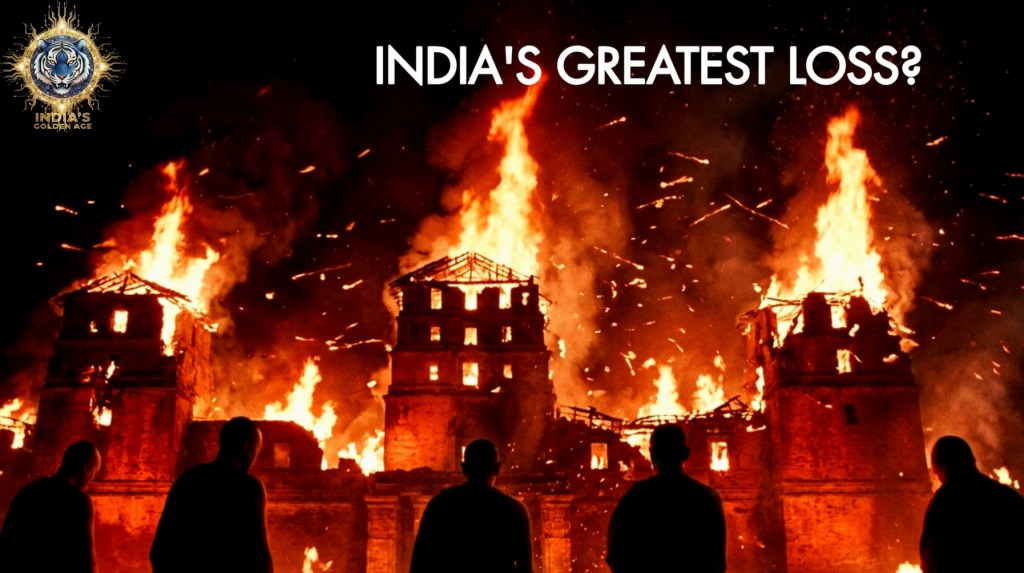
In 1193 CE, a young monk ran out of a burning complex with three manuscripts tucked under his arms. Behind him, nine million texts were turning to smoke. Nalanda, the world’s first residential university, with the largest repository of knowledge in ancient world, was burnt to death.
Today we revere Harvard, MIT, Oxbridge. Centuries before any of them existed, India built a system. It produced mathematicians, astronomers, and philosophers. Their debates on consciousness still baffle neuroscientists. This is the story of Nalanda.
A King Who Funded Ideas Over Armies
In 427 CE, with Huna raids tearing at India’s northwest, Gupta Emperor Kumaragupta I made a calculated and counterintuitive move. Rather than pouring resources only into fortifications, he redirected a part of it towards a Buddhist Mahavihara in Magadha.
A Vaishnava Gupta king funding a Buddhist institution of learning was not naivety but pragmatic pluralism. Kumaragupta understood that the investment in Nalanda would return as scholars, physicians, and astronomers tomorrow. “Empires fall to weapons,” he might have said, “but civilisations fall only when learning dies.”
This was ancient CSR in its most ambitious form, Civilisational Sangha Responsibility, and its returns compounded over seven centuries.
Inside the Most Rigorous University the Ancient World Ever Built
By the seventh century, Nalanda had grown into a walled city of ideas. It housed ten thousand students and a thousand teachers. Over a hundred lectures were delivered daily. These took place in halls designed like debating arenas with raised platforms for challengers.
The library, known as Dharmaganja, or Treasury of Truth, comprised three towers of nine storeys each. It housed nine million manuscripts in Sanskrit, Pali, Chinese, Tibetan, and Korean. Medical treatises sat beside astronomical charts, which sat beside logic problems, erotic poetry, and political satire. It was, without doubt, the largest repository of knowledge in the ancient world. A student in ancient Asia would risk everything to enter Nalanda.
Entry to Nalanda was tough. A scholar called the dvarapandita, meaning the doorkeeper scholar, was stationed at each of the four gates. They conducted a live oral examination. Seven out of eight applicants were turned away. Nalanda did not welcome the eager. It admitted only the ready.
The Chinese Monk Who Walked Ten Thousand Miles for an Education
In the seventh century, a young monk from China named Xuanzang embarked on a journey to India. He was only twenty-seven years old. Xuanzang walked ten thousand miles, passing bandits. He also traversed deserts where the lack of water could kill within days. Three years later, he arrived at Nalanda with feet wrapped in bloodied cloth. He spent seven years in Nalanda studying fifteen hours a day in a small cell. The intellectual rigour at Nalanda made his Chinese monasteries seem, by comparison, like kindergartens.
When Xuanzang returned to China carrying 657 manuscripts, the Tang Emperor personally welcomed him. He translated 74 texts and triggered what historians now recognise as a Chinese cultural revolution.
How Nalanda Invented High-Stakes Intellectual Combat Long Before Business School
Nalanda emphasised deep understanding through inquiry, relying heavily on debate, discussions, and in-depth question-and-answer sessions. Public debates were not academic exercises but bloodless, intellectual combat. A Nalanda teacher might have said, “The debates, that is where you are made or broken. Lose one badly, and your students start questioning you. Funding disappears. Your reputation bleeds slowly. People will quote your defeat long after you are gone.”
This system produced thinkers who could defend ideas under sustained attack. Now compare that to the modern learning cycle of memorise, regurgitate, forget, repeat.
Cross-Disciplinary Focus
Nalanda trained thinkers who could cross boundaries, see connections others miss. Students moved seamlessly from Buddhist Mahayana texts to medical treatises, from logic to astronomy. From foreign languages to Vedic studies.
A Nalanda professor might have said. “Specialisation is useful, but it is also dangerous. You cannot heal a body without understanding the mind. A ruler without ethics becomes a tyrant. A mathematician cannot invent zero without the comfort with emptiness.”
Ancient Indian Education Ecosystem
Nalanda was part of a vast Indian education ecosystem. Vikramashila trained three thousand in tantric Buddhism and logic. Vallabhi taught an ancient MBA: law, economics, statecraft, commercial mathematics, etc.
Chinese pilgrim Yijing wrote: “Vallabhi and Nalanda are like the two eyes of India. Without travelling to India, one could not distinguish the correct from the erroneous.”
How 1,400 Years of Knowledge Became Smoke
In 1193, Bakhtiyar Khilji sacked the complex. The Persian historian Minhaj-i-Siraj recorded it in his Tabaqat-i-Nasiri with bureaucratic detachment: the fortress was razed, great plunder was taken, and the inhabitants were killed. The historian makes no mention of libraries, no mention of the knowledge that was destroyed. It was possibly the biggest civilisational loss in Indian history. The library is said to have burned for weeks.
By the time British archaeologists arrived at the site in 1861, local villagers had forgotten about the university. They no longer remembered that it had once stood there. In a sharp irony, Bhaktiyarpur, named after the general who destroyed Nalanda, still stands as a town in Bihar today.
The Question That Nalanda Forces Us to Ask About Indian Education Today
In ancient India, knowledge was treated as civilisational infrastructure in the same way we now fund highways and power grids. The Guptas invested in universities because they understood that the returns, though slow, were compounding and irreversible. Europe built its own universities centuries later. They used translated Indian and Arabic texts. Those institutions eventually powered the Industrial Revolution.
Xuanzang walked ten thousand miles for an Indian education, risking his life. The Dalai Lama has said that the source of all Buddhist knowledge is Nalanda. Nalanda produced amazing thinkers like Dignaga, Dharmapala & Dharmakirti.
A new Nalanda University is being established, carrying forward the vision of the late Dr. Abdul Kalam. The question it must answer is the same one the original institution answered decisively. What unique offerings does this place provide? What can this place offer that nowhere else in the world can? Until India has a clear and honest answer to that, we will continue exporting talent rather than attracting it.
The article is an excerpt from my podcast – India’s Golden Age. Available on YouTube, Spotify, Apple Podcasts and other Podcasting Platforms.
 Sarvajeet D Chandra
Leave a comment