
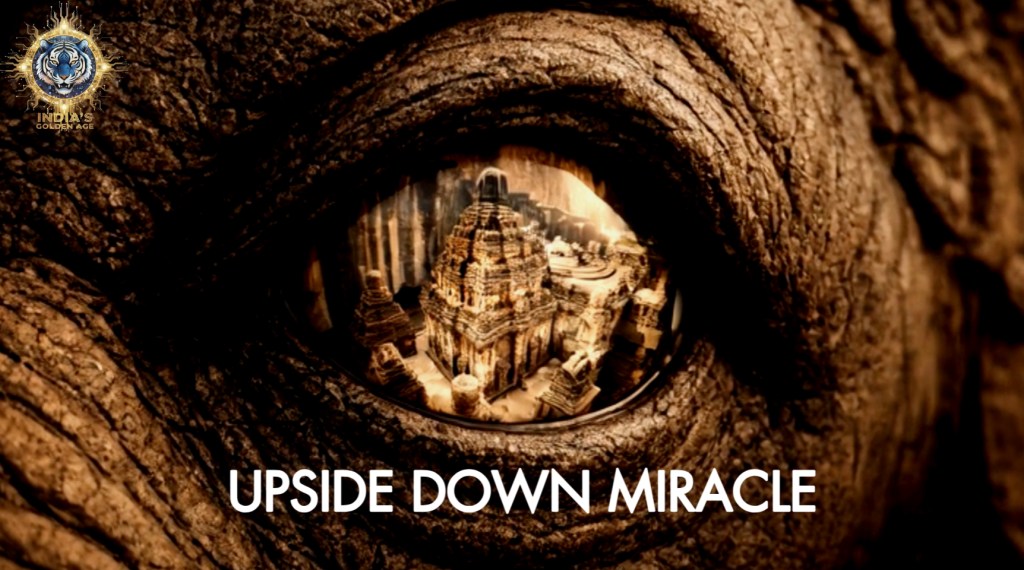
There is a legend about Aurangzeb. He sends a thousand soldiers to Ellora with a single command: destroy the Kailasa Temple. Three years pass. The battalion commander returns, defeated, and reports: “We have struck off a few noses and damaged some faces, but the structure remains broadly intact.”
The Mughal Emperor and his soldiers learnt their lesson the hard way. This place was never built. It was carved from a cliff. You cannot pull down a mountain. You can only scar it.
The Monument That Was Subtracted, Not Built
The Kailasa Temple is not masonry; it is geology. This is not a temple built upward. It is a mountain carved downward.
Cut to the early nineteenth century in Baroda, Gujarat, where archaeologists dig up copper plates over a thousand years old. The Sanskrit inscriptions credit King Krishna I of the Rashtrakutas with building the temple. According to Rashtrakuta records, the temple was “so wondrous that even the gods were astonished.”
Despite this evidence, conspiracy theories abound. Some say the Kailasa Temple must have been built by aliens; others insist it required foreign, light-skinned Aryan outsiders. These myths survive because the truth is harder to accept. Indian civilisation achieved unmatched skill and ambition at that time.
From Maurya Caves to Kailasa: The Long Road to the Impossible
Ancient Indians had the skill, patience, and confidence to carve living rock into architecture. This is evident in the Maurya Caves, Ajanta, Elephanta, and the Pallava Pancharathas. The Kailasa Temple is the culmination of this long rock-cut tradition, executed at a scale the world had never seen. It was a proof of Indian genius and Rashtrakuta genius.
The Rashtrakutas ushered in the golden age of Imperial Karnataka. At their peak, their empire stretched from Karnataka to Central India. Their King Krishna I stood atop the mountain. He might have proclaimed, in effect: “Let us carve this mountain into a prayer.”
Ninety Feet of Basalt, One Unbroken Vision: What Ellora’s Cave 16 Contains
The Ellora complex contains thirty-four caves: Hindu, Jain, and Buddhist. At Cave 16 the incredible Kailasa Temple erupts from stone. The temple features a two-storey gopuram and a rock-cut bridge. It also has seventy-foot pillars. Massive stone elephants at the base appear as if they are holding the monument itself. Inside the temple, a garbha griha houses a massive Shivalinga, and mythology crawls across every wall.
Most monuments are built up, brick by brick and stone by stone, as with the Pyramids and the Taj Mahal. The Kailasa paradigm is entirely different: it is about subtraction. Carved downward from a single basalt cliff more than ninety feet high, formed at least sixty million years ago. It brings to mind Michelangelo’s famous observation. He said the sculpture is already in the marble. You simply remove what is not needed. King Krishna I proved the same about mountains, as if to say: “The temple is not in the mountain. The temple is the mountain, turned upside down.”
Two Hundred Thousand Tons of Missing Stone? The Mystery That Haunts Kailasa
Kailasa’s construction began with vertical trenching on three sides to isolate the core rock. There is no consensus on the construction timeline. Some historians place its completion within eighteen years. Others believe it unfolded across multiple generations. They suggest it possibly began under Raja Dantidurga and continued after Krishna I. Certain sculptural elements appear to be later additions. This reinforces the view. The same master builders who worked on the Virupaksha Temple may have contributed. If they did, building Kailasa largely within a single reign is possible. Although basalt is difficult to carve by hand, there are silent blasting methods that could have been used. Hydro-expansion using wooden wedges may explain how large volumes of rock were removed within decades.
Now comes the question that unsettles everyone. The Rashtrakutas removed two hundred thousand tons of basalt, enough material to build a small city. Most of that quarried rock is untraced. Ellora shows no nearby quarries filled with discarded stone. Some argue the rock was reused elsewhere. This is possible. However, moving that volume would require four thousand truckloads today. Imagine doing it with oxen and wooden carts in the eighth century. Others hypothesise that the rock was pulverised and scattered for roads, plaster, or levelling land. Unfortunately, firm evidence for any such hypothesis remains missing. The temple is not the only miracle, the material movement is equally stunning.
The Queen Who Fasted, the Architect Who Dared, and the Spire That Saved a Life
There is a Marathi folk story about Kailasa. The Rashtrakuta king falls gravely ill, and his queen vows to build a Shiva temple if the king is cured. Once the king heals, the queen makes a declaration in court. She will not eat until she sees the shikhara of a Shiva temple. A noble points out that this will take years, and the queen weakens by the day. Kokasa meets the king in private. He may be an architect or simply a man with spectacularly bold ideas. He says to the king: “Give me one week. I will carve from the top of the cliff. The spire will appear first.” The story goes that the queen sees the spire, breaks her fast, and survives. The temple was once called Manikeshwar in her honour.
One Stone, One Plan: The Engineering Intelligence Built Into Every Corridor
As you walk the corridors, the clarity of the mind that conceived Kailasa becomes evident. Elephants, rainwater harvesting systems, bridges, and galleries are all carved from one stone, guided by one plan. The drainage system alone is a marvel. Rainwater travels through hidden channels into a storage tank. Remarkably, Kailasa has never flooded across centuries of monsoons.
Kailasa is narrative architecture, made to be read while moving. Every wall presents a new story. It insists on being read: Shiva as a lover, an ascetic, a destroyer, a dancer. There are stories of Vishnu and episodes from the Ramayana and the Mahabharata. Goddesses and the full sweep of a civilisation’s mythology are also present. One particularly interesting detail is that women appear everywhere, tucked into corners: queens, artisans, goddesses. It seems as if a civilisation is slowly and carefully describing itself to future ages. This is a civilisation that understood time far better than we do.
Multi-Generational Thinking. Not Speed & Disruption
The temple, now a UNESCO World Heritage Site, reflects an extraordinary multigenerational vision. It was built without margin for error, sustained across generations who understood the risks involved. A single mistake could undo years of effort. Stone does not allow revision. A broken section remained as it was. That constant risk must have made the work both demanding and deeply satisfying.
One can imagine a master sculptor at work, his daughter Devika beside him. He points to Shiva as Nataraja, drawing her attention to the ankle. “See this part carefully,” he says. “You must feel the grain. If one strike goes wrong, the foot will be cut off. Then nothing can be done.”
Devika nods, taking it in. “Still a lot is left, father. I think my grandchildren will be putting the final touches to this temple.”
It was a single vision carried across generations. This is what we have lost as a civilisation: the patience to build across lifetimes. Today we want disruption, speed, and things to happen at a click.
The Question Krishna I Would Ask Us If He Were Alive Today
So here is the question: are we building anything for the next era? When our names fade, what will we leave behind that is worth preserving?
Kailasa was export-grade beauty, studied and adapted across Asia. A Baroda copperplate records in awe. It says that the gods flew over the temple. They declared it impossible for mortals to have made. I can almost hear Krishna I asking: “If something like this was possible in the past, what new forms will ambition take in India’s next golden age?”
The article is an excerpt from my podcast – India’s Golden Age. Available on YouTube, Spotify, Apple Podcasts and other Podcasting Platforms.
 Sarvajeet D Chandra
Leave a comment