
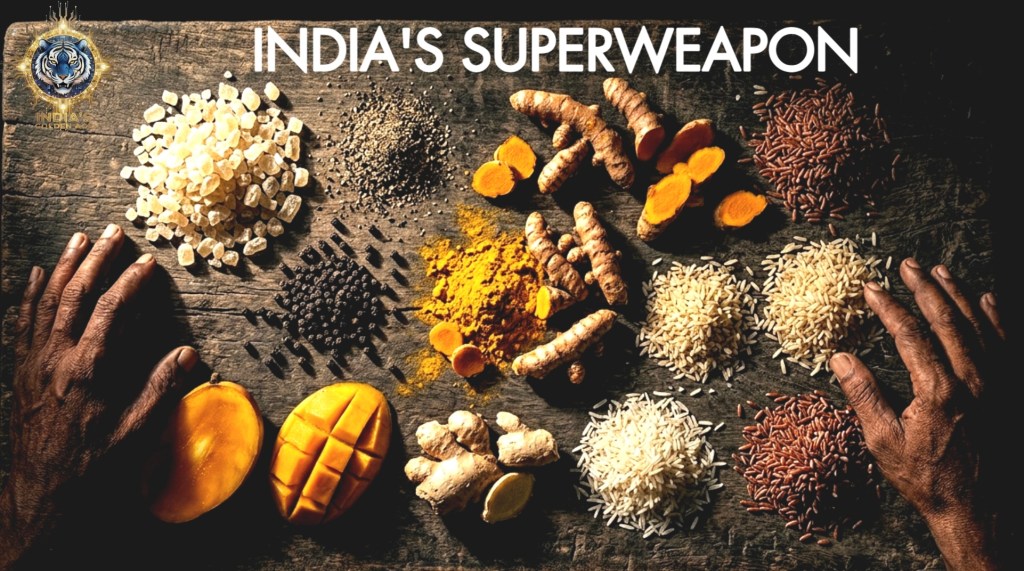
Someone orders something sweet in a café in London tonight. They speak the word “sugar” without a second thought. They are entirely unaware that its origin lies deep in ancient India. The word comes from a Sanskrit word meaning gravel: Sharkara. The word is a couple of millennia old. Its journey from Indian cane fields to the plantations of the Caribbean, to your morning coffee, is an interesting story.
India gave the world sugar, pepper, the mango, spices, etc. These were not merely traded goods. They were technologies, medicines, and civilisational contributions. These built empires, funded colonisation, and seeded global economies.
The Forgotten Indian Origins of Sugar
4th Century, CE. Centuries before sugar became a commodity, it was a craft. In Gupta India, workers in sugar furnaces produced three types of sugar.
- Guda, the dark jaggery still common in Indian kitchens
- Khanda, a name that travelled west and became the word “candy”
- Sharkara, pale crystals engineered almost perfectly for trade
From Gupta India, sugar travelled west, like mathematics, chess, and other Indian ideas and goods. Persians called it shakar. Arabs called it sukkar. Crusaders tasting it in the Levant called it sweet salt. Europe developed a taste for sugar. This obsession eventually drove the plantation system. It also fueled the slave trade and the entire architecture of early capitalism.
4th Century BCE. Nearchus, who served as admiral to Alexander the Great, attempted to explain sugarcane to the Greeks. He used an interesting description: a reed that produces honey without bees. That was the best he could do.
Rome’s Fatal Addiction to Indian Pepper
2nd Century CE. Marcus, a Roman captain, has just mortgaged his life savings. He literally signed a contract at 24 per cent interest. He did this to fill his ship with wine, copper, and gold coins. He is sailing from Egypt to a place most Romans have never heard of: Muziris, on India’s Malabar Coast. The voyage ahead is brutal, three months across the Arabian Sea under monsoon winds that can split a hull. Marcus has only one certainty. If he returns with pepper, he becomes extremely wealthy. If he fails, his family loses everything.
We know that someone like Marcus lived. Archaeologists found his contract, the Muziris Papyrus, in an Egyptian rubbish heap two thousand years later. The contract lists 500 talents of pepper, 60 chests of nard, and 4,800 talents of ivory. It is a document that reads like a billion-dollar invoice. His cargo was valued at nine million sesterces, equal to several years of tax revenue from Egypt. All on one ship, one man, one colossal bet.
This is not simply a trade story. It is an addiction story, the addiction of the West to Indian pepper, to Indian spices, to Indian foods. Such was the demand that Columbus died trying to reach us.
Ancient Grains and Climate Resilience
At Lahuradewa in Uttar Pradesh, archaeologists have uncovered rice grains dated to around 6500 BCE. This discovery means rice cultivation on the Indian subcontinent began roughly eight and a half thousand years ago. Early farmers were already domesticating the crop, developing wet paddy systems, and selecting the best grains for future harvests. Yet the most important story may lie beyond rice altogether.
Excavations at Harappan sites such as Farmana and Rakhigarhi reveal millets growing in their fields. These fields also cultivated other staples: ragi, bajra, and jowar. They are quiet crops but resilient ones, thriving with little water and surviving long dry spells. The monsoon became unreliable. The great river systems began shifting in the Sindhu-Saraswati civilisation. As a result, these grains became a form of survival technology. A farmer made a decision. She planted millets instead of other staples. That decision likely helped families endure the Harappan climate crisis.
Here lies the twist. The same crops planted during that ancient crisis are the ones we need urgently today. This occurred four thousand years ago. Scientists and governments are rediscovering them now. Today, climate change is already reducing yields of major crops like wheat and rice in several regions of the world. Millets evolved in semi-arid environments, and their resilience made them ideal during environmental stress nearly four thousand years ago. We are, in a sense, circling back to a wisdom we never should have discarded.
How India Gave the World Its Most Beloved Fruit
Every mango eaten today in Mexico, Brazil, or Florida carries a hidden passport stamped in India. The mango did not arrive in the subcontinent from somewhere else. It originated there, as its scientific name confirms: Mangifera indica. Around four thousand years ago, Indians began cultivating and spreading it. The earliest reference appears in the Brihadaranyaka Upanishad (c. 700 BCE), where it is mentioned as Amra. The name “mango” itself originated from the Tamil and Malayalam words manga or mang, which the Portuguese eventually adopted.
In the fourth century BCE, a Buddhist monk carried mango seeds carefully in his satchel. He travelled to the Malayan peninsula. With him, and other monks, the seeds travelled too, to South-East Asia. Arab traders later introduced the fruit to East Africa, and Portuguese explorers eventually carried it to the Americas.
But in India, the mango was never only a fruit. It was used in medicine, offered in rituals, and Buddhist texts describe the Buddha resting beneath mango trees. The fruit and its leaves became symbols of fertility, prosperity, and renewal.
A mango tree could take decades to reach its full yield. Kings planted groves whose finest fruit they would never taste. The Buddhist monk understood that. He carried mango seeds not because he needed food for the journey, but because he believed in the future. Somewhere along the way, we forgot how to think like that.
India Paid for Its Own Colonisation: The Bitter Irony Behind the British East India Company
In the early seventeenth century, a European trading company sailed into a port on India’s western coast. The shoreline was accustomed to Europeans. Greeks had traded here once. Roman ships had ridden the monsoon winds to these same harbours. The English East India Company came for commerce: spices, textiles, sugar, and silver. But trade generated enormous profits, and those profits began funding ships, forts, and eventually a private army. Trade posts became territory. Territory became the British Raj. India, in many ways, paid for its own colonisation.
In another irony, Indian sugar technology eventually seeded plantation economies around the world, and more than 1.6 million workers from British India were transported as indentured labourers to European colonies in the nineteenth century.
India’s Ancient Science of Food as Medicine
More than two thousand years ago, Indian physicians practised careful classification of food. Charaka classified food ingredients and prescribed dietary regimens much as modern doctors prescribe treatments. He believed that a physician must know the properties of food. It’s like how a soldier must know his weapons. Food was not separate from medicine in ancient India. The kitchen functioned as a pharmacy.
Pepper was believed to strengthen digestion. Turmeric helped cleanse the blood and reduce swelling. Ginger, whose name came from the Sanskrit shringavera, warmed the body and helped it absorb nutrients. Sesame oil, pressed in the Indus region thousands of years earlier, was used to support the nerves and joints. Sharkara, was considered cooling and pure, but also the hardest to digest, to be used in moderation.
When Roman sailors purchased pepper from traders on the Malabar coast, they thought they were buying flavour. In reality, they were also buying medicine. The knowledge existed long before. The world decided to rediscover it, rename it, and sell it back to us at a markup.
They Patented Our Turmeric and Called It Innovation
In 1995, two researchers at the University of Mississippi received a US patent. They had patented the use of turmeric powder to heal wounds. India objected immediately. Raghunath Mashelkar led the Council of Scientific and Industrial Research. He came to be known as the Haldi Ghati Warrior. The council challenged the patent and presented evidence from ancient Sanskrit texts in Washington. In 1997, the patent was revoked. Mashelkar also successfully challenged the US patents on Basmati rice.
Consider what that moment meant. India had to prove in an American court their traditional use of turmeric. It had been part of their medical traditions for centuries, even before Columbus crossed the Atlantic.
India produces nearly eighty per cent of the world’s turmeric today. However, the premium attached to turmeric-based wellness products is often captured elsewhere. What your grandmother called haldi doodh now appears on urban menus. It is offered as a turmeric latte at several hundred rupees a cup.
The western pattern is familiar. They take the technique and often the vocabulary. Then, they drop the attribution and rewrite the origin story. In a generation the narrative changes.
Why India’s Agricultural Legacy Is the World’s Best-Kept Secret
Sugar, pepper, rice, turmeric, spices, mango: these ingredients once formed the pantry that fed the world. That legacy still survives, in the soil, in markets, and in the hands of our grandmothers. Every time your mother puts haldi in the dal, she is performing a two-thousand-year-old prescription. She just calls it cooking.
India has an extraordinary agricultural heritage. At least a hundred thousand varieties of rice have been cultivated across the subcontinent. Farmers selected each variety over generations by adapting crops to local conditions. Much of that diversity is now disappearing as monoculture farming expands. If we lose this biodiversity, we lose our climate resilience. Ancient rice, once a daily staple, is now a “superfood” rivalling quinoa in global markets.
Sugarcane fields are increasingly being used for biofuel production, transforming an ancient crop into a resource for a greener economy. The story is not finished. The story of India reflects the world’s appetite. It is still being written, one bite at a time. We must remember, we must preserve, and we must feast.
The article is an excerpt from my podcast – India’s Golden Age. Available on YouTube, Spotify, Apple Podcasts and other Podcasting Platforms.
 Sarvajeet D Chandra
Leave a comment