
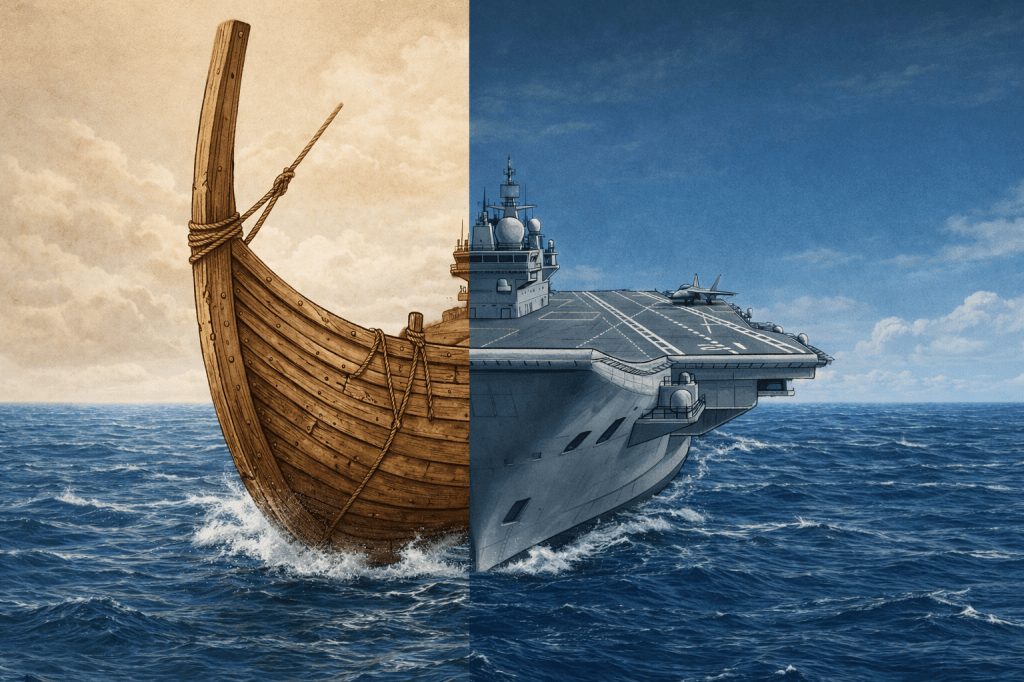
In 1025 CE, a Tamil fleet embarked on a significant journey. They sailed across the Bay of Bengal. The fleet struck the heart of Southeast Asia’s most powerful maritime empire. This was not a raid. It was a statement. This statement was backed by two centuries of strategic thinking. Merchant intelligence networks also supported it. There was a civilisational understanding of the sea that most of the world has since forgotten. India’s relationship with the ocean is older than most of its land borders. It’s time to tell that story properly.
The Chess Player Who Saw the Ocean as a Board
In the late tenth century, Chola King Rajaraja the First looked at a map strategically. He observed it like a chess player examines a board. He did not ask what is here. Instead, he asked what position he needed to be in three moves from now. And then he made the moves.
The Chola kingdom controlled the Coromandel Coast under his rule. Occasionally, they also controlled the Malabar shore. These two shores face the most valuable maritime corridor of the Indian Ocean. His first move was Sri Lanka, an island sitting across India’s southern tip and a major chokepoint between two seas. Rajaraja captured the northern half and marked the conquest with a Shiva temple. His next move was the Maldives. Observers often dismissed this chain of small coral islands. However, Rajaraja understood them as toll booths. Arab merchant ships simply could not pass east without passing through them.
When his son Rajendra inherited the throne, the board was ready. One move remained: Srivijaya.
When a Trader’s Complaint Changed the History of Southeast Asia
The greatest naval expedition in medieval Asian history was not started by a king’s ambition. It was started by a merchant guild’s complaint, and what followed changed the map of Asia.
The influential Ainnurruvar guild had spent years watching Srivijaya seize their ships and confiscate their cargo. Traders who attempted to bypass Srivijayan ports often lost everything. When the guild finally approached the Chola court, they were not asking for sympathy. They were asking for action, and they had the resources to help pay for it.
What distinguished the Ainnurruvar was that they were not simply a merchant group. They were, in every meaningful sense, a true multinational corporation, operating five centuries before the East India Company was incorporated. They had their own military force, the Three-Leaf Warriors, warriors first and merchants second according to the guild’s own inscriptions. They had their own legal code, the Pancha Sata Vira Sasana, meaning the Edict of the Five Hundred. They flew their own flag: the bull of Shiva. The Chola crown’s letters of charter granted them judicial autonomy. They also received tax exemptions and protection of their trade routes. In return, they financed the navy. The relationship was symbiotic to the point of being inseparable: the state protected trade, and trade funded the state.
Diplomacy added yet another dimension. At the court of the Song dynasty in China, Srivijayan envoys allegedly portrayed the Cholas as vassals. They claimed that the Cholas were a subordinate power. They also asserted that Srivijaya controlled trade through the straits. For the Chola rulers, this was not merely a trade dispute. It was a direct challenge to their political standing in the wider Asian world.
October 1025: The Day India Launched the Greatest Naval Armada the Medieval World Had Ever Seen
October 1025. Nagapattinam harbour roared with movement. Ships were loaded with rice, dried fish, weapons, and spare rigging. Medical teams prepared for disease. Priests travelled with the fleet.
Rajendra had no permanent navy. Merchant vessels were transformed into fighting ships. They were fitted with archer platforms, catapults, and reinforced hulls. Many of these ships likely belonged to the private navies of the guilds themselves.
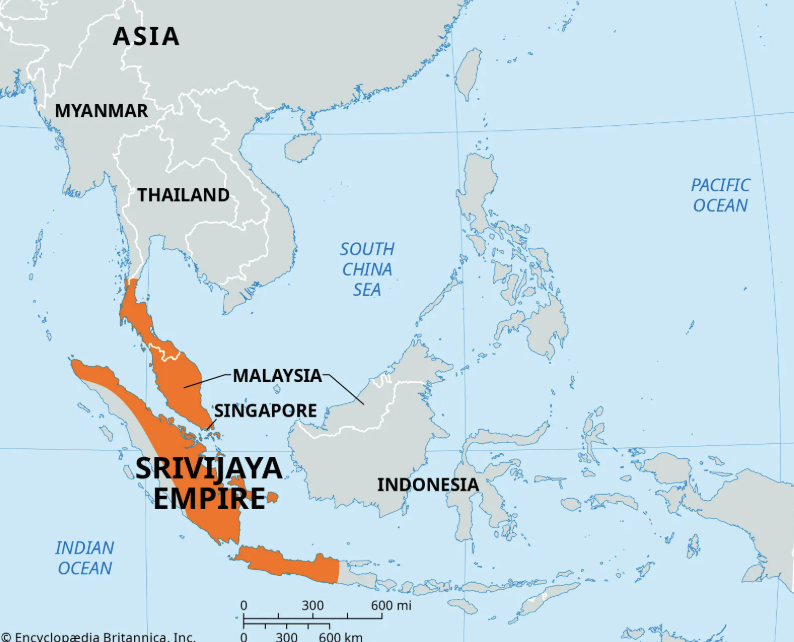
Srivijaya waited at Kedah for the attack. Rajendra sent a decoy there while the main fleet sailed through the Sunda Strait and struck Palembang from the south. The city fell quickly. The king was captured and the palace gate taken as tribute.
This conquest was aided by a robust maritime intelligence system. The Chola guilds maintained agents across the Bay of Bengal. These agents knew the Srivijayan ports, including harbour depths and monsoon timing. They also knew which port commanders were open to negotiation. The principal written source for the campaign is a Tamil inscription carved at Thanjavur around 1030. It lists fourteen places captured or raided. Among them are Srivijaya herself, ports in North Sumatra, Jambi, Thailand, the Malay Peninsula, Aceh, the Nicobar Islands, and Kedah. Read that list today and you are essentially unrolling the entire maritime spine of Southeast Asia.
Archaeology confirms what the inscriptions suggest. Chinese Song ceramics appear in Tamil Nadu while Tamil ceramics appear across Southeast Asia. A Tamil inscription dated 1088 CE was found at Barus in West Sumatra. This was sixty-three years after the Chola expedition. It names the Ainnurruvar guild’s city commander. It also lists his officer ranks and his trading arrangements. Clearly, the Chola fleet carried more than soldiers: priests, merchants, and artisans followed. Tamil temples appeared in Sumatra, and Sanskrit entered the vocabulary of local courts.
Kanhoji Angre, the Kunjali Marakkars and the Long Resistance
The sixteenth century was supposed to belong to the Portuguese at sea. Their ships were tall, their guns were loud, and their confidence was immense. On the Malabar Coast, the Kunjali Marakkars saw the weakness in that confidence clearly.
The Kunjali Marakkars possessed no great ships. Their strength lay in small oared vessels with shallow drafts. These boats could move quickly through creeks and mangroves. Portuguese hulls could not follow them there. For four generations, they engaged in a consistent and quiet war. They avoided direct battle with the Portuguese navy and relied on timing and geography. When the wind dropped and the great sails went limp, the rowboats came out. A single boat does not seem like a threat. However, a hundred boats swarming from every direction in the dark can destroy an empire’s confidence. For eighty years, with boats smaller than the Portuguese captains’ dining rooms, they held the Malabar Coast.
A century later, from 1698 to 1729, Kanhoji Angre served as Sarkhel, Grand Admiral of the Maratha fleet. During his three decades at sea, he spent most of his career fighting European fleets successfully along the Konkan Coast. In 1721, a joint English and Portuguese fleet sailed against him and was expected to crush Maratha resistance at sea. Instead, Angre forced the alliance into defeat. This was likely the first Asian naval victory over a combined European fleet. It occurred nearly two centuries before the Battle of Tsushima in 1905. He also challenged European maritime authority directly with licences known as Dastak and Kaul. He asserted an alternative to the Portuguese Cartaz system. Angre created a parallel structure of control over trade. The British solved their embarrassment by calling him a pirate, and over time the label did its work.
The Wadias, HMS Trincomalee and the Politics of Excellence
In the seventeenth century, Shivaji was just twenty-seven years old. He looked at the Konkan coastline and concluded that he needed a navy. Twenty-three years later, he had close to two hundred coastal war vessels. Shivaji’s declaration, “He who has the navy owns the sea” (Jalamev Yasya, Balamev Tasya), was not mere rhetoric. It was a governing philosophy, one that the Cholas had reached six centuries before him.
In the nineteenth century, the Wadia family of Bombay became the master war shipbuilders of their era. Their work was so highly regarded that the British Royal Navy commissioned them directly. HMS Trincomalee was launched in Bombay in 1817. It is still afloat today. It remains the oldest warship still floating anywhere in the world. That success, however, bred resentment. London shipbuilders could not match the Indian quality. They lobbied against it instead. Through Navigation Acts and related measures, Indian-built ships were effectively barred from British ports. A Wadia-built ship, made with Indian timber, Indian hands, and Indian knowledge, was legally excluded from the most profitable ports in the world. This exclusion was not because it was inferior. It was precisely because it was not.
INS Vikrant and the Lessons India Must Carry Forward
Stand today on the flight deck of INS Vikrant. The Arabian Sea wind blows across an impressive vessel. This ship stretches 262 metres and displaces forty-five thousand tonnes. It is India’s first indigenous aircraft carrier. This carrier was designed and built entirely at home. Vikrant’s anchor chain was manufactured in Bhavnagar, Gujarat. This location is close to the ancient port of Lothal. Vessels sailed from Lothal’s docks towards Mesopotamia four thousand years ago.
Commissioned in September 2022, Vikrant represents more than a modern warship. It reflects a maritime tradition returning to the surface. India’s Act East Policy is guided by the same geopolitics that drove the Cholas. The Malacca Strait still funnels trade between the Pacific and the Indian Ocean. The Bay of Bengal still carries ships across one of the busiest maritime highways on earth.
India is now expanding naval infrastructure in the Andaman and Nicobar Islands, positioned close to the Malacca chokepoint. An Indonesian minister made a quietly revealing remark. Indonesia’s nearest neighbour is not Malaysia or Australia. It is India, with one Andaman island lying only a few kilometres away.
The names of the powers change. The map does not.
The article is an excerpt from my podcast – India’s Golden Age. Available on YouTube, Spotify, Apple Podcasts and other Podcasting Platforms.
 Sarvajeet D Chandra
Leave a comment