
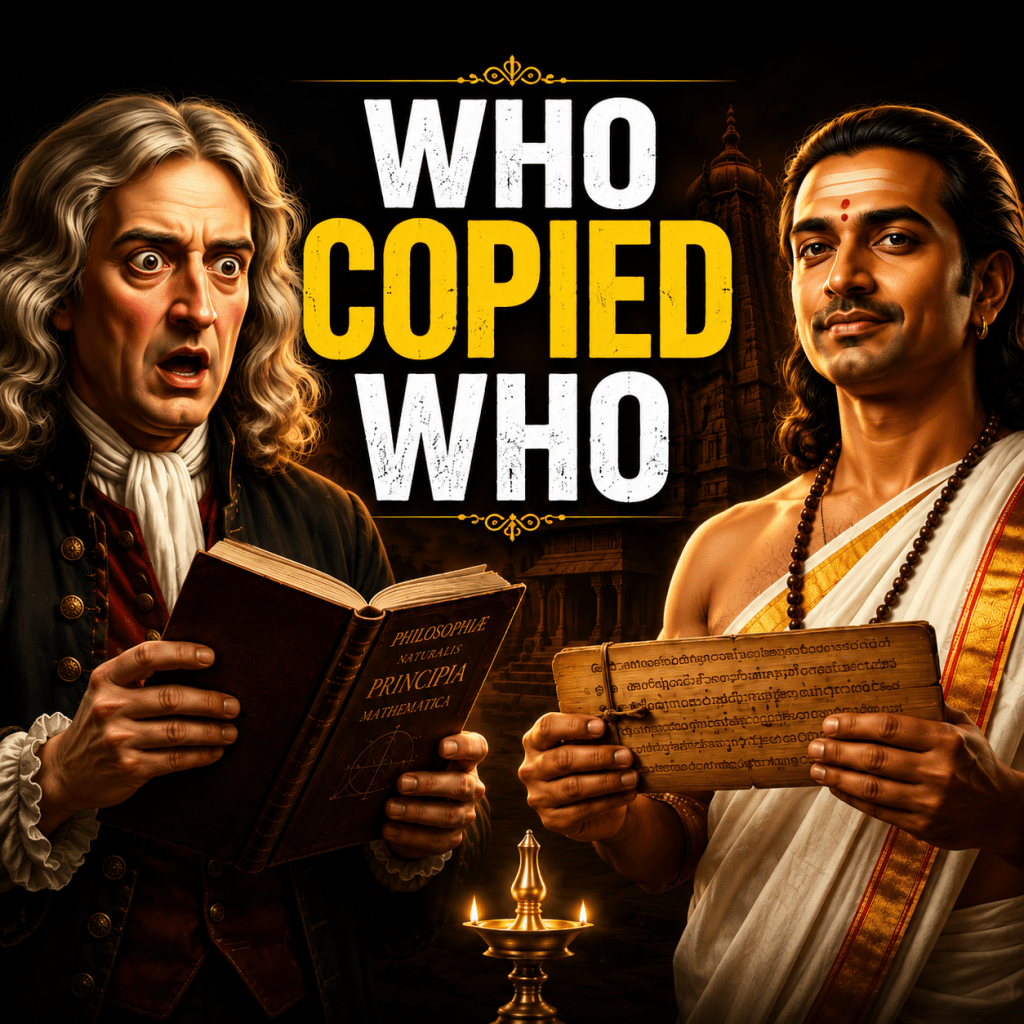
The rain falls hard over fourteenth-century Kerala as an oil lamp burns low. Madhava is awake, etching careful lines into a palm leaf with a metal stylus, and outside, the monsoon drowns every sound while inside, a quiet revolution unfolds. One man is exploring mathematics that the rest of the world will not formally rediscover for another three hundred years.
He calculates pi correctly to eleven decimal places, 3.14159265359, and in a small village few will ever hear of, he comes within four digits of the precision NASA would later use to navigate spacecraft between planets. This is the Kerala School of Astronomy and Mathematics, and it begs the question: why did it take so long for the world to recognise their work?
Not One Genius, But a Two-Hundred-Year Conversation
In the Kerala School, mathematics was never one man’s genius; it was a living tradition, passed from teacher to student, from commentary to commentary, from verse to verse, along the banks of the Nila River. For nearly two centuries, each generation built carefully on the work of the last. The scholars were Nambudiri Brahmins, serving simultaneously as priests, astrologers, calendar-makers and mathematicians, and the tradition began with Madhava and endured long after him. His own manuscripts have almost vanished, and his ideas survive only because others chose to preserve them. Those ideas were extraordinary: Madhava showed that sine, cosine and arctangent could be written as infinite series, with more terms added whenever greater precision was needed. That is the essential idea behind the Taylor series, centuries before it became part of modern calculus.
Precision Was Never About Curiosity, It Was About Consequence
To understand Madhava, one has to understand what drove him, because every infinite series he refined and every extra decimal place he extracted was never merely an academic exercise. In temple-centred Kerala, astronomy governed ritual, and a wrongly predicted eclipse could damage a temple’s authority along with the standing of an astronomer-priest’s family built over generations.
The same instinct that drives a modern analyst to improve a risk model drove Madhava to push trigonometric approximations further than anyone before him, not for recognition, but because his family’s livelihood depended on the moon appearing exactly when he predicted. The history of mathematics is rarely powered by curiosity alone; its greatest advances often come from consequence, and the Kerala School pursued precision because mistakes in the sky carried real costs. That brings us to the document that should have changed everything.
‘The Language of Reasoning’: India’s Answer to a Proof-Based Mathematics
In 1530, a scholar named Jyeshtadeva chose to write in Malayalam instead of Sanskrit because he wanted to be understood, and he did something even more important than that: he explained the proof, the reasoning behind it. The Yuktibhasha, meaning ‘the language of reasoning’, is not a mere catalogue of results but a book of proofs, laying out the derivations behind the infinite series for sine, cosine and arctangent. It discusses methods that resemble early integration and examines the irrationality of pi, and it was written for students, calendar-makers and working astronomers who needed to understand and apply the mathematics rather than merely memorise it. While Europe was still more than a century away from the scientific revolution, Kerala already had a proof-based mathematical text containing methods later linked to Newton and Leibniz.
India’s Quiet Challenge to the Geocentric Universe
Now go back another thirty years, to around 1500, to Nilakantha Somayaji. More than forty years before De Revolutionibus was published in 1543, Nilakantha had already developed a striking new planetary model. In the Tantrasangraha, he proposed a model that broke from the familiar geocentric picture, keeping the Earth at the centre while having Mercury, Venus, Mars, Jupiter and Saturn orbit the Sun, which in turn orbited the Earth. It was a partial heliocentrism, sometimes compared to the later Tychonic system in Europe, built from calculation rather than philosophy. Nilkantha’s work goes further still, offering inductive proofs, a refined Madhava-Gregory series for arctangent, an improved computation of pi, and an examination of why pi can never be written as a ratio.
The Englishman Who Found India’s Lost Calculus and Was Ignored Anyway
In 1835, Charles Matthew Whish, a young East India Company civil servant, arrived in Kerala and worked with Malayalam scholars to study the Tantrasangraha, the Yuktibhasha, the Karana Paddhati and the Sadratnamala. The mathematics astonished him.
In a paper for the Royal Asiatic Society of Great Britain and Ireland, he described these works as abounding in fluxional methods and infinite series, and ‘fluxions’ was Newton’s own term for derivatives. Mr Whish found himself questioning how the history of mathematics had been taught. Yet little changed, and his paper was cited by specialists but never reshaped the textbooks of the British Empire, where generations of Indians learned that calculus began with Newton and Leibniz, and nowhere else.
From a Reed Mat in Kerala to Every Smartphone on Earth
Recognition for the Kerala School came much later. From the 1940s onward, scholars including C. T. Rajagopal and David Pingree helped restore the Kerala School to its rightful place in the history of mathematics. But it is this thought that stays with me: every smartphone processing a sine wave, every GPS satellite calculating position, and every engineering student at IIT Madras or MIT learning numerical methods draws on ideas that trace back through generations of mathematicians, to a scholar working on a reed mat in a rain-soaked village in Kerala, six centuries ago.
Lessons for today’s India
Madhava’s story is not simply a curiosity from the history of mathematics; it is a mirror for how India builds, protects and communicates its intellectual capital today. A few lessons stand out.
Precision was born from accountability, not applause. The Kerala School advanced because astronomer-priests were personally answerable for the accuracy of their predictions. Today’s India, building everything from space missions to fintech infrastructure, still benefits most when institutions reward rigour and consequence over showmanship.
Knowledge without documentation disappears, no matter how brilliant. Madhava’s own manuscripts are almost entirely lost, and his genius survives only because Jyeshtadeva and later scholars chose to write it down in Malayalam, a language people could actually read.
Tradition and innovation are not opposites. The Kerala School thrived precisely because it treated mathematics as a living conversation across generations rather than a fixed inheritance. For an India balancing deep civilisational roots with rapid modernisation, that same spirit, honouring what came before while building boldly on it, remains the more durable model of progress.
The article is an excerpt from my podcast – India’s Golden Age. Available on YouTube, Spotify, Apple Podcasts and other Podcasting Platforms.


Leave a Reply