
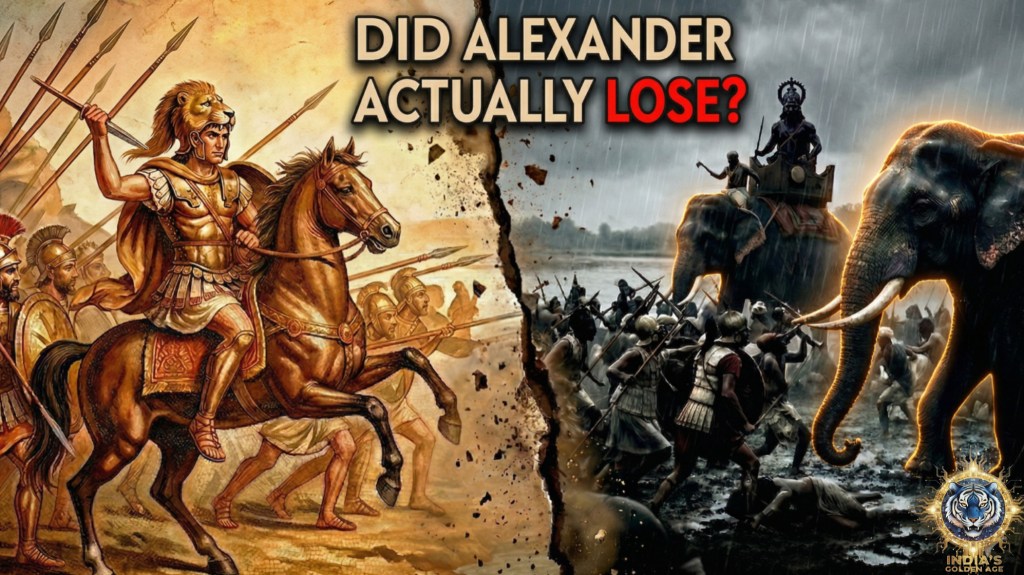
327 BCE. The banks of the Beas River. Punjab.
Rain is hammering down. Alexander’s army is camped here, and something is shifting in the air. Not the weather, something else.
Imagine a Greek soldier, let’s call him Philotas. He has been away from home for eight years. Eight years of mountains, deserts, rivers, and driving his spear through men whose names he never knew, raiding cities he could not pronounce. Nothing in those eight years had frightened him. Not once, until this rumour.
“Six thousand elephants.”
Philotas says it again. Quietly.
He knew what even a few hundred of these beasts could do. He had been at the banks of the Hydaspes (Jhelum) river. He had watched Greek warhorses rear and scream in pure panic. He had watched men he had known for eight years get crushed into the mud before they could even raise a shield. Six thousand of those beasts was not a battle. It was a carnage.
Around him, the camp went silent. When a number like that travels through an army, it does not need explaining. Men just stop talking, and in that silence, eight years of victories begin to feel very, very far away.
India was already beginning to seem like a terrible nightmare.
Why the World’s Greatest Army Went Quiet at India’s Border
Alexander had already fought in India: at the Hydaspes River, against King Porus and his war elephants. That battle was one of the hardest battles the Macedonian army had ever fought. Alexander had to think on his feet in real time: cross the river from the far side to flank the enemy, target the mahouts sitting atop the elephants, drive javelins into the animals’ eyes and feet, and create enough chaos that the elephants turned on both armies at once. It worked, just barely. And that was against a few hundred elephants belonging to one local king.
Now his scouts were returning with reports about what lay further east. The Nanda Empire. Capital at Pataliputra.
Here are the numbers the scouts brought back.
- Six thousand war elephants
- Two lakh infantry
- Twenty thousand cavalry
- And Pataliputra itself, many kilometres of walls, five hundred and seventy towers, a moat so wide and so deep it could swallow an entire Macedonian formation and leave no trace.
Alexander had never, in his life, walked away from a fight. But between him and the Nanda Empire sat five more rivers, hundreds of kilometres, and a full monsoon season bearing down. This was not going to be one fearsome battle. It was going to be a long, grinding, punishing campaign, and every single soldier in that army understood exactly what that meant.
When Ten Years of Loyalty Finally Spoke Back
At the Hyphasis (Beas) River, Alexander gathered his army and spoke. He talked about the Great Ocean at the edge of the world, about reaching the place no conqueror had ever stood, the same vision that had carried this army across three continents. The words were inspiring, delivered in a voice that had once made bleeding, exhausted, terrified men stand back up and march.
He finished.
No cheer. No shields striking shields in the old Macedonian way. Just silence.
Then Coenus stepped forward. Coenus was one of Alexander’s most trusted commanders, a man who had marched beside him for ten years. He spoke with tears in his eyes. “The men are finished, Alexander. Not in body alone, but in spirit. They want to go home. They want to see their families. They want to grow old.”
Alexander said nothing. He turned and walked into his tent. He stayed inside his tent for three days. Without food, no visitors allowed. When he emerged, his voice was steady. His eyes told the real story. “The gods have advised turning back. We retreat tomorrow.”
Within two years, at thirty two, Alexander was dead in Babylon. He never saw the Ganges. Or the edge of the world. One wonders if he regretted that.
Alexander the Great Does Not Exist in Indian History. Here Is Why That Matters.
Alexander fought major battles in north-western India. Takshashila, one of the greatest universities the ancient world ever produced, sat practically next to his battlefield. And yet, in Indian records, Alexander does not exist. Not a word in the Puranas, not a mention anywhere. Chanakya, the most meticulous political mind of that entire era, does not mention Alexander once.
Compare that with what follows just a decade later. When Seleucus, Alexander’s own general, came to India, Indian sources recorded the entire encounter in detail. That negotiation with Chandragupta Maurya is remembered and discussed to this day.
So why is Seleucus remembered but not Alexander?
Perhaps the records were lost. Perhaps they were destroyed. Or perhaps the claim of Marshal Gregory Zhukov, a renowned Soviet military commander (who in 1957 addressed cadets at the Indian Military Academy in Dehradun), deserves more serious attention than historians have given it.
Zhukov suggested something historians have been oddly reluctant to take seriously: what if the so-called victory over Porus is propaganda? What if Porus won, or at minimum fought Alexander to a stalemate? What if the Greeks quietly rewrote a very difficult, very damaging outcome into a noble victory followed by a noble retreat? What if Alexander did not choose to turn back? What if he had to?
The Man Who Conquered the World Could Not Conquer the Weather
Fifteen centuries pass. The year is 1221. The Indus is in flood. A similar story begins again.
Genghis Khan stands on the western bank of the Indus River. Behind him lies a trail of destruction running from Beijing to Samarkand. In two decades he had built the largest contiguous land empire in human history.
Khan was at Indus because he was chasing a man: Jalal ad-Din Mingburnu, the last ruler of the Khwarazmian Empire, the last man still standing against the Khan. Cornered at the edge of the Indus, Mongol cavalry at his back and the flooded river in front of him, Jalal ad-Din looked down at the water, looked back at the enemy, and drove his horse off the cliff. Thirty feet into a river in full flood.
Genghis Khan watched him go and raised his hand. “Stop, do not release an arrow”. Even the Khan, at the moment of the kill, could recognise something worth respecting. He watched Jalal ad-Din drag himself out on the far bank, gasping, alive, on Indian soil.
Khan knew how rich India was. But he did not cross.
Sometime later, a scout arrived wrapped in mud. “Khan. Tough terrain. Horses are sinking. Food & grazing difficult. Rivers everywhere.” And Genghis Khan, the man who had never stopped for anything, decided to camp at the bank of the Indus and wait.
For a Mongol army, everything was the horse. Speed was the weapon. Mobility was the entire strategy. Without the horse, the Mongols were not even half the force people feared. There was also something else, a deeper concern the Khan did not voice out loud.
The Mongol composite bow was, at that point in history, the most advanced ranged weapon in the world: wood, bone, and sinew laminated together under enormous tension with animal glue. On the cold, dry steppe, it had twice the range of any other bow, and a Mongol warrior could fire with full accuracy from a galloping horse. That super weapon was one of the key reasons that the empires had fallen.
In the humidity of the Indus valley, the composite bow began to quietly come apart, as it would in any wet environment. The organic glue softened. The layers separated. The bow lost tension, lost range, and lost the precision that made it lethal. Genghis tried wrapping it in oilcloth, but the performance was not good enough.
Genghis Khan had never, in all his campaigns, encountered a landscape that just silently destroyed his advantage. Genghis Khan was not looking at an enemy army. He was looking at a geography, at an ecology that was quietly and methodically taking apart everything his army depended on.
Four Words That Saved Delhi From the Mongols
While Genghis stood at the river calculating, Iltutmish, the Sultan of Delhi, was doing the same. He had begun his life as a slave and had a very precise understanding of risk, built from experience, from years of knowing exactly how fast everything you have built can be taken away.
When Jalal ad-Din’s envoy arrived in Delhi asking for asylum and an alliance against the Mongols, Iltutmish did not react immediately. He listened to everything. He asked two careful questions. Then he took four days. Four days to think about one decision.
He saw the pattern clearly: Genghis Khan does not mobilise without a reason. Every Khan campaign in history followed a provocation, an insult, an act of defiance. To give shelter to the man the Khan was hunting was to hand the Khan his justification for attack. He sent back his answer to Jalal ad-Din.
“India’s climate will not suit you.”
Not one unnecessary word, a short & clear message. Iltutmish had given Genghis Khan absolutely no rationale to attack him. For a Khan, already grappling with ecology & geography, there was no recourse but to turn back.
In both instances, India refused to be drawn in. Sometimes the most powerful thing you can do is make sure the fight never starts.
India Did Not Win These Battles. It Made Sure They Never Happened.
During both these instances India had a strong empire at the centre. The Delhi Sultanate, and the Nanda Empire, were not to be scoffed at. Yet that was not the biggest deterrent for these world conquerors.
At the edge of India, across fifteen centuries, both Alexander & Genghis arrived at the same conclusion. The subcontinent could not be taken quickly. The Himalayas controlled who came in. The monsoon impacted logistics. Rivers carved up formations. And the land itself fought back in ways that no army, however powerful, had a strategy for.
At the same time, India did not provoke. Did not rush out to meet them. The Nanda Empire’s greatest weapon was a number, a rumour. The Delhi Sultanate’s greatest weapon was a neutrality. Both world conquerors turned around.
India did not win those confrontations. It did everything to not to trigger them.
What This Means for India Today
Two of the most formidable military forces in human history turned back because India presented a combination that aggressive powers consistently underestimate: genuine, credible defensive depth paired with the strategic discipline not to provoke a fight unnecessarily.
The Nanda Empire did not march out to challenge Alexander. It simply made the cost of engagement visible. Iltutmish did not lecture the Mongols about morality or ally with Jalal ad-Din. He removed the pretext. Both approaches were rooted in something deeper than military calculation. They reflected a civilisational understanding that strength is not the same as aggression, and that the most durable form of deterrence is one that never needs to be used.
For today’s India, navigating a genuinely complex neighbourhood, balancing assertiveness with restraint on multiple fronts simultaneously, these are not abstract historical footnotes. The strategic grammar that kept two of history’s most dangerous conquerors at bay was built on knowing your terrain, understanding your own strengths, maintaining credible capacity, and refusing to be drawn into conflicts on someone else’s terms.
Remember Philotas, the Greek soldier standing in the rain on the banks of the Beas. He makes it home. He sees his mother again. And in the years that follow, when he thinks about India, he does not think about it the way Alexander had imagined it, as the edge of the world, the place where maps run out and the known becomes the unknown. He knows now it was the opposite.
India was not the end of the world. It was the beginning of another one entirely.
If you want to listen to the above story on my podcast, please click the image with the Youtubelink below. The podcast is also available on Spotify, Apple Podcasts, Amazon Music & other podcasting platforms.


Leave a Reply