
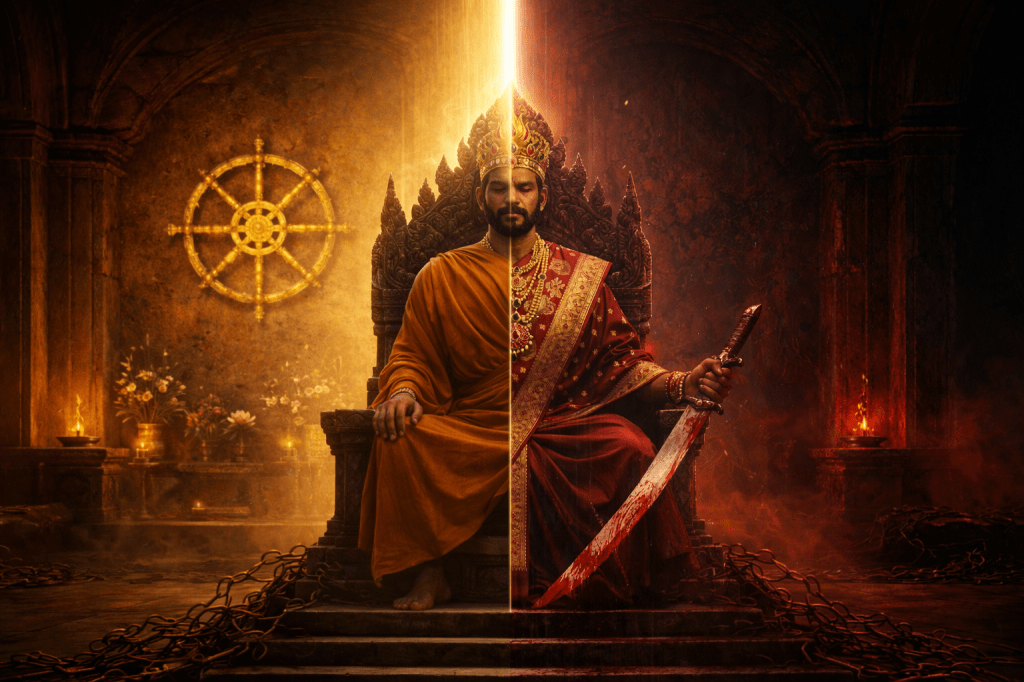
261 BCE. The Daya River, Odisha. The water is not merely red, it is opaque. It is a slurry of silt and the blood of a hundred thousand Kalingans. Ashoka, forty-three years old, is a man who has dealt in death his entire life. He looks at the carnage and asks a question that will echo for millennia: “What have we really won?” Was this the genuine remorse of one of India’s great emperors, or was it the greatest political rebrand in ancient history?
The Prince Nobody Wanted
Ashoka was not meant to matter. He was the “spare” in a pack of a hundred and eight sons, and his father King Bindusara reportedly loathed him for his rough, dark complexion, said to resemble the bark of a tree. The golden boy was Susima: the eldest, the handsome, the heir apparent. Yet Ashoka turned out to be better at nearly everything.
At eighteen, when Crown Prince Susima had failed to calm a revolt in Taxila, a major Silk Road city, the king sent Ashoka instead. The revolt dissolved, not by force but by sheer force of presence, by something in the way he commanded a room.
Susima, feeling the threat, begged the king to send Ashoka away from Pataliputra. At twenty, Ashoka was exiled to Kalinga, where he bided his time, absorbing the irrelevance and the insult. When Bindusara died and left a sudden vacuum, Ashoka moved swiftly before anyone could react.
He walked into the Pataliputra court and asked the ministers which side they were on. The ministers supported the Crown Prince Susima’s claim. Ashoka did not argue. Five hundred beheadings followed in a single afternoon. This was not a transition of power but a purge.
When Susima finally arrived to claim his birthright, he found Ashoka already on the throne. Later, in the gardens, a pit of coals burns hot enough to warp the air. The air smells of charred teak. Ashoka stands beside it, watching. Susima is dangling over the heat.
Ashoka says: “So you thought the throne was yours by birth, Susima? You do not have the power to hold it.” Susima, in pain, cries: “You are a monster, Ashoka!”
Ashoka lets go. He does not blink.
Ashoka secured the capital in 273 BCE, though the throne was not formally his until 269 BCE. Legends say that in those four intervening years, he hunted down ninety-nine of his brothers, sparing only one, Vitashoka. On the day of his coronation, the people gave him a new name: Chandashoka. Ashoka the Cruel.
Jasmine, Mango Trees, and Boiling Copper
Before what would later be called the Great Peace, Ashoka built a masterpiece of sadism known as Ashoka’s Hell. From the outside it looked like a paradise, with scented jasmine, heavy mango trees and still water, but once the gates locked, the executioner Girika took over.
Girika, a man who reportedly killed his own parents to prove his apathy, specialised in theatrical torture involving boiling copper poured down throats and iron stakes through the chest. This was Ashoka’s psychological theatre of terror: structured, deliberate and entirely intentional.
Everything changed when a monk named Samudra survived the garden’s tortures through what the Buddhist chronicles call miraculous endurance. His survival long enough to attract the king’s attention planted, according to later accounts, the first seeds of Buddhism in Ashoka’s mind.
Dhamma, Guilt, and the World’s First Communications Strategy
Ashoka’s Rock Edict 13 is perhaps the most extraordinary document produced by any ancient ruler. Written in the first person, it records the conquest of Kalinga, a death toll of a hundred thousand, the deportation of a hundred and fifty thousand, and a statement of deep remorse. No ancient ruler had ever written anything so raw: an admission of guilt by an emperor, carved permanently into granite and broadcast across the empire at Shahbazgarhi in modern Pakistan, at Kalsi in Uttarakhand, at Girnar in Gujarat and at Sopara near Mumbai.
But there was a catch. He never posted the apology in Kalinga itself. In Kalinga, two special edicts exist instead, instructing governors to be gentle, to treat the people as children, to govern with patience. The great public confession was broadcast everywhere but withheld precisely where it would have landed hardest. Is it cynical? Is it brilliant statecraft? Perhaps Ashoka knew exactly where words would matter and where they would fail.
After Kalinga, Ashoka knew he could not rule by fear alone. The empire was too large and too fractured, and he needed a new story. He called it Dhamma. Dhamma was not Buddhism. It was a code designed to hold together approximately fifty million people, roughly thirty per cent of the entire world’s population at the time, from Hellenised Greeks in the north-west to Tamil traders in the south to Kalingan fisherwomen (who had every reason to hate him). He wrote in their languages: Brahmi, Kharoshthi, Greek and Aramaic.
Ashoka created the Dhamma Mahamatras, a new class of official who moved through provinces visiting prisons and town centres, listening and asking questions about kindness to servants, respect for elders and restraint in speech. This was, in effect, the world’s first compliance department. The Dhamma Mahamatras promoted tolerance but also prevented dissent. The man who once built a prison disguised as a garden had not stopped building. He had simply made the walls invisible.
The Blind Prince and the Jain Painting, Ashoka’s Darkness Resurfaces
Eight years after Kalinga, the edicts and Dhamma Mahamatras were all over the place. A Jain artist painted the Buddha bowing to a Tirthankara, a gesture that was perhaps devotional, perhaps provocative. Ashoka responded by ordering the artist and his entire family locked inside their home, then ordering the house burned. His subsequent proclamation offered a gold coin for every Jain head.
The violence escalated rapidly, and the Ashokavadana records that eighteen thousand Ajivikas, followers of a rival tradition, were put to death in Bengal in a single episode. The killing stopped only when a soldier presented a head to claim the reward and it turned out to belong to Vitashoka, Ashoka’s last surviving brother, who was a Buddhist monk. The killing had been a mistake. Chandashoka had never fully left the building.
Then there is the episode of Prince Kunala. Ashoka fell seriously ill, and his youngest queen, Tishyarakshita, nursed him back to health. In gratitude, he granted her anything she desired. She asked for the royal seal for seven days. It was an odd request, though no one said so aloud.
Her motive soon became clear: she was in love with Ashoka’s heir apparent, Prince Kunala, whose eyes were described as auspicious as the blue lotus, but Kunala did not return her love. He was governing the north-west from Taxila.
Tishyarakshita wrote the order herself, pressed the seal into wax and sent it north: “Blind the prince.” The executioners in Taxila could not bring themselves to carry it out, so Kunala took the heated iron from their hands himself, saying it was his father’s will and he would not make him wait for it. Ashoka, upon discovering what his queen had done, is said to have had her burned alive. Some things did not change.
The Lion Capital on Every Rupee Note
Ashoka died in 232 BCE at the age of seventy-two, having reigned for thirty-eight years. Within fifty years, the Mauryan Empire was gone, the last emperor assassinated during a military parade by his own general.
The historian Romila Thapar has attributed the decline to multiple causes, including weak successors and the economic stress of Ashoka’s extraordinary generosity to the Buddhist Sangha. A competing explanation holds that prolonged emphasis on moral governance gradually degraded military and administrative effectiveness, leaving the empire with reduced coercive capacity and slower responses to threats. The peace that followed Kalinga may have been, in the long run, the empire’s quiet death sentence.
In 1950, the Republic of India adopted the Lion Capital of Ashoka as its national emblem, placing it on the rupee, on passports and on every government building in a country of 1.4 billion people. Ashoka proved that an empire is ultimately an idea. He balanced the Wheel of Dhamma, representing law, with the Lion, representing power. Power without righteousness collapses. Righteousness without power cannot hold. Few systems, or rulers, since have sustained that equilibrium.
What Ashoka’s Story Still Owes Modern India
Ashoka’s story is a mirror held up to every leader who must govern a vast, diverse and restless polity. Three lessons stand out for India today.
First, the architecture of power matters more than its symbols. Ashoka built elaborate machinery to broadcast Dhamma but did not build equally robust institutions capable of institutionalising it. Modern democracies need institutional depth that survives any individual leader, however remarkable. Remarkable leaders are often precisely the ones least inclined to build what comes after them.
Second, the apology that never reached Kalinga remains instructive. Communication calibrated only towards those already sympathetic is not governance, it is performance. When public discourse is shaped by geography, language or ideology rather than genuine reach, it deepens the fractures it claims to be healing. Ashoka’s edicts, for all their beauty, did not rebuild what the war had broken in Odisha.
Third, the tension between the Lion and the Wheel is unresolved still. A state that abandons coercive capacity in the name of moral authority becomes vulnerable, as the post-Kalinga Mauryan Empire demonstrated. But a state that relies on coercive capacity alone loses the legitimacy that sustains it over time. The balance Ashoka sought, imperfectly and sometimes violently, remains the central challenge of statecraft in a country as large and as layered as India.
The article is an excerpt from my podcast – India’s Golden Age. Available on YouTube, Spotify, Apple Podcasts and other Podcasting Platforms.


Leave a Reply