
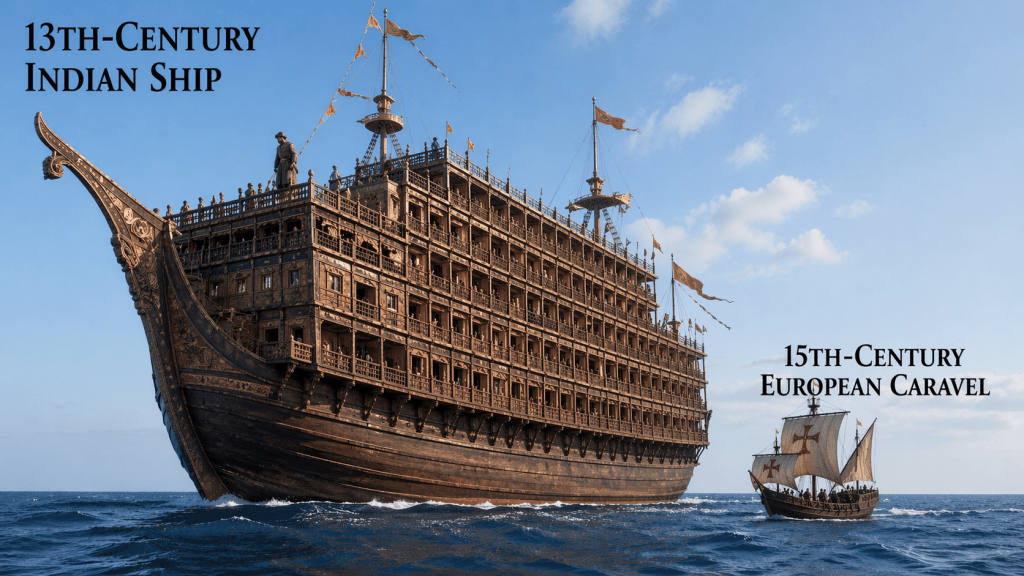
Bay of Bengal, 1025 CE. Three hundred miles from shore, the monsoon is trying to kill everyone on board. The ship carries no iron, not one nail, not one bolt. She is fastened with coconut fibre rope and sealed with resin. By European logic, she should not survive this. Yet she moves with the storm, flexing rather than fighting. When the waves strike, she bends, rises and breathes.
The captain Dhruva’s voice cuts through the wind: “Pull the lines. Starboard. NOW.” The crew obeys without debate or panic. One man slips, catches himself and keeps pulling. The hull shivers and holds. The storm wanted wreckage; it finds resilience instead. This is not luck. This is design.
Today, India builds less than one per cent of the world’s ships. A thousand years ago, we owned these oceans. Let us sail back.
Lothal, 2400 BCE. The World’s First Tidal Dockyard
Before we meet the engineers and sailors who built this maritime world, we must travel to 2400 BCE and Lothal, Gujarat, home to what historians regard as the world’s first tidal dockyard. This was the era when Egyptians were building pyramids; Indians were building ports.
The dock is two hundred and twenty-two metres of perfectly laid brick, a basin aligned to the pulse of the tide itself. Modern engineers have studied it and found no flaws.The Harappans watched the sea carefully. They learned when it rose and when it withdrew, how long it lingered and how predictably it returned. Then they built gates to trap high water, so that when the sea retreated the dock remained full, with ships floating as though the tide had chosen to stay.
Three thousand years before European ports understood tidal management, Lothal had already woven the sea’s behaviour into stone.
One Man, Five Ministries: The Ancient Indian Bureaucrat Who Managed an Entire Ocean
The Rigveda, composed around 1500 BCE, speaks of hundred-oared ships crossing great waters. The Ramayana describes sea crossings and the Mahabharata has ocean battles. These are cultural memories of a seafaring people, not allegory.
By 300 BCE, the Mauryan Empire was at its peak, and somewhere in the capital Pataliputra one man was running the largest maritime bureaucracy the ancient world had ever seen. The Arthashastra calls him the Navadhyaksha, the Superintendent of Ships. On paper, he was an administrator. In practice, he managed timber extraction, shipbuilder licensing, port monitoring, piracy tracking, sailing clearances and tax collection (with river fleets and ocean fleets separately categorised). The Greek ambassador Megasthenes, who visited Chandragupta’s court, describes this naval department with surprise, as though he has encountered something far more organised than anything back home.
This level of oversight tells you something important: maritime trade was not a side business for India. It was strategic infrastructure. India also had an unfair advantage – Malabar Teak. The teak did not rot quickly in warm saline waters; fifty years of service was not unusual. The Mauryans understood something the Europeans would take centuries to grasp: maritime trade is not merely commerce, it is also a projection of power.
Stitched, Not Nailed: Why India’s Shipwrights Built Hulls That Survived What European Vessels Could Not
Let us imagine Neeli, a shipwright working in the fifteenth century and one of five hundred shareholders in a powerful maritime guild (an organisation that resolved its own disputes, pooled funds into shipyards and maintained armed vessels to protect its cargo). She has inherited the knowledge and the trade from her father, who learnt it from his father, back to ancestors no one can name.
She drills two holes along each plank seam. Coconut fibre is packed tight; in water it swells, closing the gaps further. Then she stitches with coir rope in a deliberate pattern, II-X-II . “When the wood swells from seawater,” she tells her apprentice, “the cross-stitch keeps the parallel stitches from loosening. The sea tests every joint. This pattern passes.” Resin seals the seam. The hull has give in it, and when struck it flexes and spreads the force rather than concentrating it. In a European nailed hull, the same impact gathers at each metal point, the nail strains and the wood splits.
The eleventh-century text Yukti Kalpataru, attributed to Raja Bhoja, describes specialised ocean-going vessels called Vishesha ships, built long and narrow with ratios approaching one to eight, engineered for speed and distance. Much of that knowledge is lost; the Nalanda library was burnt to ashes.
The Monsoon Was Not an Obstacle. It Was the Engine.
Imagine Dhruva, a ship captain, twenty-three years on the Bay of Bengal. In his hand is a kamal, a simple wooden board with a knotted string. He aligns its base with the horizon and counts knots until the string reaches Polaris. “Three fingers above the horizon. Polaris steady. We are at the latitude of Bharuch.” No compass, no satellite; only a simple tool and a mental map built from fifteen generations of star knowledge.
His vessel carries square sails and cannot tack against the wind. European sailors might call that a limitation. Indian mariners built an entire navigational system around it instead. For six months the northeast monsoon drives across the ocean; then it reverses completely and the southwest winds return with equal force. The entire weather system shifts like a clock resetting. Dhruva smiles. “Why fight the monsoon? Let it push you east to Bali. Trade while you wait. Return on the reverse winds.”
His grandfather told him to watch the sea turtles crossing the Bay of Bengal and follow their route, because they know the currents better than any map. It sounds like superstition. It is not. Sea turtles migrate along the exact same current corridors that Indian ships used for centuries.
The Arthashastra documents ship departure timing by star position. The festival of Bali Yatra in Odisha, celebrated at Kartik Poornima, marks the precise end of the southwest monsoon. When the festival fires are lit, sailors know the window has opened. This is science dressed as ritual so that it would survive. All of this was established long before Rome noticed these winds, and long before a Greek called Hippalus was handed the credit for discovering the monsoons.
Marco Polo Called Indian Ships the Largest in the World. Europe Called Him a Liar.
In the late 1200s, Marco Polo stood at the edge of a Tamil quay, surrounded by salt and timber, watching a ship so vast it seemed to own the horizon. He writes about the formidable ships of the Malabar coast: crews of between 150-300 men, with multiple decks and more than 60 cabins for merchants. He notes that the hull is divided into watertight compartments, so that if one section is breached the others hold. He observes that many ships, surprisingly, are fastened not with iron nails but with cords, stitched like fabric, making the hull flexible and capable of withstanding impacts that would shatter European vessels.
Polo describes ships approaching eighty metres in length. Columbus’s Santa María was nineteen metres. Indian ships were four times the size, with watertight compartments that European shipbuilders would not independently develop for another five centuries. Polo returned to Europe in 1295 and was called a liar for decades. The Indian ships were simply too large to believe.
The Gun Port That Changed Everything: Why India’s Greatest Engineering Strength Became Its Fatal Weakness
After Polo’s visit, another two hundred years of Indian maritime dominance passed. Then something arrived on the horizon that the Indian guilds and their private navies had no framework for.
It is 1498, on the Malabar Coast. Neeli, now thirty-seven years at the craft, watches unfamiliar Portuguese ships cut across the sea.
She says quietly to her apprentice Arjun, “The port side. Below the upper rail. See properly.”
Arjun studies the vessel. “Square openings. With covers fixed over them.”
Neeli replies, “Gun ports. When a cannon fires, the recoil is immense. A rigid frame absorbs it.”
Arjun suggests they can mount cannons too on their ships. There is a pause.
“Our hull breathes,” Neeli says. “It gives. It flexes. That same give will betray us. Each shot loosens the stitches. The seams open. The more it fires, the more it leaks.” The strength of India’s stitched ships had become the weakness. Five thousand years of engineering, ended by recoil physics.
How India Lost the Sea: The Double Blow of Cultural Withdrawal and Colonial Sabotage
India’s maritime decline happened in two movements. The first was internal, a slow cultural withdrawal from the sea. After roughly 1000 CE, ocean travel began to carry associations of ritual pollution and social risk, and maritime professions lost status. The brightest in communities like Neeli’s were no longer drawn to shipbuilding or ocean commerce.
Then the financial architecture also collapsed. Indian Ocean trade had been funded for centuries through temple-based banking. When Portuguese intrusion disrupted trade, temple revenues fell, credit dried up and ships were no longer commissioned. Somewhere between 1600 and 1700 there was a last generation of master shipwrights who knew the old methods. Their children became traders. Their grandchildren forgot the knots and the sea.
In the eighteenth century, Britain had a problem. English oak rotted in tropical waters, while ships built in Surat and Bombay from Malabar teak lasted decades. The Wadia family of Bombay became the master shipbuilders of the era, their work so highly regarded that the Royal Navy commissioned them directly. HMS Trincomalee, launched in Bombay in 1817, is still afloat today, the oldest warship still floating anywhere in the world.
Success bred resentment. London shipbuilders, unable to match Indian quality, lobbied instead, and through Navigation Acts and related measures, Indian-built ships were effectively barred from British ports. If you cannot outbuild your competitor, you restrict his market. A Wadia-built ship was legally barred from the most profitable ports in the world, not because it was inferior, but precisely because it was not.
INS Kaundinya Sails Again: How a Recreated Ancient Ship Proved India’s Maritime Heritage Was Never Lost, Only Interrupted
Something in India never quite let go of the sea. In Kerala, in the coastal workshops of Beypore, the knowledge of stitched-plank construction survived, passed down the way all essential knowledge survives when institutions fail, from person to person and hand to hand. When researchers came looking in the early twenty-first century, it was still there, waiting.
In February 2026, INS Kaundinya, a recreated Indian stitched ship of the type Dhruva commanded and Neeli built, eased into Karwar harbour after a fourteen-hundred-kilometre passage from Muscat. No GPS, no modern instruments. Seventeen Indian Navy sailors navigated using a kamal, stellar positions, wind patterns and ocean currents. The ship, inspired by a painting from the Ajanta caves, was built using reconstructed ancient techniques: teak bound with coconut coir in the II-X-II pattern, with no iron nails and a breathing hull.
This voyage was not nostalgia. It established that the engineering described in ancient texts and painted on cave walls functions in open water. The tradition was not imaginary. It was interrupted. Now it has been tested again, and it holds.
Lessons for Today’s India: What a Breathing Hull Teaches a Rising Nation
India did not lose its ocean dominance because it lacked ships, timber or skill. It lost its competitive edge because it stopped believing the sea was central to its destiny.
The first lesson is that engineering superiority needs continuous reinvention. The stitched hull was superior to its European counterpart in almost every respect, until a single technological shift, the cannon and its recoil, rendered its greatest virtue a liability. Dominance requires not just excellence in what you have mastered, but continuous awareness of what others are developing.
The second lesson is the danger of cultural withdrawal from economic activity. When ocean travel began to carry stigma and maritime professions lost status, India did not lose ships; it lost the human capital that built and sailed them. A nation’s economic ambitions must align with its social hierarchies and its aspirations for its brightest minds.
The third lesson is that knowledge often outlives institutions. The methods of stitched-plank construction survived Nalanda’s burning, survived colonial disruption and survived centuries of neglect, carried forward in the workshops of Beypore. INS Kaundinya was possible because that thread was never fully cut.
Today, India builds less than one per cent of the world’s commercial fleet. By 2047, the ambition is to be amongst the top five shipbuilding nations.
The Indian Ocean bears India’s name, not as a political claim but as a historical fact. From the dock engineers of Lothal four and a half thousand years ago to the Chola naval expeditions of the eleventh century, Indian ports and fleets dominated trade & commerce . India has been a maritime giant before. The question is not whether it has the heritage to reclaim that position. The question is whether it has the resolve.
The article is an excerpt from my podcast – India’s Golden Age. Available on YouTube, Spotify, Apple Podcasts and other Podcasting Platforms.
 Sarvajeet Dinesh Chandra
Leave a comment