
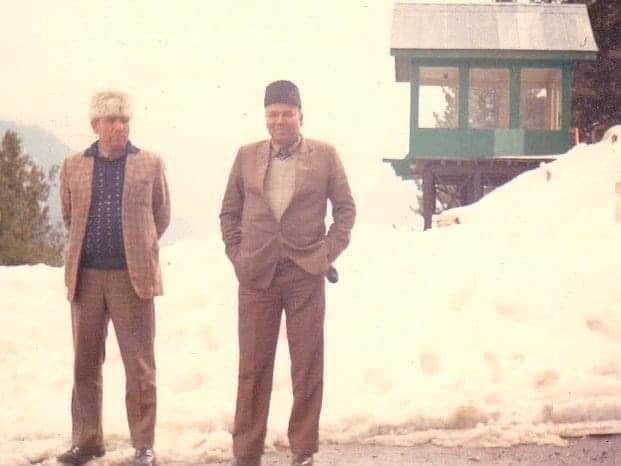
A friend of my father’s once told me, that I would be considered a miserable failure if I ended up doing a B.A. in history, and that usually it was one of the last recourse for a below average student. Hence like a lot of other ‘good’ students, whatever that meant, I ended up grudgingly focusing on science & maths.
My father lived several lives at once spy/poet/historian/novelist. I also started leading a double life. I found enough ways to take out time from Pythagoras’ Theorem (an Indian invention by Baudhayana) and whet my appetite for history.
My historical fiction journey started with copy editing my father’s books. My father wrote books on history, especially iconography, aside from the prolific poetry collections, and novels he would dish out (and publish sometimes under my mother’s name!). Also, being a PhD in archaeology, he had a lot of old history books in his library, which I studied, and sometimes re-studied (like the Kamasutra by Vatsyayana).
The book that made the most impression on me was “The Wonder That Was India” by A L Basham.
At the time, I just wanted to believe in the title. After all, it carried a white man’s stamp of approval. Mr Basham remained my hero for a long time, until his place was usurped a few years ago by another white storyteller, William Dalrymple. Writing Dhruvadevi, finally helped me get rid of the white heroes, and the desperate need for their validation.
As a schoolboy though, I got carried away by the ‘Wonderful India’ narrative. I did a science project, trying to prove that we had aeroplanes (the Pushpak Vimana from Ramayana) and a host of other ridiculous claims. This truly spooked my science teacher, who otherwise rated me highly. My father ended up consoling me by saying that on some aspects, at the very least, like town planning (his PhD thesis was on ‘Town Planning in Ancient India’), Ancient India was indeed amazing.
It took me a lifetime, however, to figure out how ancient India was indeed a wonderful place. As a civilisation, we have lived through many golden ages, and were obnoxiously well off for long periods (to have the luxury of writing the Upanishads). The process was triggered by my research for my novel Dhruvadevi. And continued with the podcast I started recently, ‘India’s Golden Age’. But that story is for another day.
Somehow, I convinced my father that I needed to visit Delhi’s Central Archaeological Library to get good marks in 9th & 10th grade history. It was a flimsy argument for a schoolboy but I suspect my father could sense my enthusiasm, and did not try to puncture my argument. I spent my summers immersed in the wonderful world of history books & journals, marvelling, for instance, at the finesse of Maya Civilization (which was a footnote in my school history book). I quite liked the day spent reading serious dissertations, well above my pay grade, and taking a spicy fruit chaat break at Janpath nearby.
My father did think that I was overstudying the subject, but he didn’t have the heart to dissuade me. What helped my case was that I was a good proof reader (and occasionally a critic) for his books. A writer lives a lonely, solitary life. And I was his reliable companion. I would ask questions, give suggestions, correct passages, anything to remain useful etc.
Looking back I feel that his skills as a spy were quite useful in historical research. Sometimes history is like solving a puzzle, cracking a case. My father would talk of connecting the dots, especially in ancient India where enough information on anything was not readily available. He would reminisce about the long walks with his eccentric history professor in Lucknow University, who in the middle of an interesting interpretation would say ‘excuse me’, take a fart break, and then resume the discussion as if nothing really happened.
I learnt history was not just collection of facts and evidence, it also needed judgement. I also learnt that to deeply research an ancient era, one had to take various sources: inscriptions, coins, literature, travelogues, mythological books like the Puranas for example into account. I also learnt how to create the three buckets: what could be established beyond doubt, what can be inferred, and what is likely to remain a dark hole.
That training and framework held me in good stead when I researched for and wrote Dhruvadevi. Today, one would assume that a LLM would make the research easier. If you ask an LLM today, who is the likely Saka ruler who besieged the Guptas, the LLMs will talk about Rudrasimha (the last Saka ruler), but there is a problem in chronology. Rudrasimha was not a contemporary of Gupta King Ramagupta (disputed by some historians). If Ramagupta existed, he likely ruled in the 375-380 CE period, between the death of Samudragupta, to when Chandragupta was clearly in charge.. The Saka king who still issued coins in that five year period (till 378 CE) was Rudrasena. So with all due respect to AI, if you really need to dig deep into history, as my father taught me, and connect the dots, humans still hold an edge.
I dedicated my novel to my historian/novelist/spy father Late Dr. Dinesh Chandra. It is a small token of gratitude to a man whose books, ideas, thoughts, interpretations and eccentricities shaped my thinking. In many subconscious ways, he also influenced my writing. At this point of time, I do not regret though that I did not do a BA in history. My novel is enriched by so many other subjects that I studied, like war, strategy, theatre, brand building, etc, etc. (even things like cuisines, music).
I know that my father speaks through me when I say that in some ways Dhruvadevi would have been a queen, like the way I describe her. In some ways she would not be. Regardless of that, he would highly approve of the adventure, the roller coaster ride I went on to discover the ‘Queen Who Made Chandragupta.’
Check out My Novel ‘Dhruvadevi’ on Amazon
Learn More About the Book


Leave a Reply