
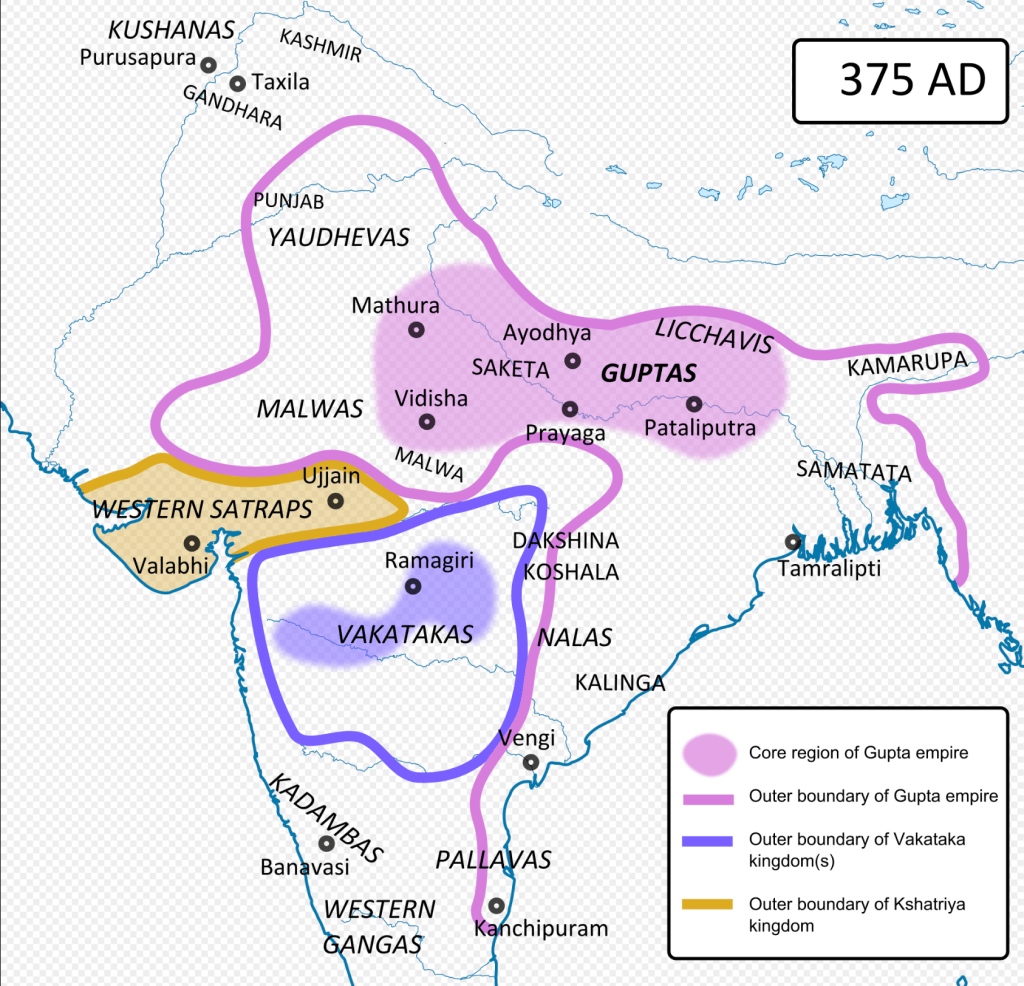
The ‘Napoleon of ancient India’, Samudragupta, attempted to immortalise himself on the pillar at Prayaga, celebrating his innumerable victories, boasting about his superiority to one and all. But he does not claim victory over the the Western Sakas/Kshtrapas, who ruled western India.
The story becomes more interesting when we look at his son, Chandragupta Vikramaditya, who it seems, spent decades fighting the Sakas. It seemed the most important priority for him, eventually earning him the title “Sakari”, the terminator of the Sakas, perhaps only towards the fag end of his life.
One wonders how could an ancient Ukraine-type smaller Saka kingdom, stand up to the Russia-like Gupta Empire? This question troubled me when I began researching my novel, Dhruvadevi: The Queen Who Made Chandragupta.
“Barbarians” Who Ran Two of India’s Greatest Cities
My instincts as a business strategist told me that in order to have a chance against a monolith, you need to know when to fight, and when to hide. Size has some obvious advantages, but also creates some inevitable vulnerabilities. As a smaller player, you have to assess the risks, understand the terrain, choose where to play.
Business and war operate on remarkably similar first principles. Strategy matters obviously, but tactics and execution matters just as much, or maybe more. What differs, obviously, is the stakes, the price of failure. In business, a bad decision may cost you a quarter. In war the same mistake may cost you a civilisation.
Ostracised by the Gangetic elite as barbarians, or Mlecchas, the Western Sakas nevertheless ruled Gujarat and large parts of central India for close to four centuries. They controlled two of the greatest cities of the time, vital hubs of ancient Indian commerce. They ruled Ujjain, a crucial inland crossroads hub connecting the Deccan with northern India, and Bharuch, one of the major ports of the time.
They were not just casual traders. They maintained one of the more stable currencies of the era, commissioned the earliest long inscription in Sanskrit at Junagadh, and patronised a sophisticated artistic tradition in western India, with the submerged stupa at Devni Mori offering one striking example. Perhaps the biggest tribute to them was when the Government of India adopted the Saka era for its calendar system.
That Saka prosperity, the civilisational strength surprised me when I began thinking about their long conflict with the Guptas. I was keen to find a plausible answer to the question: how could they withstand the overwhelming military power of the Guptas?
Geography as a Weapon
The answer lies partly in something every strategist learns sooner or later: geography is not merely the backdrop to a war. It can become one of its most powerful weapons. We see how Iran has weaponised the Strait of Hormuz. It explains why India paid a high price in Kargil war, and why it is so important for Indian army to hold onto the Siachen glacier.
In the novel, I put forward a hypothesis about how the Sakas might have used the Malwa Plateau to their advantage. Its rugged terrain, dense forests and treacherous black cotton soil, especially during the monsoon, would make it hard for an invading Gupta army, adept at fighting in the plains.
The elephants, the terrifying animals on open ground, the tanks of ancient Indian warfare, were vulnerable in muddy, narrow & rocky terrain. I can imagine the beasts being swallowed by the mud trap mid-charge, become easy pickings for Saka archers. The Gupta army moving through unfamiliar, narrow passes and broken terrain, were vulnerable to guerrilla warfare tactics. The Sakas could potentially have used ambushes, sudden attacks and rapid withdrawal to exploit that vulnerability.
Velocity vs. Mass
In order to fight a guerrilla war, the Sakas needed to possess another weapon: mobility.
It is quite plausible that the Sakas possessed a deadly cavalry component. As a people with steppe origins, they would have had traditions of horsemanship and a unique ability to shoot from horseback, potentially even while moving at speed. If attacked with overwhelming force, they could quickly withdrew deeper into terrain they knew intimately, draw Guptas away from their bases, attack vulnerable detachments. They could strike at Gupta flanks, their supply lines , and then disappear.
Centuries later, Chhatrapati Shivaji and the Marathas would employ similar logic to harry the Mughals. Mobility, intimate knowledge of the terrain and carefully calculated engagements allowed a smaller force to impose enormous costs on a much larger one.
The Sakas did not need to match the Guptas in sheer military strength. They needed to ensure that the Guptas could never bring all that strength to bear at once. They avoided the head-on, open plains combat, where they knew that Gupta numbers would become overwhelming. The Sakas never gave the Guptas the fight they wanted.
This idea found it expression in the novel where the Saka Mahakshtrapa Rudrasena argues, “We must be proactive and vigilant, not fearful of the Guptas. The Guptas will never defeat us! Not until they understand the simplest truth about war. Military force is a product of mass and velocity. Let them have greater mass. But we, the Sakas, will possess greater velocity. Always.”
I have always valued “velocity”. It is as important in business, as in war. Jennings and Haughton called it, “It’s Not the Big that Eat the Small… It’s the FAST that Eat the Slow!” The phrase is modern, but the principle is very old. In Act 1 of my novel, we see this David-Goliath fight unfold. But in Act 3, we see how a Goliath learns to fight like David.


Leave a Reply